Hair loss affects millions of men and women, often beginning earlier than expected and progressing faster than hoped. While genetics plays a significant role, modern medicine offers effective interventions that can slow, stop, and even reverse many forms of hair loss when caught early enough.
Platelet Rich Plasma (PRP) therapy has emerged as one of the most promising non-surgical treatments for hair restoration. By harnessing the regenerative power of your own blood platelets, PRP stimulates dormant hair follicles, extends the growth phase of existing hairs, and creates a healthier scalp environment for natural regrowth.
This guide covers everything you need to know about PRP hair treatment in Kolkata, including how it works, who benefits most, what to expect during treatment, and how to maximise your results.
| Experiencing Hair Loss? Let’s Discuss Your Options Book Your PRP Hair Consultation | Call: 09830 836 666 |
Understanding Hair Loss: Why It Happens and When to Act
Before exploring PRP treatment, understanding why hair loss occurs helps you appreciate how PRP works and why timing matters.
The Hair Growth Cycle
Hair follicles cycle through three distinct phases. The anagen phase is the active growth period lasting two to seven years, during which the hair shaft lengthens. The catagen phase is a brief transitional period of two to three weeks when growth stops, and the follicle shrinks. The telogen phase is a resting period of approximately three months, after which the old hair sheds and a new anagen phase begins.
In healthy scalps, approximately eighty-five to ninety per cent of hairs are in anagen at any time. Hair loss conditions disrupt this balance, shortening the anagen phase and increasing the proportion of hairs in telogen.
Common Types of Hair Loss
Androgenetic alopecia, also called male or female pattern baldness, is the most common form of hair loss. In men, it typically presents as a receding hairline and thinning at the crown. In women, it usually causes diffuse thinning across the top of the scalp while maintaining the frontal hairline.
This type of hair loss results from genetic sensitivity to dihydrotestosterone (DHT), a hormone derived from testosterone. DHT causes susceptible follicles to miniaturise progressively, producing thinner, shorter hairs until the follicle eventually stops producing visible hair altogether.
Other forms of hair loss include telogen effluvium, which is temporary shedding triggered by stress, illness, or hormonal changes. Alopecia areata is an autoimmune condition causing patchy hair loss. Traction alopecia results from persistent pulling on hair from tight hairstyles.
Important Read: PRP vs Hair Transplant: Which Hair Treatment Is Better for You?
Why Early Intervention Matters
The key principle in hair restoration is that it is easier to maintain existing hair than to regrow lost hair. Once a follicle has completely miniaturised and stopped producing hair, it becomes increasingly difficult to reactivate.
This is why early intervention is critical. PRP works best on follicles that are still functioning, even if they are producing thinner, weaker hairs. The earlier you begin treatment, the more follicles remain viable for stimulation.
How PRP Hair Treatment Works: The Science of Regeneration
PRP therapy leverages your body’s natural healing mechanisms to stimulate hair growth. Understanding the science helps you appreciate why this treatment is effective.
What Is Platelet Rich Plasma?
Blood consists of plasma (the liquid component), red blood cells, white blood cells, and platelets. Platelets are cell fragments primarily known for their role in blood clotting, but they also contain numerous growth factors crucial for tissue repair and regeneration.
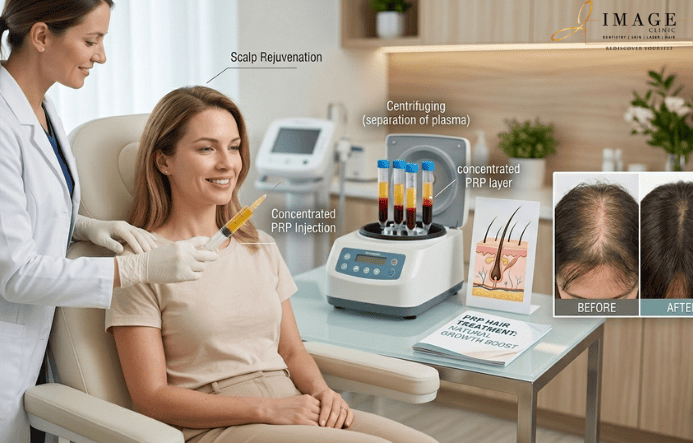
When blood is processed in a centrifuge, components separate by density. The plasma layer, particularly the portion richest in platelets, can be isolated. This platelet-rich plasma contains three to five times the normal concentration of platelets, along with concentrated growth factors.
Important Read: PRP Therapy for Hair: Is It the Secret to Stronger, Thicker Hair?
Growth Factors in PRP
The regenerative power of PRP comes from the growth factors released when platelets are activated. Key growth factors include:
- Platelet-Derived Growth Factor (PDGF): Stimulates cell proliferation and blood vessel formation
- Transforming Growth Factor-Beta (TGF-β): Regulates cell growth and differentiation
- Vascular Endothelial Growth Factor (VEGF): Promotes new blood vessel formation, improving nutrient delivery to follicles
- Epidermal Growth Factor (EGF): Stimulates cell growth and differentiation
- Insulin-Like Growth Factor (IGF): Promotes cell growth and survival
How PRP Stimulates Hair Growth
When injected into the scalp, PRP triggers several beneficial responses:
- Extends the anagen (growth) phase: Growth factors signal follicles to remain in active growth longer, producing longer, thicker hairs
- Stimulates dormant follicles: Miniaturised follicles still capable of function can be reactivated
- Improves blood supply: VEGF promotes new capillary formation, enhancing nutrient and oxygen delivery to follicles
- Reduces inflammation: Anti-inflammatory effects create a healthier scalp environment
- Strengthens existing hair: Improved follicle health produces thicker, stronger hair shafts
| Want to Understand How PRP Can Help Your Specific Situation? Start Your Hair Restoration Journey | 09830 836 666 |
The PRP Hair Treatment Procedure: What to Expect
Initial Consultation and Assessment
Effective PRP treatment begins with a thorough assessment. During your consultation, your dermatologist or trichologist will:
- Review your medical history, including any conditions or medications that might affect treatment
- Examine your scalp and assess your hair loss pattern, density, and follicle health
- Perform trichoscopy, a specialised examination using magnification to evaluate hair follicle miniaturisation
- Order blood tests if needed to rule out underlying causes like thyroid dysfunction or nutritional deficiencies
- Discuss realistic expectations based on your specific situation
This assessment determines whether PRP is appropriate for you, how many sessions you might need, and what results you can reasonably expect.
Blood Collection and Processing
On treatment day, approximately fifteen to twenty millilitres of blood is drawn from your arm, similar to a routine blood test. This blood is placed in specialised tubes and processed in a centrifuge.
The centrifugation process, typically using a double-spin method, separates blood components by density. The platelet-rich layer is carefully extracted, resulting in a concentrated preparation ready for injection. This processing takes approximately fifteen to twenty minutes.
PRP Injection
Before injection, your scalp may be numbed with a topical anaesthetic or local anaesthetic injections to ensure comfort. The PRP is then injected into the scalp using fine needles, targeting the areas of thinning or hair loss.
Injections are typically placed at one-centimetre intervals across the treatment area, ensuring even distribution of growth factors. The entire injection process takes approximately twenty to thirty minutes.
Alternative Delivery: Microneedling with PRP
Some practitioners combine PRP with microneedling rather than direct injection. In this approach, PRP is applied to the scalp and then driven into the skin using a microneedling device. The micro-channels created by the needles allow PRP to penetrate deeply while also triggering additional collagen stimulation.
This combination may enhance results for some patients, particularly those with significant scalp fibrosis or scarring.
After Your Treatment
PRP involves minimal downtime. You may experience mild soreness, redness, or swelling at injection sites for one to two days. These effects resolve quickly without intervention.
Most patients can return to normal activities immediately after treatment. However, you should avoid washing your hair for at least twelve hours, avoid vigorous exercise for twenty-four to forty-eight hours, and avoid direct sun exposure on the scalp for a few days.
Important Read: Say Goodbye to Hair Loss: Best Hair Treatments in Kolkata
Who Benefits Most from PRP Hair Treatment?
Ideal Candidates
PRP works best for individuals with:
- Early to moderate androgenetic alopecia: When follicles are still functioning but producing thinner hairs
- Diffuse thinning: Rather than complete baldness in areas
- Recent onset of hair loss: Within the past five years
- Adequate platelet counts: Some conditions affect platelet quality or quantity
- Realistic expectations: Understanding that PRP improves rather than completely reverses hair loss
Less Suitable Candidates
PRP may be less effective or inappropriate for:
- Complete baldness in areas: If follicles are entirely non-functional, PRP cannot revive them
- Very long-standing hair loss: Old, scarred follicles respond less well
- Certain medical conditions: Blood disorders, active infections, or autoimmune conditions may contraindicate treatment
- Those on blood thinners: May need to pause medication under medical supervision
For patients with advanced hair loss, hair transplantation may be more appropriate, often combined with PRP to enhance graft survival and growth.
Treatment Protocols and Timeline
Initial Treatment Phase
Most protocols recommend an initial series of three to four treatments spaced four to six weeks apart. This intensive phase jumpstarts the regeneration process and establishes a foundation for ongoing improvement.
Some patients notice reduced shedding within the first few weeks. New hair growth typically becomes visible by the third or fourth month, with continued improvement over six to twelve months.
Maintenance Phase
After the initial series, maintenance treatments are typically recommended every three to six months to sustain results. Without maintenance, benefits gradually diminish as the natural hair loss process continues.
The exact maintenance schedule depends on your response to treatment, the severity of your hair loss, and your goals.
Combining PRP with Other Treatments
PRP is often most effective as part of a comprehensive hair restoration approach:
- Minoxidil: Topical treatment that promotes blood flow to follicles. PRP and minoxidil work synergistically
- Finasteride: Oral medication that blocks DHT. Combining with PRP addresses hair loss from multiple angles
- Low-level laser therapy: Light therapy that stimulates follicles, complementing PRP’s growth factor approach
- Hair transplantation: PRP enhances graft survival and may improve results when used before and after transplant surgery
- Nutritional optimisation: Addressing deficiencies in iron, vitamin D, biotin, and protein supports overall hair health
| Ready to Create Your Personalised Hair Restoration Plan? Book Your PRP Hair Consultation | Call: 09830 836 666 |
Setting Realistic Expectations
What PRP Can Achieve
Clinical studies demonstrate that PRP can increase hair density, improve hair thickness, reduce shedding, and prolong the growth phase. Many patients experience noticeable improvement in hair volume and coverage.
However, results vary significantly between individuals. Factors affecting outcome include the severity and duration of hair loss, your individual response to growth factors, adherence to treatment protocols, and overall health and lifestyle factors.
What PRP Cannot Do
PRP cannot resurrect completely dead follicles, create new follicles where none exist, provide results equivalent to surgical hair transplantation, or work as a one-time permanent solution.
Understanding these limitations helps you approach treatment with appropriate expectations. PRP is best viewed as a tool for optimising hair health and slowing progression, rather than a miracle cure.
Safety and Side Effects
Because PRP uses your own blood, the risk of allergic reaction or rejection is essentially zero. This autologous nature makes PRP one of the safest regenerative treatments available.
Common Side Effects
Most patients experience only mild, temporary effects:
- Injection site soreness lasting one to two days
- Mild swelling or redness at injection sites
- Temporary headache in some patients
- Rarely, bruising at blood draw or injection sites
These effects resolve without treatment and do not prevent normal activities.
Contraindications
PRP may not be suitable for individuals with blood disorders affecting platelets, active scalp infections, certain autoimmune conditions, those taking anticoagulants (without medical clearance), or during pregnancy or breastfeeding. Your consultation will identify any contraindications specific to your situation.
Frequently Asked Questions About PRP Hair Treatment in Kolkata
1. How much does PRP hair treatment cost in Kolkata?
PRP costs vary based on the protocol used, the area treated, and whether combination treatments are included. During your consultation, you will receive a detailed quote based on your personalised treatment plan.
2. Is PRP hair treatment painful?
Most patients report minimal discomfort. Topical or local anaesthesia numbs the scalp before injections, making the procedure quite tolerable. Any post-procedure soreness is mild and short-lived.
3. How long before I see results from PRP?
Reduced shedding may be noticed within weeks. New hair growth typically becomes visible by three to four months, with continued improvement over six to twelve months. Patience is important, as hair growth is a slow process.
4. How many PRP sessions will I need?
Most protocols recommend three to four initial sessions spaced four to six weeks apart, followed by maintenance treatments every three to six months. Your specific needs will be determined during the consultation.
5. Can PRP regrow hair in completely bald areas?
PRP works best on areas with miniaturised but still-functioning follicles. Completely bald areas where follicles are no longer viable respond poorly. For such areas, hair transplantation may be more appropriate.
6. Does PRP work for both men and women?
Yes, PRP is effective for both male and female pattern hair loss, as well as other forms of hair thinning. The treatment approach may be adjusted based on the specific pattern and cause of hair loss.
7. Can I combine PRP with other hair loss treatments?
Yes, PRP often works best as part of a comprehensive approach. It can be combined with topical treatments like minoxidil, oral medications like finasteride, where appropriate, and even hair transplant surgery.
8. How long do PRP results last?
PRP results are not permanent. Without maintenance treatments, benefits typically last several months to a year before gradually diminishing. Regular maintenance sessions help sustain results long-term.
9. What should I avoid after PRP treatment?
Avoid washing your hair for at least twelve hours, vigorous exercise for one to two days, direct sun exposure on the scalp, and blood-thinning medications or supplements unless cleared by your doctor.
10. How do I book a PRP consultation?
You can schedule your consultation by calling 09830 836 666 or booking online. During your consultation, we will assess your hair loss, discuss your goals, and determine if PRP is right for you.
The Bottom Line
PRP hair treatment offers a scientifically-backed, minimally invasive approach to addressing hair loss using your body’s own regenerative capabilities. When performed by experienced practitioners using proper protocols, it can meaningfully improve hair density, thickness, and overall scalp health.
The key to success lies in early intervention, appropriate patient selection, adherence to treatment protocols, and realistic expectations. PRP works best as part of a comprehensive approach to hair health, often combined with other treatments and lifestyle modifications.
If you are experiencing hair loss and want to explore your options, the first step is a thorough assessment by a qualified specialist. Contact IMAGE Clinic to schedule your personalised consultation and learn whether PRP is right for you.
| Ready to Restore Your Hair Naturally? BOOK YOUR PRP CONSULTATION TODAYCall: 09830 836 666 |