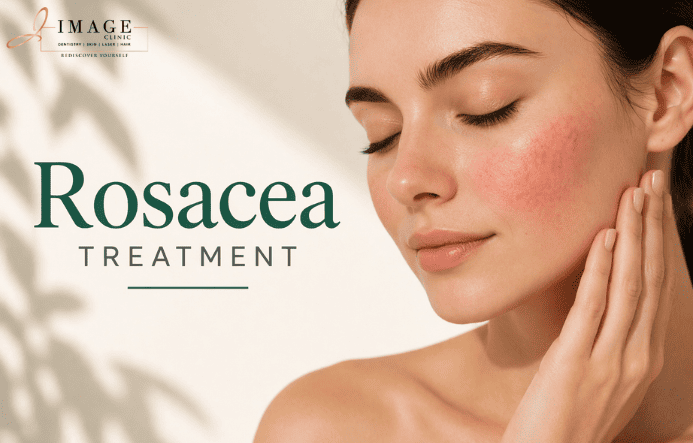
Rosacea is a chronic inflammatory skin condition that causes persistent facial redness, visible blood vessels, and — in more advanced cases — papules, pustules, and skin thickening. It is frequently mistaken for acne, sunburn, or simple flushing, which means many patients spend years managing symptoms without addressing the underlying condition. Effective rosacea treatment in Kolkata is available at IMAGE Clinic, where our dermatologists combine accurate diagnosis with clinically validated therapies to reduce redness, calm inflammation, and protect long-term skin health.
If you have noticed that your face flushes easily, remains red longer than expected, or shows persistent redness and visible vessels across the nose and cheeks, this guide will help you understand what rosacea is, how it progresses, and how a personalised treatment plan at IMAGE Clinic can help you achieve lasting relief.
| Concerned about facial redness or rosacea? Get an expert assessment from our dermatologists. Book Your Rosacea Consultation |
What Is Rosacea? Understanding the Condition Before Seeking Rosacea Treatment in Kolkata
Rosacea is a chronic, relapsing condition that primarily affects the central face — the cheeks, nose, chin, and forehead. It is characterised by episodes of flushing and persistent redness, and over time, by the development of visible blood vessels (telangiectasia) and inflammatory lesions. Although it is not contagious and does not pose a systemic health threat, rosacea significantly impacts quality of life, contributing to self-consciousness, social anxiety, and reduced confidence.
The condition is more common than widely recognised in India, particularly among individuals with lighter complexions, though darker skin tones are not immune. Because Indian patients often present differently — with redness less visually apparent against deeper skin tones — rosacea is frequently underdiagnosed or misclassified as acne or seborrhoeic dermatitis.
The Four Subtypes of Rosacea
Understanding the subtype of rosacea is the foundation of effective treatment planning, as each presents differently and responds to different interventions:
- Erythematotelangiectatic Rosacea (ETR): The most common subtype, characterised by persistent central facial redness, flushing, and visible telangiectasia (dilated blood vessels). The skin is often sensitive and reactive to temperature, products, and lifestyle triggers.
- Papulopustular Rosacea: Presents with inflammatory papules and pustules alongside redness, resembling acne — but without blackheads or whiteheads. This subtype is frequently confused with adult acne.
- Phymatous Rosacea: A rarer subtype involving skin thickening, irregular surface texture, and enlargement — most notably of the nose (rhinophyma). More common in men and associated with chronic, undertreated rosacea.
- Ocular Rosacea: Involves the eyes and eyelids, causing dryness, irritation, redness, and a gritty or burning sensation. It often co-exists with facial rosacea and may require ophthalmological assessment alongside dermatological care.
Triggers That Worsen Rosacea: Identifying and Managing Your Personal Profile
Rosacea is a trigger-driven condition — symptoms flare in response to identifiable stimuli that provoke vascular dilation and inflammatory responses. Identifying and modifying your personal trigger profile is a critical component of any rosacea treatment in Kolkata programme at IMAGE Clinic.
Environmental Triggers
Sun exposure is the most universally reported trigger for rosacea flares in Indian patients, as ultraviolet radiation directly stimulates vascular dilation and inflammatory mediators. Temperature extremes — both heat and cold — provoke similar vascular responses. Humidity and wind exposure are additional environmental factors that disrupt the already-compromised skin barrier in rosacea patients.
Dietary Triggers
Spicy foods, hot beverages, and alcohol — particularly red wine — are well-documented triggers due to their vasodilatory effects. Histamine-rich foods (aged cheese, fermented products, cured meats) and cinnamaldehyde-containing foods (tomatoes, citrus, chocolate) can also precipitate flushing in susceptible individuals. A symptom diary is an invaluable tool for identifying personal dietary triggers.
Skincare Product Triggers
Many commonly used skincare ingredients are poorly tolerated by rosacea-prone skin. Alcohols, fragrances, menthol, camphor, sodium lauryl sulphate, and high concentrations of retinoids or acids can disrupt the skin barrier and precipitate inflammatory flares. Our dermatologists provide detailed guidance on building a rosacea-compatible skincare routine as part of your treatment plan.
Psychological and Physiological Triggers
Emotional stress, intense exercise, hot baths or saunas, and certain medications (particularly vasodilators and topical steroids) can all trigger or worsen rosacea symptoms. Topical steroid use — a frequent and inadvertent cause of rosacea exacerbation in Indian patients — is a particularly important factor to disclose during your consultation.
| Our dermatologists will help identify your triggers and design a treatment plan around them. Book Your Consultation at IMAGE Clinic |
Rosacea Treatment in Kolkata: IMAGE Clinic’s Evidence-Based Approach
At IMAGE Clinic, rosacea treatment in Kolkata is guided by a combination of dermatological assessment, subtype identification, and personalised multimodal therapy. Our approach addresses both the visible symptoms — redness, vessels, and inflammation — and the underlying vascular and inflammatory pathophysiology that drives the condition.
Laser and Light-Based Treatments for Rosacea
Energy-based treatments are among the most effective interventions for erythematotelangiectatic rosacea, targeting the dilated blood vessels responsible for persistent redness and visible telangiectasia.
Nd: YAG Laser: The 1064nm Nd: YAG laser selectively targets oxyhaemoglobin in dilated blood vessels, causing them to coagulate and be reabsorbed by the body’s lymphatic system without damaging the surrounding skin. This is a first-line treatment for visible telangiectasia and diffuse facial redness. It is well-suited to Indian skin tones due to its longer wavelength, which penetrates deeper with reduced risk of epidermal damage.
Laser Toning: Our laser toning treatment delivers low-fluence Q-switched Nd: YAG energy across the skin surface, reducing background redness and improving skin tone uniformity over a series of sessions. It is particularly effective for diffuse erythema where individual vessel targeting is less feasible.
Laser Skin Resurfacing: For patients with phymatous rosacea or those whose skin texture and quality have been affected by chronic inflammation, laser skin resurfacing can address surface irregularities and promote collagen remodelling.
Medical Therapies for Papulopustular Rosacea
When rosacea presents with inflammatory papules and pustules, topical and systemic medical therapies are integral to management:
- Topical azelaic acid: A naturally occurring dicarboxylic acid with anti-inflammatory, antimicrobial, and anti-keratinising properties. It reduces papules and pustules and improves redness without the irritation associated with retinoids.
- Topical metronidazole: A well-established rosacea treatment with anti-inflammatory and antiparasitic activity against Demodex mites — organisms implicated in the pathogenesis of papulopustular rosacea.
- Topical ivermectin: A newer agent with anti-inflammatory and Demodex-reducing properties, shown in clinical trials to be superior to metronidazole for papulopustular rosacea.
- Oral doxycycline: At sub-antimicrobial doses, doxycycline exerts anti-inflammatory effects that reduce papulopustular lesions. It is prescribed for moderate to severe cases and used alongside topical therapies.
Chemical Peels for Rosacea
Carefully selected chemical peels can improve the skin’s barrier function, reduce sebaceous gland activity, and address the inflammatory burden in papulopustular rosacea. Azelaic acid peels and mandelic acid peels — which are gentler than glycolic or salicylic acid formulations — are preferred for rosacea-prone skin.
Peels are administered at conservative concentrations and carefully monitored in rosacea patients to avoid triggering inflammatory flares. Our dermatologists will assess your skin’s reactivity and tolerance before recommending any peel protocol.
HydraFacial for Rosacea Skin
The HydraFacial treatment offers a non-irritating approach to skin hydration and gentle exfoliation in rosacea patients. Its vortex-fusion technology cleanses and hydrates the skin without the mechanical abrasion of traditional facials, making it suitable for the sensitive, reactive skin characteristic of rosacea. Calming serum infusions — including those containing niacinamide, peptides, and hyaluronic acid — can further reduce redness and reinforce the skin barrier.
Skincare Barrier Restoration
A compromised skin barrier is both a cause and consequence of rosacea. Our dermatologists prescribe medical-grade skincare protocols that restore the barrier using ceramide-rich moisturisers, niacinamide-based formulations, and mineral sunscreens. This reduces sensitivity to triggers, decreases baseline inflammation, and supports the efficacy of in-clinic treatments.
Rosacea vs Acne: Key Differences You Should Know
| Feature | Rosacea | Acne Vulgaris |
| Affected age group | Predominantly adults (30s–50s) | Adolescents and young adults (primarily) |
| Comedones (blackheads/whiteheads) | Absent | Present (a defining feature) |
| Facial redness | Persistent, often symmetrical | Localised to breakout areas |
| Visible blood vessels | Common (telangiectasia) | Not a feature |
| Triggers | Sun, heat, spicy food, alcohol | Hormones, diet, stress, bacteria |
| Flushing | A primary symptom | Not a feature |
| Treatment | Laser, anti-inflammatories, barrier care | Retinoids, antibiotics, comedolytics |
| Topical steroids | Worsens rosacea — must avoid | Occasionally used short-term |
What to Expect During Your Rosacea Treatment at IMAGE Clinic
Your rosacea treatment journey at IMAGE Clinic begins with a thorough diagnostic consultation with one of our experienced dermatologists. Here is what the process looks like:
- Initial Consultation: Your dermatologist will take a detailed history — including duration of symptoms, known triggers, previous treatments, and current skincare products — and assess your skin type and rosacea subtype. Blood tests or skin assessment tools may be used to rule out associated conditions.
- Personalised Treatment Plan: Based on your subtype and symptom profile, a customised plan will be designed — often combining laser therapy with topical prescriptions and a rosacea-safe skincare protocol.
- Trigger Management Guidance: Our team will work with you to identify and systematically reduce your personal triggers, including reviewing your current skincare products for ingredients that may be causing flares.
- In-Clinic Treatment Sessions: Laser and light-based sessions are performed by trained professionals using calibrated devices. Sessions are typically 20–30 minutes. Mild post-treatment warmth and redness may be present for a few hours.
- Ongoing Review: Rosacea requires long-term management. Our dermatologists schedule regular review appointments to assess progress, adjust treatments as needed, and ensure your results are maintained.
- Education and Empowerment: You will leave each appointment with clear guidance on home care, product choices, and lifestyle modifications — because managing rosacea day-to-day is as important as clinical treatment.
| Take the first step towards calmer, clearer skin with expert rosacea care. Book Your Appointment Now |
Why Choose IMAGE Clinic for Rosacea Treatment in Kolkata?
- Accurate Diagnosis First: Rosacea is frequently misdiagnosed. Our specialist dermatology team conducts a thorough assessment to confirm the diagnosis and identify the specific subtype before any treatment begins.
- Indian Skin Expertise: Rosacea presents differently in Indian patients, particularly those with Fitzpatrick types III–V. Our experience with diverse skin tones ensures that treatments are calibrated to deliver results without triggering PIH or barrier damage.
- US FDA-Approved Laser Technology: All laser devices used at IMAGE Clinic for vascular and pigmentation concerns carry US FDA approval — a standard not universally met by clinics in Kolkata.
- Holistic Management: We go beyond treating visible symptoms. Your plan includes trigger identification, skin barrier restoration, prescription-grade topicals, and long-term maintenance — a comprehensive approach that reduces relapse frequency.
- Transparent Clinical Results: Our before and after gallery includes documented outcomes for inflammatory and vascular skin conditions, setting realistic expectations from your first visit.
- Full Aesthetic Ecosystem: IMAGE Clinic offers a complete range of skin treatments, including anti-ageing treatments, skin tightening, and PRP for skin rejuvenation — all available to complement your rosacea management as needed.
Frequently Asked Questions: Rosacea Treatment in Kolkata
1. Can rosacea be permanently cured?
Rosacea is a chronic condition with no permanent cure at present, but it is highly controllable. With appropriate treatment at IMAGE Clinic — including laser therapy, medical management, and trigger control — most patients achieve significant and sustained symptom reduction. Many enter long periods of remission with minimal maintenance.
2. How many laser sessions are needed for rosacea in Kolkata?
The number of sessions depends on the subtype and severity. Erythematotelangiectatic rosacea with visible vessels typically responds well to three to six laser sessions spaced four to six weeks apart. Your dermatologist will provide a personalised estimate during your consultation.
3. Is laser treatment for rosacea safe for Indian skin?
Yes, when performed by experienced dermatologists using appropriate wavelengths and energy settings. The 1064nm Nd: YAG laser is particularly well-suited to Indian skin tones due to its reduced risk of epidermal damage and hyperpigmentation compared to shorter-wavelength devices.
4. Will rosacea treatment help with the redness on my nose specifically?
Yes. Nose and central face redness are the primary targets of vascular laser treatment. Visible telangiectasia on and around the nose typically responds well to Nd: YAG laser sessions. Persistent redness without discrete vessels responds to laser toning protocols.
5. I have been using a steroid cream on my face for redness. Could this have caused rosacea?
This is a very important and common concern. Long-term use of topical corticosteroids on the face can cause perioral dermatitis and rosacea-like presentations — a condition sometimes called steroid-induced rosacea. Discontinuing the steroid under medical supervision and treating the resulting inflammation is the correct approach. Our dermatologists are experienced in managing this scenario.
6. Can diet changes help control rosacea?
Dietary modifications can significantly reduce the frequency of flares for many patients. Avoiding known triggers — spicy foods, hot drinks, alcohol, and histamine-rich foods — is a core component of rosacea management. Our dermatologists will help you identify your personal dietary triggers.
7. Is it safe to have a HydraFacial if I have rosacea?
Yes. The HydraFacial is one of the few facial treatments generally compatible with rosacea-prone skin due to its non-abrasive, non-irritating technique. Calming serums used during the treatment can further reduce redness and reinforce the skin barrier. Always inform the technician about your rosacea before the session.
8. What skincare products should I avoid with rosacea?
Avoid alcohol-based toners, fragranced products, menthol or camphor-containing formulations, high concentrations of retinoids or AHAs, and sodium lauryl sulphate cleansers. Our dermatologists will review your current skincare and recommend a rosacea-compatible routine.
9. Can rosacea spread to other parts of the face or body?
Rosacea primarily affects the central face. In rare cases, phymatous changes may affect the nose, chin, ears, or forehead. Ocular rosacea affects the eyes. It does not typically spread to the body beyond these areas. Early treatment reduces the risk of progression to more advanced subtypes.
10. How do I book a rosacea consultation in Kolkata at IMAGE Clinic?
You can book your consultation online via our contact page or call IMAGE Clinic directly at 09830 836 666. Visit your nearest IMAGE Clinic for an expert assessment and a personalised rosacea treatment plan tailored to your skin.
| Begin Your Rosacea Treatment Journey at IMAGE Clinic, KolkataExpert dermatologists. US FDA-approved technology. Personalised care for Indian skin. Book Your Appointment Now | Call: 09830 836 666Or visit your nearest IMAGE Clinic — find your nearest branch here. |