
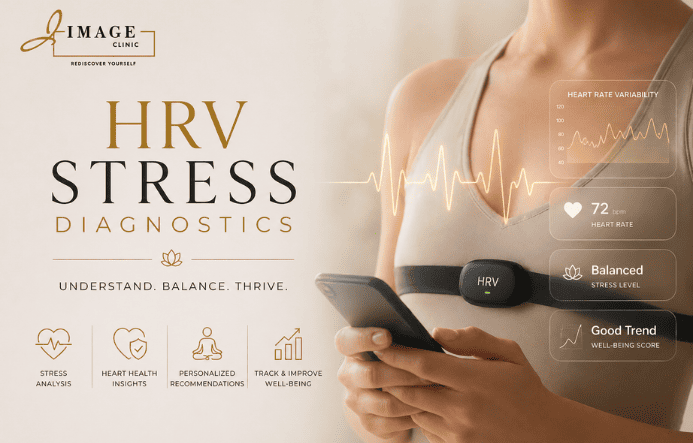
In the era of optimised health and biohacking, Heart Rate Variability (HRV) has emerged as one of the most powerful and clinically validated biomarkers for assessing the body’s stress resilience, autonomic nervous system function, sleep quality, and overall physiological readiness. If you are experiencing persistent fatigue, poor sleep, high stress, or simply want to understand your body’s performance at a deeper level, HRV stress diagnostics in Kolkata at IMAGE Clinic offers a sophisticated, data-driven assessment that goes far beyond conventional health screening.
This guide explains what HRV is, what it reveals about your health, how IMAGE Clinic conducts the assessment, and how the insights from HRV diagnostics inform a personalised wellness and longevity programme.
| Curious about your body’s stress resilience? Book your HRV assessment at IMAGE Clinic today. Book Your HRV Diagnostics Consultation |
What Is Heart Rate Variability (HRV)?
Heart Rate Variability is the variation in the time intervals between consecutive heartbeats. While a resting heart rate of, say, 60 beats per minute might suggest that the heart beats once every second, in reality, the interval between each beat varies continuously — sometimes 0.95 seconds, sometimes 1.05 seconds, and so on. This variation is not a sign of an irregular heartbeat; it is a normal and desirable feature of a healthy cardiovascular system.
The degree of this variability — how much the intervals fluctuate — is what HRV measures. Counterintuitively, greater variability generally indicates better health. A higher HRV reflects a well-regulated autonomic nervous system (ANS) that can efficiently switch between sympathetic (fight-or-flight) and parasympathetic (rest-and-recover) activation. A lower HRV indicates a nervous system under chronic stress or strain — less adaptable, less resilient, and typically associated with poorer health outcomes.
The Two Branches of the Autonomic Nervous System
To understand HRV, it helps to understand the ANS — the system that governs all involuntary body functions, including heart rate, breathing, digestion, and stress response:
- Sympathetic nervous system (SNS): The ‘fight-or-flight’ branch. Activates under stress — physical or psychological — accelerating heart rate, releasing cortisol and adrenaline, and directing resources towards immediate survival responses. In the modern context, this branch is chronically overactivated by work pressure, poor sleep, inflammation, and lifestyle stress.
- Parasympathetic nervous system (PNS): The ‘rest-and-digest’ branch. Governs recovery, digestion, immune function, and restorative sleep. Activation of the PNS increases HRV and is associated with improved recovery, mood, cognitive function, and longevity.
HRV is primarily a measure of parasympathetic tone — the degree to which the PNS is actively governing the heart. A high HRV indicates strong parasympathetic regulation; a low HRV indicates sympathetic dominance, often reflecting chronic stress, poor sleep, overtraining, inflammation, or early disease.
What Does HRV Reveal About Your Health?
HRV diagnostics at IMAGE Clinic assess multiple dimensions of autonomic function, stress response, and physiological resilience. The insights generated inform a personalised wellness strategy across several health domains:
- Stress load and resilience: HRV directly quantifies the physiological burden of stress on your body — not just subjective feelings of being stressed. It distinguishes between acute (manageable) and chronic (damaging) stress states, providing an objective measure that self-reported stress questionnaires cannot.
- Sleep quality and recovery: HRV rises significantly during quality sleep — particularly during deep (slow-wave) and REM sleep phases. Chronically low overnight HRV is a reliable indicator of poor sleep quality, insufficient recovery, or sleep-disrupting conditions such as sleep apnoea. Improving sleep quality is one of the most powerful ways to raise HRV — and IMAGE Clinic’s HRV and sleep diagnostics provide the data to identify exactly where your sleep architecture is failing.
- Cardiovascular health: Low HRV is associated with increased cardiovascular risk — specifically, higher risk of arrhythmia, coronary artery disease, and all-cause cardiovascular mortality. HRV assessment provides a non-invasive window into cardiac autonomic function that standard ECG does not capture.
- Athletic performance and recovery: In athletes and physically active individuals, HRV is used to guide training load — high HRV days indicate readiness for intense training, while low HRV days signal the need for recovery. IMAGE Clinic’s HRV diagnostics help optimise training periodisation and prevent overtraining syndrome.
- Metabolic and hormonal health: Low HRV is associated with insulin resistance, metabolic syndrome, elevated cortisol, and thyroid dysfunction — all conditions that IMAGE Clinic’s metabolic health programme can assess and address comprehensively.
- Mental health and cognitive performance: HRV is a reliable correlate of emotional regulation, anxiety, depression, and cognitive flexibility. Higher HRV is associated with better executive function, greater emotional resilience, and reduced susceptibility to burnout.
HRV Diagnostics at IMAGE Clinic: What the Assessment Involves
IMAGE Clinic’s HRV stress and sleep diagnostics programme is one of the most sophisticated health assessments available outside a tertiary medical centre. It combines wearable HRV monitoring with clinical interpretation by specialists in metabolic medicine and longevity — translating raw data into actionable health insights.
- Pre-Assessment Consultation: A physician consult to review your health history, current symptoms, lifestyle, sleep patterns, and stress profile — providing context for interpreting your HRV data.
- Wearable HRV Monitoring: A clinical-grade wearable device records your HRV data continuously over a defined period — typically 24–72 hours — capturing both daytime and overnight patterns. This time-domain and frequency-domain data is far more informative than a single spot measurement.
- Sleep Architecture Analysis: Where sleep disruption is a concern, the HRV data is analysed alongside sleep staging information to identify disruptions in deep sleep, REM sleep, and overall sleep efficiency.
- Stress Response Profiling: The sympathetic-parasympathetic balance across the day and night is mapped, identifying specific time periods of stress dominance — such as late-night sympathetic activation that prevents restorative sleep — and correlating these with lifestyle, work patterns, and dietary factors.
- Clinical Report and Interpretation: A detailed clinical report is generated, translating the HRV data into clear insights about your stress load, recovery capacity, sleep quality, and cardiovascular autonomic function.
- Personalised Wellness Plan: Based on your HRV profile, your physician designs a personalised intervention programme — incorporating lifestyle modifications, IV nutritional therapy, biohacking protocols, and, where appropriate, medical management of contributing conditions such as thyroid dysfunction, insulin resistance, or adrenal dysregulation.
HRV Diagnostics as Part of IMAGE Clinic’s Longevity and Biohacking Programme
HRV diagnostics sit at the core of IMAGE Clinic’s broader longevity and biohacking programme — a first-of-its-kind initiative in Kolkata that positions the clinic not just as an aesthetic destination but as a comprehensive wellness and performance optimisation centre.
Based on HRV insights, patients may be directed towards complementary treatments within IMAGE Clinic’s biohacking and wellness ecosystem:
- Red light therapy: Clinically validated to improve mitochondrial function, reduce inflammation, and improve sleep quality — directly addressing the cellular-level contributors to low HRV.
- IV nutritional therapy: IV infusion therapy with tailored micronutrient protocols — including magnesium, B vitamins, glutathione, and NAD+ — supports nervous system function, adrenal recovery, and cellular energy production.
- NAD+ therapy: NAD+ (nicotinamide adenine dinucleotide) is a critical coenzyme in cellular energy production and DNA repair. NAD+ decline — which accelerates with age and chronic stress — is directly linked to autonomic dysfunction and low HRV. IV NAD+ therapy supports mitochondrial health and HRV improvement.
- PEMF therapy: Pulsed Electromagnetic Field therapy modulates autonomic nervous system function, has demonstrated HRV-improving effects in clinical studies, and supports deep sleep — addressing the physiological mechanisms underlying low HRV directly.
- Metabolic health programme: Where HRV diagnostics reveal metabolic contributors — including insulin resistance, thyroid dysfunction, or adrenal fatigue — IMAGE Clinic’s metabolic health programme addresses these clinically.
Who Should Consider HRV Stress Diagnostics in Kolkata?
HRV diagnostics are valuable for a broad range of individuals:
- Professionals experiencing chronic work-related stress, burnout, or performance decline
- Individuals with persistent fatigue, low energy, or poor sleep quality that does not improve with rest
- Athletes and active individuals seeking to optimise training load and recovery
- Those with a family history of cardiovascular disease who want a proactive autonomic health assessment
- Patients with metabolic conditions — insulin resistance, thyroid dysfunction, or PCOS — where autonomic dysregulation commonly co-exists
- Individuals interested in biohacking and longevity medicine who want data-driven health optimisation
- Anyone experiencing anxiety, mood instability, or reduced cognitive performance that may have a physiological basis
Why Choose IMAGE Clinic for HRV Stress Diagnostics in Kolkata?
- First-Mover Expertise in Kolkata: IMAGE Clinic is among the first aesthetic and wellness clinics in Kolkata to offer clinical-grade HRV diagnostics — positioning patients at the leading edge of preventive health and performance optimisation.
- Physician-Interpreted Data: Raw HRV data without clinical interpretation has limited value. At IMAGE Clinic, your HRV results are interpreted by physicians trained in metabolic medicine and longevity — not by an app algorithm.
- Integrated Intervention Capability: Unlike standalone diagnostic services, IMAGE Clinic can directly implement the interventions indicated by your HRV profile — including IV therapy, biohacking protocols, and metabolic health management — under one roof.
- Holistic Wellness Philosophy: IMAGE Clinic’s wellness programme treats the whole person — integrating HRV diagnostics with aesthetic treatments, metabolic health, and longevity medicine to support both how you look and how you perform.
- Confidential and Personalised: Your HRV diagnostic results are entirely confidential and interpreted individually. There are no generic wellness recommendations — every intervention plan is specific to your autonomic profile, health history, and lifestyle.
Frequently Asked Questions: HRV Stress Diagnostics in Kolkata
1. What is a good HRV score?
HRV is highly individual — what constitutes a good score varies by age, sex, fitness level, and health status. Rather than comparing your HRV to population norms, the most meaningful approach is tracking your own HRV over time. IMAGE Clinic’s diagnostics establish your personal baseline and track changes in response to interventions — giving you data that is relevant to you specifically.
2. How is HRV measured at IMAGE Clinic?
IMAGE Clinic uses clinical-grade wearable devices that capture continuous RR interval data over 24–72 hours. This allows for both time-domain analysis (SDNN, RMSSD) and frequency-domain analysis (LF/HF ratio) — providing a comprehensive picture of autonomic function across different physiological states.
3. Can HRV diagnostics identify heart problems?
HRV diagnostics can identify reduced autonomic nervous system flexibility and elevated cardiovascular risk — but they are not a substitute for ECG, echocardiogram, or cardiological assessment. If your HRV results suggest a cardiovascular concern, IMAGE Clinic’s physicians will refer you for appropriate specialist evaluation.
4. How often should I have HRV diagnostics?
For patients undergoing active wellness interventions, repeat HRV assessment every three to six months allows tracking of autonomic function improvement in response to lifestyle changes, IV therapy, biohacking protocols, or medical management. For initial screening, a single assessment establishes your baseline and guides your first intervention plan.
5. Can HRV diagnostics help with sleep problems?
Yes. HRV overnight analysis is one of the most informative tools available for assessing sleep quality — identifying disruptions in deep sleep and REM phases, detecting signs consistent with sleep apnoea, and mapping the timing of sympathetic nervous system activation that disrupts sleep architecture. Interventions identified through HRV sleep analysis often produce significant improvements in sleep quality.
6. Is HRV diagnostics relevant if I am young and healthy?
Yes. HRV diagnostics are valuable at any age for health optimisation, performance enhancement, and early identification of autonomic stress load before overt symptoms develop. Many young professionals find that their HRV reveals significant physiological stress burden — driven by work pressure, poor sleep, and lifestyle factors — that they were not consciously aware of.
7. Can HRV be improved?
Yes. HRV is a dynamic, modifiable biomarker — it responds to lifestyle changes, targeted interventions, and medical treatment. Regular aerobic exercise, quality sleep, stress management practices (including mindfulness and breathwork), reduced alcohol consumption, and treatment of underlying metabolic or hormonal conditions all improve HRV. IMAGE Clinic’s interventions — including IV therapy, NAD+, red light therapy, and PEMF — are selected specifically for their evidence-based HRV-improving effects.
8. What is the difference between HRV and a standard health check?
A standard health check measures static markers — blood pressure, cholesterol, and blood glucose — at a single point in time. HRV diagnostics measure the dynamic adaptability of your nervous system across a full day and night — revealing the body’s functional resilience under real-world conditions that static markers cannot capture. The two approaches are complementary, and at IMAGE Clinic, HRV is typically interpreted alongside standard metabolic investigations.
9. Can HRV diagnostics help with anxiety and mental health?
HRV is closely correlated with emotional regulation capacity. Low HRV is consistently associated with higher anxiety, reduced stress tolerance, and impaired cognitive flexibility. Interventions that improve HRV — including those offered at IMAGE Clinic — often produce concurrent improvements in anxiety symptoms, mood stability, and mental performance.
10. How do I book HRV stress diagnostics in Kolkata at IMAGE Clinic?
Call IMAGE Clinic at 09830 836 666 or book online via our contact page. HRV diagnostics are available at all IMAGE Clinic Kolkata locations as part of our biohacking and longevity wellness programme.
| HRV Stress Diagnostics in Kolkata — IMAGE ClinicData-driven. Physician-interpreted. Personally actionable. Book Your Appointment Now | Call: 09830 836 666Or visit your nearest IMAGE Clinic — find your nearest branch here. |