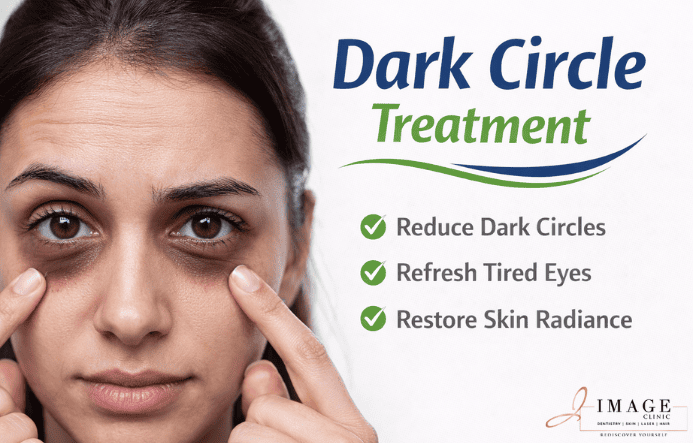

Dark circles are one of the most frustrating cosmetic concerns precisely because they seem so simple — yet resist almost everything you throw at them. Serums, concealers, cold spoons, cucumber slices — most people have tried them all, with limited success. The reason these remedies fail is not because dark circles are untreatable; it is because the vast majority of people are treating the wrong cause. Dark circles are not a single condition. They are the visible endpoint of several quite different biological processes — and each requires a completely different treatment approach.
If you have been disappointed by previous treatments for dark circles, the most likely explanation is that the treatment was mismatched to your specific cause. This guide explains the distinct causes of under-eye darkening, how to identify which one you have, and which dark circle treatment in Kolkata is most likely to produce real improvement for your particular situation.
| Not sure what’s causing your dark circles? Our dermatologists can accurately identify the cause and match the treatment. Book Your Under-Eye Assessment at IMAGE Clinic |
Why Dark Circles Are Not All the Same: The Four Distinct Causes
Cause 1: Vascular (Blood Vessel) Darkness — The Blue-Purple Tint
This is the most common form of under-eye darkness in Indian patients and the one most often confused with pigmentation. The under-eye skin is the thinnest skin on the face — typically 0.5mm compared to 2mm on the cheeks. Through this thin skin, the superficial blood vessels beneath are visible, casting a blue-purple shadow that is most pronounced in people with naturally prominent vasculature, those who are fatigued (vasodilation increases with tiredness), and those with a genetic tendency toward thin periorbital skin.
Vascular dark circles are characterised by a distinctly bluish or purplish hue — not brown. They are typically worse in the morning and improve slightly as the day progresses. Pressing the skin lightly and temporarily blanching it will cause the colour to momentarily disappear — a simple clinical test that confirms the vascular origin.
What works: Under-eye filler treatment (hyaluronic acid placed in the tear trough) is the most effective intervention for vascular dark circles — it thickens the overlying skin to mask the underlying vessels. PRP treatment also improves vascular dark circles by stimulating collagen production in the thin periorbital skin, progressively improving skin thickness and reducing vessel visibility over three to four sessions.
Cause 2: Pigmentation — The Brown Tint
Periorbital hyperpigmentation — genuine melanin deposition in the under-eye skin — produces the characteristic brown-toned dark circles common in Indian and South Asian patients. It is driven by sun exposure (UV stimulates melanocytes even through the thin under-eye skin), friction (rubbing the eyes damages the skin barrier and triggers PIH), allergic rhinitis (the ‘allergic shiner’), hormonal changes, and genetic predisposition.
Pigmentation-based dark circles are brown rather than blue-purple and do not lighten with pressure. They tend to worsen in summer with increased UV exposure and often have a defined border around the orbital rim.
What works: Laser toning with Q-switched Nd: YAG targets the melanin deposits in the periorbital skin, progressively lightening brown pigmentation over four to six sessions. The EyeRevive specialised peel uses mandelic and azelaic acid formulations specifically developed for the delicate under-eye skin, gently exfoliating surface pigmentation. Topical depigmenting agents (kojic acid, arbutin, niacinamide) complement in-clinic treatments and are safe for periorbital use.
Cause 3: Structural Shadows — The Hollow Trough
Not all dark circles involve colour at all. In many patients — particularly those in their 30s, 40s, and beyond — what appears to be dark circles is actually a shadow cast by volume loss and structural changes in the periorbital area. As the mid-face fat pads deflate and migrate downward with age, a groove (tear trough) forms between the lower eyelid and the cheek. This indentation catches light differently from the surrounding convex surfaces, creating a perpetual shadow that mimics dark pigmentation.
What works: Tear trough filler (hyaluronic acid) is the definitive treatment for structural dark circles — filling the hollow to restore a smooth transition from the lower lid to the cheek, eliminating the shadow. This is one of the most technically demanding injectable procedures, requiring a dermatologist with specific tear-trough expertise. When performed correctly, the improvement is immediate and can last twelve to eighteen months.
Cause 4: Skin Laxity and Texture Changes
Thinning, crepey under-eye skin — typically a feature of both ageing and chronic sun exposure — creates a textured surface that diffuses light unevenly, producing a shadowed, tired appearance even in the absence of true pigmentation or volume loss. PRP growth factor therapy is particularly effective here, stimulating collagen and elastin in the delicate periorbital skin. Profhilo — injected into the periorbital area by an experienced clinician — improves skin quality, hydration, and texture for a more consistent, rested appearance without adding volume.
| Your dark circle treatment must match your cause. Get the right diagnosis first. Book Your Consultation at IMAGE Clinic |
Identifying Your Dark Circle Type: A Quick Reference
| Type | Colour | Worse When | Pressing Skin Test | Primary Treatment |
| Vascular | Blue-purple | Morning, after poor sleep, fatigue | Colour disappears temporarily | Tear trough filler, PRP |
| Pigmentation | Brown | After sun exposure, summer | No change | Laser toning, EyeRevive peel, topicals |
| Structural/Hollow | Grey-dark shadow | Always present, angle-dependent | No change | Tear trough filler |
| Skin laxity | Dull grey-brown | With age, dehydration | No change | PRP, Profhilo, skin boosters |
Most patients presenting with dark circles have a combination of two or more of these causes — for example, vascular darkness compounded by pigmentation, or structural hollowing worsened by skin laxity. The most effective treatment plans at IMAGE Clinic address all contributing factors simultaneously rather than targeting a single mechanism.
What Genuinely Does Not Work for Dark Circles
Part of treating dark circles effectively is understanding why so many commonly recommended approaches fail — so you stop investing time and money in things that will not make a meaningful difference to your specific type.
- Cucumber slices and cold compresses: Temporarily reduce puffiness (via vasoconstriction) but have no effect on pigmentation, structural hollowing, or skin laxity. The improvement is visible only while the cold is applied.
- Generic eye creams with vitamin C: Vitamin C is a legitimate depigmenting ingredient but penetrates the periorbital skin poorly in standard cream formulations. Medical-grade topicals prescribed by a dermatologist deliver significantly higher active concentrations in appropriate carriers.
- Getting more sleep: Adequate sleep reduces vascular dilation and puffiness, which can improve the appearance of blue-purple dark circles. However, it has no effect on pigmentation, hollowing, or skin laxity — the causes of most persistent dark circles in Indian patients.
- Vitamin K creams: The evidence base for vitamin K in under-eye darkness is extremely weak. It has no clinically validated effect on any of the four causes described above.
- Chemical peels at standard concentrations over the eye area: Strong peels are contraindicated near the orbital rim due to the risk of chemical injury to the delicate periorbital skin. Specialised peels formulated for this area — such as the EyeRevive peel — are required.
The IMAGE Clinic Approach to Dark Circle Treatment in Kolkata
At IMAGE Clinic, every patient presenting for dark circle treatment in Kolkata undergoes a structured under-eye assessment before any treatment is recommended:
- Cause identification: The dermatologist uses clinical examination — including the blanching test, dermoscopy, and assessment of orbital anatomy — to identify the primary and secondary causes of the dark circles.
- Skin type assessment: Indian skin (Fitzpatrick types III–V) requires specific parameter calibration for any laser or energy-based treatment near the eye. The periorbital skin is particularly reactive, and treatments must be adapted accordingly.
- Personalised treatment plan: Based on the cause assessment, a treatment plan is designed — often combining two or more modalities to address the specific combination of factors present. The plan, expected timeline, and realistic outcomes are discussed in full before any treatment begins.
- Treatment delivery: Tear-trough fillers and periorbital PRP are performed by experienced dermatologists with specific expertise in the periorbital anatomy. All laser treatments use US FDA-approved devices with parameters calibrated for the under-eye area.
- Review and maintenance: A follow-up appointment assesses treatment response and guides any adjustments. A maintenance plan is established to sustain results — including appropriate home care with clinician-prescribed topicals.
People Also Ask: Dark Circle Treatment in Kolkata
Which treatment works best for dark circles?
There is no single best treatment — effectiveness depends entirely on the cause. For vascular dark circles: tear trough filler or PRP. For brown pigmentation: laser toning and the EyeRevive peel. For structural hollowing: hyaluronic acid tear-trough filler. For skin laxity: PRP and Profhilo. A proper dermatological assessment is the essential first step.
Are dark circles permanent?
Dark circles caused by genetics — such as inherently thin periorbital skin or hereditary pigmentation — are not self-resolving, but they are treatable. Results from tear-trough filler, laser toning, and PRP are significant and lasting, though maintenance is required. Dark circles caused by lifestyle factors such as chronic sleep deprivation may improve with behaviour change alongside clinical treatment.
How many sessions are needed for under-eye dark circle treatment?
Session requirements depend on the treatment. Tear-trough filler produces immediate improvement in a single session (repeated every twelve to eighteen months as filler gradually dissolves). Laser toning for pigmentation typically requires four to six sessions. PRP for under-eye skin is typically three sessions spaced four to six weeks apart, with progressive improvement continuing for three to six months.
Is tear-trough filler safe?
Tear-trough filler is safe when performed by an experienced dermatologist familiar with the periorbital anatomy and the specific risks of this delicate area. At IMAGE Clinic, all injectable treatments are performed by qualified physicians. Hyaluronic acid fillers are also reversible — dissolved with hyaluronidase if needed — making them a particularly safe option for the tear-trough area.
Can dark circles under the eyes be treated at home?
Home treatments have very limited efficacy for established dark circles. They can provide mild supportive benefits — vitamin C or niacinamide serums for mild pigmentation, sufficient sleep for vascular swelling — but cannot reverse structural hollowing, significant pigmentation, or vascular darkness meaningfully. Medical-grade treatment at a dermatology clinic is required for visible, lasting improvement.
What causes dark circles in young people?
In younger patients, the most common causes are genetic predisposition (thin periorbital skin or inherited pigmentation), chronic allergic rhinitis (which dilates under-eye vessels), iron deficiency anaemia, and lifestyle factors such as chronic sleep deprivation, screen time, and dehydration. A dermatological assessment identifies the specific cause and guides appropriate treatment.
| Dark Circle Treatment in Kolkata — IMAGE ClinicAccurate diagnosis. Cause-matched treatment. Real results. Book Your Appointment Now | Call: 09830 836 666 Or visit your nearest IMAGE Clinic — find your nearest branch here. |