Gum disease is the leading cause of tooth loss in adults worldwide — and it is predominantly silent in its early and middle stages. Most patients who require periodontal treatment arrive not because of pain, but because of a routine dental examination that reveals bone loss, deep gum pockets, or receding gum tissue that has been progressing unnoticed for months or years. Traditional periodontal surgery — involving scalpels, sutures, and significant recovery periods — has historically deterred many patients from pursuing the treatment they need.
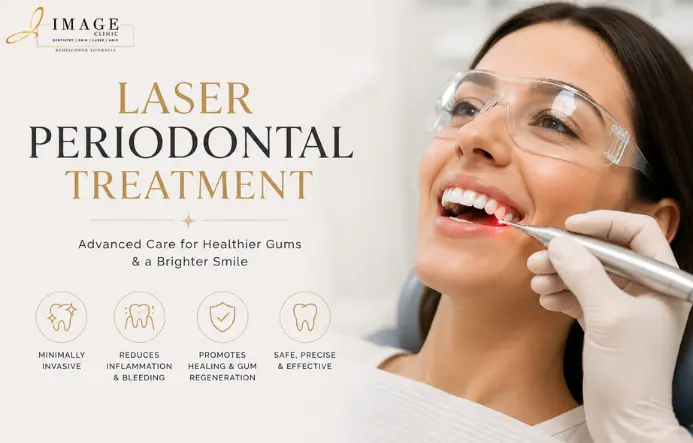
Laser periodontal treatment changes this calculus. At IMAGE Clinic in Kolkata, our periodontal surgery employs the Fotona Er: YAG and Nd: YAG laser system — the same internationally acclaimed platform trusted by leading periodontal clinics globally — to treat gum disease with a precision, comfort, and healing profile that traditional surgery cannot match.
| Concerned about your gum health? Our dental team will assess and explain your options. Book Your Periodontal Assessment at IMAGE Clinic |
Understanding Periodontal Disease: A Brief Clinical Overview
Periodontal disease (periodontitis) is a chronic inflammatory condition affecting the supporting structures of the teeth — the gums (gingiva), the periodontal ligament, and the alveolar bone. It begins as gingivitis (gum inflammation), which is fully reversible with professional cleaning. When left untreated, gingivitis progresses to periodontitis — where bacterial toxins trigger an immune response that destroys bone and connective tissue, creating deeper gum pockets that are increasingly difficult to clean.
The depth of gum pockets is the primary clinical measure of periodontal health. Healthy pockets are 1–3mm. Pockets of 4–5mm indicate early periodontitis; 6mm or deeper indicates moderate to severe disease with significant bone loss. Once bone is lost, it does not fully regenerate — making early intervention the most effective clinical strategy.
Key warning signs that warrant immediate periodontal assessment include bleeding gums when brushing or eating, persistent bad breath, gum recession (teeth appearing longer than before), loose or shifting teeth, and sensitivity at the gum margin.
Why Laser? The Clinical Case for Fotona in Periodontal Treatment
The Fotona dual-wavelength laser system — combining Er: YAG (2,940nm) and Nd: YAG (1,064nm) in a coordinated protocol — offers a compelling clinical alternative to conventional periodontal surgery for several specific reasons:
- Bactericidal precision: The Nd: YAG wavelength penetrates gum tissue and destroys periodontopathic bacteria within the gum pocket — bacteria that are the direct cause of the inflammatory destruction. The laser achieves bacterial reduction levels that mechanical scaling alone cannot match, particularly in deep pockets inaccessible to instruments.
- Diseased tissue removal: The Er: YAG wavelength selectively ablates infected and ulcerated soft tissue within the pocket while preserving the healthy tissue adjacent to it. This specificity is not achievable with scalpel techniques, which remove tissue indiscriminately.
- Root surface decontamination: The laser decontaminates the root surface of bacterial biofilm and endotoxins more thoroughly than hand or ultrasonic instrumentation, creating a biologically clean surface to which healthy gum tissue can reattach.
- Clot formation and healing enhancement: The laser promotes the formation of a stable fibrin clot within the treated pocket — providing the biological scaffold for new connective tissue attachment. This accelerates healing and supports the regenerative response.
- Minimal invasiveness: Unlike traditional flap surgery, which requires incisions, tissue reflection, and sutures, the Fotona laser protocol is delivered entirely through the gum tissue via a thin optical fibre — with no incisions and no sutures in most cases.
What to Expect: The Laser Periodontal Treatment Journey at IMAGE Clinic
Initial Assessment and Diagnosis
The treatment journey begins with a comprehensive periodontal assessment — including full-mouth pocket depth charting, clinical attachment level measurement, assessment of tooth mobility, and radiographic evaluation of alveolar bone levels. This data maps the full extent of the disease and guides the treatment protocol.
Treatment Planning
Based on the assessment, a personalised treatment plan is presented — specifying the number of sessions required, which areas are to be treated, and the specific laser protocol recommended. For mild to moderate periodontitis, two to four sessions are typical. Severe or extensive periodontitis may require more. Each session typically addresses one or two quadrants of the mouth.
Pre-Treatment Preparation
Prior to laser periodontal treatment, a thorough professional dental cleaning is performed to remove bulk calculus from all tooth surfaces. This reduces the bacterial load in the mouth and allows the laser to target the residual pathogenic bacteria in the deep pockets more effectively.
The Laser Treatment Session
Local anaesthetic is administered to ensure complete comfort. A thin optical fibre, inserted into the gum pocket, delivers the laser energy precisely within the pocket — decontaminating the root surface, ablating infected tissue, and stimulating the healing response. The procedure is performed systematically around each tooth in the treatment quadrant.
During the procedure, patients typically experience mild warmth and vibration — significantly less discomfort than conventional periodontal surgery. Most patients describe the experience as more comfortable than they anticipated.
Immediately After Treatment
There are no incisions and no sutures — the treated tissue is intact. Post-operative instructions include a soft diet for 24–48 hours, avoiding vigorous rinsing, and taking any prescribed antibiotics or antimicrobial mouth rinse as directed. Mild gum soreness for one to two days is normal and typically well-managed with standard analgesics.
Recovery and Reassessment
Healing occurs progressively over four to six weeks. At the six-week review appointment, pocket depths are re-measured to assess the treatment response. In well-responding cases, pocket depths decrease significantly as the gums reattach to the root surface and inflammation resolves. Further laser sessions may be recommended where deeper pockets persist.
| Don’t let gum disease progress. Our dental team can assess and treat it with precision laser technology. Book Your Periodontal Consultation |
| Traditional Periodontal Surgery | Fotona Laser Periodontal Treatment | |
| Incisions required | Yes | No |
| Sutures | Yes | Usually not required |
| Anaesthesia | Local injection | Local injection |
| Procedure time (per quadrant) | 45–90 minutes | 30–60 minutes |
| Post-op swelling | Significant (3–7 days) | Minimal (1–2 days) |
| Return to normal activity | 3–7 days | Same day or next day |
| Bactericidal effect | Indirect (mechanical only) | Direct (laser energy in pocket) |
| Tissue selectivity | Limited | High (laser spares healthy tissue) |
People Also Ask: Laser Periodontal Surgery in Kolkata
Is laser gum treatment painful?
Laser periodontal treatment is performed under local anaesthesia, ensuring the procedure itself is comfortable. Post-procedure soreness is typically mild and manageable with over-the-counter analgesics — significantly less than the discomfort associated with traditional surgical techniques.
How many laser periodontal sessions are needed?
The number of sessions depends on the extent and severity of gum disease. Mild to moderate periodontitis typically requires two to four sessions, treating one or two quadrants per visit. Severe or widespread disease may require more. Your treatment plan will be presented in full at the initial assessment.
Will my gums grow back after laser treatment?
Laser periodontal treatment reduces gum pockets by promoting reattachment of the gum tissue to the cleaned root surface — not by growing new gum tissue upward. In cases where gum recession is a concern alongside disease, additional procedures such as gum grafting may be discussed.
Can I prevent gum disease from returning after laser treatment?
Yes — with consistent maintenance. Following active laser treatment, regular professional dental cleanings every three to four months are essential to prevent disease recurrence. Meticulous daily oral hygiene and lifestyle modifications (such as smoking cessation) are equally important.
How do I book laser periodontal treatment in Kolkata at IMAGE Clinic?
Call IMAGE Clinic at 09830 836 666 or book online via our contact page. A comprehensive periodontal assessment will be conducted to determine whether laser treatment is indicated and to design your personalised treatment plan.
| Laser Periodontal Treatment in Kolkata — IMAGE ClinicAdvanced Fotona laser. Minimal discomfort. Lasting results. Book Your Appointment Now | Call: 09830 836 666 Or visit your nearest IMAGE Clinic — find your nearest branch here. |