Laser skin resurfacing has evolved significantly from the aggressive ablative procedures of the 1990s — which produced dramatic results but came with weeks of recovery and a significant risk of complications in darker skin tones. Today’s fractional laser systems deliver controlled, precise skin renewal with shorter recovery, greater safety for Indian skin, and outcomes that extend well beyond the surface-level improvements of most non-ablative treatments. The question is no longer whether laser resurfacing works — the clinical evidence is extensive — but whether it is the right treatment for your specific skin concerns, tone, and lifestyle.
This guide from IMAGE Clinic’s dermatologists in Kolkata breaks down the five most clinically significant benefits of laser skin resurfacing in Kolkata, who is most likely to benefit from each, and the honest answers to the questions patients ask most often before committing to the procedure.
| Find out if laser skin resurfacing is right for your skin. Book a consultation with our dermatologists at IMAGE Clinic. Book Your Laser Skin Resurfacing Consultation |
Understanding Laser Skin Resurfacing: Fractional vs Ablative
Before exploring the benefits, it is worth clarifying what modern laser skin resurfacing actually involves — since many patients arrive with preconceptions formed by older, more aggressive procedures.
Ablative resurfacing (CO2 or Er: YAG laser): Removes the entire epidermis and a controlled depth of dermis, stimulating complete skin regeneration. Highly effective for deep wrinkles, significant scarring, and advanced sun damage — but requires five to seven days of recovery and carries a higher risk of post-inflammatory hyperpigmentation (PIH) in darker skin tones.
Fractional resurfacing (fractional CO2 or fractional Er: YAG): Treats only a fraction of the skin surface in each session — creating thousands of micro-treatment zones surrounded by untreated tissue. The untreated columns provide a reservoir of cells for rapid healing, reducing recovery to two to four days while still delivering meaningful collagen stimulation and textural improvement. Fractional resurfacing is the preferred modality for Indian skin (Fitzpatrick types III–V) at IMAGE Clinic, as the reduced thermal load significantly lowers PIH risk.
A third category — Nd: YAG laser toning — is non-ablative and produces more gradual improvement with zero downtime, making it suitable for ongoing maintenance between resurfacing courses and for patients with mild concerns who do not require the more significant intervention of fractional treatment.
Important Read: Laser Skin Resurfacing in Kolkata: Your Expert Guide to Smoother, Younger-Looking Skin
Benefit 1: Significant Reduction in Acne Scars and Skin Texture Irregularities
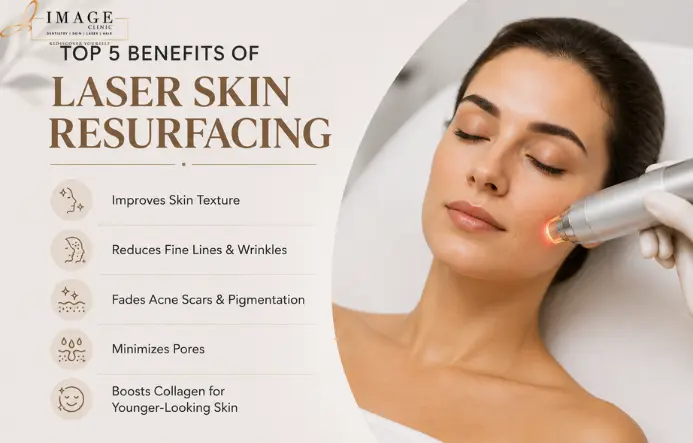
Atrophic acne scars — ice pick, boxcar, and rolling — represent one of the most common reasons patients seek laser skin resurfacing in Kolkata. The mechanism is well-established: fractional laser energy creates controlled micro-injury columns that penetrate to the scarred dermis. The healing response mobilises fibroblasts to lay down fresh collagen and elastin in place of the scar tissue — progressively filling and remodelling the scar architecture over three to six months following each session.
Clinical studies consistently demonstrate 40–70 per cent improvement in atrophic acne scars over three to five sessions of fractional CO2, with the degree of improvement correlating with the energy parameters used and the severity of the baseline scarring. Rolling and boxcar scars — which have broader, shallower architecture — respond more completely than ice-pick scars, which may require combination with subcision or TCA CROSS before laser resurfacing.
At IMAGE Clinic, acne scar resurfacing protocols are combined with MNRF treatment and PRP to maximise the regenerative response and accelerate the visible improvement — producing outcomes that neither treatment achieves in isolation.
Best suited for: Patients with moderate to severe atrophic acne scars who have completed active acne management and are committed to the two-to-four-day recovery period per session.
Benefit 2: Measurable Improvement in Fine Lines and Skin Laxity
One of the most consistent outcomes of fractional laser resurfacing is the stimulation of new collagen and elastin — the structural proteins that determine skin firmness, elasticity, and the depth of expression lines. As the skin ages and collagen degrades (accelerated by UV exposure, smoking, and pollution — all significant factors in Kolkata’s urban environment), fine lines deepen, and skin loses the structural resilience that keeps it appearing smooth and taut.
Fractional resurfacing reverses this degradation process in two ways: the ablation of aged surface tissue removes the wrinkled epidermis directly, and the thermal stimulus at the dermis drives fibroblast activation and new collagen synthesis over the following three to six months. The cumulative result — typically assessed at six months after the final session — is a measurable increase in dermal collagen density and a visible reduction in fine lines, particularly around the eyes, mouth, and forehead.
For patients concerned primarily with skin laxity rather than surface lines — particularly in the lower face and neck — HIFU treatment delivers focused ultrasound energy to the SMAS layer for structural lifting and is frequently combined with laser resurfacing for a comprehensive anti-ageing result that addresses both surface texture and structural laxity.
Best suited for: Patients in their 30s to 50s with fine to moderate lines, loss of skin firmness, and early photodamage.
| Acne scars, fine lines, or uneven texture? Our dermatologists will recommend the right laser approach for your skin. Book Your Consultation at IMAGE Clinic |
Benefit 3: Correction of Sun Damage, Pigmentation, and Uneven Skin Tone
Kolkata’s UV radiation — among the highest in India during the summer months — produces cumulative photodamage that manifests as uneven skin tone, brown patches, solar lentigines (sun spots), rough texture, and dullness. This photodamage accumulates in the epidermis and superficial dermis over years of UV exposure, often becoming visibly apparent from the late 20s onward.
Fractional resurfacing addresses photodamage through two mechanisms. The ablative component removes the damaged epidermal tissue — including the melanin deposits and dyspigmented cells that produce the uneven tone. The thermal stimulus drives collagen remodelling in the superficial dermis, replacing sun-damaged extracellular matrix with new, healthy collagen. The result is a more uniform skin tone, improved luminosity, and the elimination of discrete sun spots in most cases.
For patients with melasma — a chronic pigmentation condition that is aggravated rather than improved by aggressive laser treatment — fractional resurfacing is not the primary modality. The Cosmelan combination protocol combined with low-fluence laser toning is more appropriate. The distinction between photodamage and melasma is an important one that IMAGE Clinic’s dermatologists establish during the pre-treatment assessment.
Best suited for: Patients with sun spots, diffuse photodamage, uneven skin tone from UV exposure, and rough surface texture — particularly those aged 35 and above with significant cumulative UV exposure.
Benefit 4: Visible Improvement in Pore Size and Skin Texture
Enlarged pores — a near-universal complaint in Kolkata’s oily-skin population — are a structural consequence of increased sebum production, repeated follicular distension from comedones, and the gradual loss of the periorbital collagen that normally keeps the pore walls taut. Pores do not literally ‘open’ and ‘close’ — their visible size is determined by the structural integrity of the surrounding dermis.
Fractional laser resurfacing addresses enlarged pores through two mechanisms: the thermal collagen stimulus tightens the periorbital dermis, mechanically reducing the visible pore diameter; and the ablation of the superficial cornified layer removes the shadow effect of the pore opening that makes pores appear larger than they are. Patients consistently report visible pore size reduction alongside the primary outcomes of scar improvement or fine line reduction.
For patients whose primary concern is enlarged pores and oily skin texture — without the degree of scarring or photodamage that would indicate resurfacing — MNRF treatment or the carbon peel offer targeted pore-reduction benefits with lower downtime and lower cost per session.
Best suited for: Patients with visibly enlarged pores, oily skin texture, rough surface quality, and mild to moderate photodamage seeking a comprehensive textural improvement.
Benefit 5: Long-Lasting Results That Compound Over Time
Unlike many aesthetic treatments whose results are immediately visible and then gradually fade, laser skin resurfacing produces an initial improvement that continues to develop for three to six months after the final session — as the collagen remodelling response matures and the new collagen fibres integrate into the dermal architecture.
The longevity of fractional resurfacing results is also superior to many non-ablative treatments. The structural collagen produced in response to resurfacing is new, healthy collagen — not simply a temporary stimulation of existing collagen. With appropriate sun protection (SPF 50+ daily is non-negotiable for maintaining resurfacing results in Kolkata’s UV environment), the improvements in texture, tone, and scar appearance achieved through a course of fractional resurfacing are sustained for two to five years.
A maintenance protocol of one to two laser toning sessions per year and quarterly chemical peels or HydraFacial treatments extends the results further — preventing the accumulation of new photodamage and maintaining the textural improvements achieved through resurfacing.
Best suited for: Patients who want results that improve progressively over six months and are maintained with relatively minimal ongoing treatment investment.
Is Laser Skin Resurfacing Right for Your Skin? A Practical Guide
| Skin Concern | Recommended Approach | Caution |
| Moderate to severe acne scars | Fractional CO2, 3–5 sessions | Active acne must be controlled first |
| Fine lines and early laxity | Fractional CO2 or Er: YAG, 2–3 sessions | Avoid if pregnant or on isotretinoin |
| Sun spots and photodamage | Fractional CO2 or Q-switched laser | Not suitable for active melasma |
| Enlarged pores and oily texture | Fractional CO2 or MNRF | Carbon peel suitable for milder cases |
| Melasma | Laser toning (low-fluence only) | Avoid fractional CO2 — worsens melasma |
| Very dark skin (Fitzpatrick V–VI) | Fractional Er: YAG, conservative params | Higher PIH risk; dermatologist assessment essential |
People Also Ask: Laser Skin Resurfacing in Kolkata
What does laser resurfacing do for skin?
Short answer: Laser skin resurfacing removes damaged surface skin and stimulates new collagen production in the dermis. The ablative component eliminates wrinkled, pigmented, or scarred tissue from the surface; the thermal stimulus drives fibroblast activation, resulting in firmer, smoother, more evenly toned skin as the healing response matures over three to six months. Fractional laser resurfacing at IMAGE Clinic targets acne scars, photodamage, fine lines, enlarged pores, and uneven texture.
Is laser resurfacing painful?
Short answer: Laser resurfacing at IMAGE Clinic is performed with topical anaesthetic cream applied 45–60 minutes before the procedure, making the treatment tolerable for most patients. The sensation during treatment is typically described as mild heat or tingling. Post-procedure, the skin feels warm and sensitive for 24–48 hours — similar to a sunburn sensation. Most patients manage this comfortably with simple analgesics and cooling. Recovery from fractional resurfacing is two to four days of redness and mild swelling, reducing progressively.
How many sessions are needed for laser skin treatment?
Short answer: Session requirements depend on the concern and severity. Mild photodamage and surface texture issues often respond well in one to two sessions. Moderate acne scars typically require three to four sessions. Severe scarring may require four to six sessions. Sessions are spaced four to six weeks apart to allow complete healing between treatments. Your dermatologist at IMAGE Clinic will recommend the appropriate number of sessions after assessing your skin at the initial consultation.
What is the recovery time after laser resurfacing?
For fractional CO2 resurfacing, most patients experience two to four days of redness, mild swelling, and fine skin crusting that sheds progressively. Most patients return to work within three to five days with mineral make-up coverage. Full social confidence recovery is typically achieved by days five to seven. Healing is faster for lighter fractional passes and slower for more aggressive parameters — your IMAGE Clinic dermatologist will adjust the treatment parameters to match your available downtime.
Is laser resurfacing safe for Indian skin?
Fractional resurfacing is safe for Indian skin (Fitzpatrick types III–V) when performed by an experienced dermatologist using appropriate parameters. The primary risk in darker skin tones is post-inflammatory hyperpigmentation (PIH) — which is minimised at IMAGE Clinic through a pre-treatment priming protocol with topical depigmenting agents, conservative parameter selection, and mandatory post-procedure sun protection. The Er: YAG fractional laser has a lower PIH risk than CO2 in very dark skin tones and is selected accordingly for Fitzpatrick V–VI patients.
| Laser Skin Resurfacing in Kolkata — IMAGE ClinicClinically proven. Dermatologist-calibrated. Transformative results. Book Your Appointment Now | Call: 09830 836 666Or visit your nearest IMAGE Clinic — find your nearest branch here. |