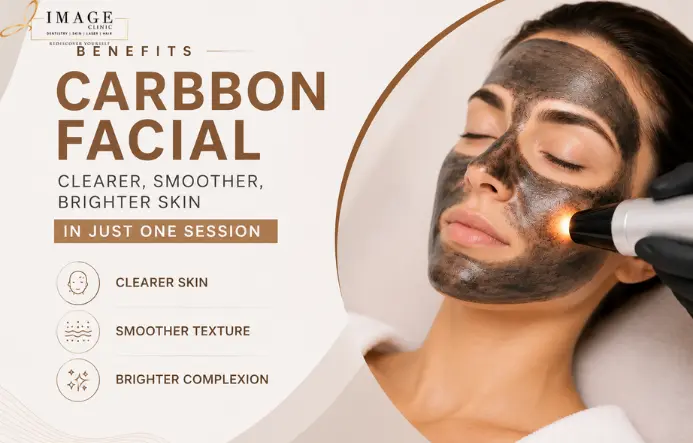
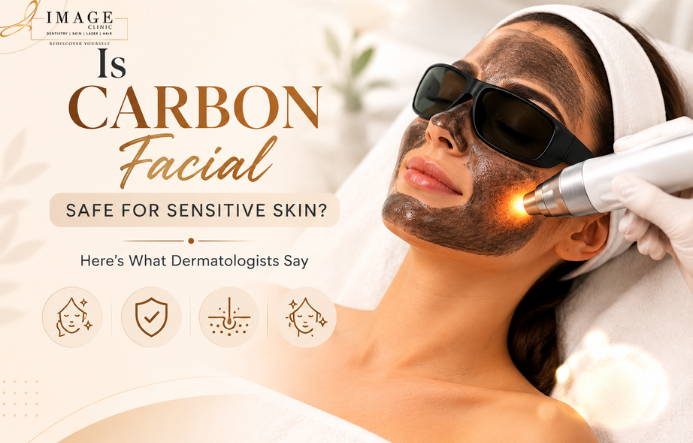
The carbon facial — also known as the Hollywood Peel or carbon laser peel — has gained a reputation as one of the most versatile and well-tolerated aesthetic treatments available. But for patients with sensitive or reactive skin, any procedure involving a laser gives pause: will it cause irritation? Will it trigger redness that lasts for days? Is it too aggressive for skin that reacts to almost everything?
The dermatologists at IMAGE Clinic address these concerns directly. Carbon laser peel treatment in Kolkata is one of the few aesthetic treatments that is genuinely well-tolerated by sensitive skin — not despite the laser component, but partly because of how the laser energy is delivered. This guide explains why, who is most likely to benefit, and what the treatment can and cannot achieve for reactive skin types.
| Sensitive skin and unsure if carbon facial is right for you? Our dermatologists will assess your skin before any treatment. Book Your Carbon Peel Consultation at IMAGE Clinic |
How the Carbon Laser Peel Works
Understanding why the carbon peel is safe for sensitive skin requires understanding exactly what happens during the procedure — because it is quite different from what most patients imagine.
- Carbon application: Liquid medical-grade carbon is applied evenly across the treatment area. The carbon particles are ultra-fine and penetrate into the upper portion of each pore, bonding with the oil, dead cells, and debris within the follicle.
- Laser pass 1 (carbon heating): A Q-switched Nd: YAG laser (1,064nm) makes a first pass over the skin at low fluence. The laser energy is selectively absorbed by the carbon particles, warming them and the contents of the pore — this phase delivers a mild thermal stimulus that gently exfoliates the follicle contents and stimulates the underlying dermis.
- Laser pass 2 (carbon vaporisation): A second, higher-energy pass vaporises the carbon particles explosively — taking with them the impurities to which they are bonded. This phase simultaneously deep-cleans the pore, destroys surface C. acnes bacteria, and delivers a controlled micro-exfoliation of the stratum corneum.
- Collagen stimulation: The thermal energy from both laser passes stimulates dermal fibroblasts, producing a mild but cumulative collagen-stimulating effect that improves skin quality, texture, and radiance over a series of treatments.
The critical safety feature for sensitive skin is the selectivity of the laser energy. Because the 1,064nm Nd: YAG wavelength is absorbed by the carbon — not directly by the skin — the surrounding tissue receives only indirect thermal stimulation. The epidermis and dermis are not directly ablated, and the melanocytes that are responsible for post-inflammatory pigmentation (PIH) receive far less direct energy than in ablative laser procedures.
Why the Carbon Peel Is Particularly Suitable for Sensitive Skin
Several specific properties of the carbon laser peel make it well-suited to reactive or sensitive skin types:
- No chemical acids: Unlike chemical peels, the carbon peel does not apply acidic solutions that can disrupt the skin barrier and trigger reactivity in sensitive skin. The exfoliation is purely laser-mediated via the carbon intermediary.
- No ablation of the epidermis: The laser does not remove or damage the epidermal layer — the skin surface remains intact. This is in contrast to fractional CO2 resurfacing, which creates actual micro-ablation zones and requires a recovery period.
- Anti-inflammatory effect: The Q-switched Nd: YAG wavelength has documented anti-inflammatory properties — reducing erythema and calming reactive skin rather than provoking it. Patients with rosacea-prone or chronically reactive skin often experience an improvement in their baseline redness over a series of carbon peel sessions.
- Zero downtime: The procedure produces no visible recovery period in most patients — mild warmth and transient redness resolve within one to two hours. This eliminates the extended inflammatory response that can provoke reactivity in sensitive skin.
- Adjustable parameters: The laser fluence and the number of passes can be adjusted for sensitive or reactive skin — a conservative approach still delivers meaningful results without the provocation that aggressive settings might cause.
At IMAGE Clinic, every patient’s skin is assessed for sensitivity and reactivity before the carbon peel is performed. For patients with very reactive skin, a test patch is applied before the first full session to confirm tolerance.
| Rosacea-prone, reactive, or sensitive skin? Find out how the carbon peel can work for you at IMAGE Clinic. Book Your Consultation at IMAGE Clinic |
What Conditions Does the Carbon Laser Peel Treat?
| Skin Concern | Carbon Peel Mechanism | Expected Improvement | Sessions Needed |
| Active acne (mild-moderate) | Deep pore cleansing + C. acnes destruction | 30–50% reduction in active lesions over 4–6 sessions | 4–6 sessions |
| Oily skin and enlarged pores | Sebum extraction + mild collagen tightening | Visible pore reduction; oil control for 2–3 weeks | Monthly maintenance |
| Dull or uneven complexion | Controlled exfoliation + collagen stimulation | Immediate brightening; cumulative glow over sessions | 1 session visible; 4–6 for sustained result |
| Sensitive/rosacea-prone skin | Anti-inflammatory laser + gentle exfoliation | Reduced background redness; calmer baseline skin | 4–6 sessions |
| Early fine lines | Mild collagen stimulation | Subtle progressive improvement | 6+ sessions |
| Post-acne pigmentation (mild PIH) | Exfoliation of pigmented surface cells | Mild improvement; best combined with laser toning | Combined protocol recommended |
Carbon Peel vs Other Options for Sensitive Skin: How It Compares
Patients with sensitive skin are often advised against chemical peels, ablative lasers, and aggressive microneedling — which narrows their treatment options considerably. The carbon peel occupies a valuable niche: it delivers meaningful results (oil control, brightening, anti-acne effect) without the risks that other treatments carry for reactive skin.
- Carbon peel vs chemical peel: Chemical peels carry a higher irritation risk for sensitive skin — particularly at the concentrations needed for clinical efficacy. The carbon peel achieves comparable oil control and surface exfoliation without acid exposure.
- Carbon peel vs HydraFacial: HydraFacial is also well-tolerated by sensitive skin and delivers excellent hydration and extraction. For patients with primarily oily, acne-prone skin, the carbon peel’s oil-control and anti-bacterial effects are more targeted; for patients with sensitive-but-dry or dehydrated skin, HydraFacial may be preferred.
- Carbon peel vs fractional CO2: Fractional CO2 laser creates actual micro-ablation zones and requires two to four days of recovery — making it significantly more aggressive than the carbon peel. For sensitive skin, fractional CO2 is not appropriate without careful selection and conservative parameters. The carbon peel is the more appropriate first-line laser option for reactive skin.
People Also Ask: Carbon Laser Peel in Kolkata
What is a carbon laser peel good for?
Short answer: The carbon laser peel is most effective for oily and acne-prone skin (oil control, pore cleansing, C. acnes reduction), dull or congested complexions (surface brightening), and sensitive or rosacea-prone skin (anti-inflammatory laser effect). It is a versatile maintenance treatment with zero downtime — suitable for monthly use as part of an ongoing skin management programme. Book a consultation to confirm whether the carbon peel addresses your specific concerns.
Is carbon peel safe for sensitive skin?
Short answer: Yes — the carbon laser peel is one of the most sensitive-skin-appropriate aesthetic treatments available. The laser energy is absorbed by the carbon particles rather than directly by the skin, the epidermis is not ablated, and the Nd: YAG 1,064nm wavelength has anti-inflammatory properties. There is no acid exposure, no downtime, and no extended inflammatory response — all of which make it safer for reactive skin than most equivalent treatments. A skin assessment at IMAGE Clinic confirms individual suitability before treatment.
How long do the results of carbon peeling last?
Short answer: The immediate results — oil reduction, pore clarity, surface brightening — last two to four weeks before sebum production returns to baseline. With monthly maintenance sessions, the results are sustained continuously. The cumulative benefits — progressive improvement in skin texture, reduced background redness, and mild collagen stimulation — develop and persist over a course of four to six sessions. Most patients notice others commenting on their skin improvement by sessions three to four.
How is a carbon peel different from other laser treatments?
The carbon peel is non-ablative — it does not remove or damage the skin surface. Unlike fractional CO2 or Er: YAG lasers, which create micro-ablation zones requiring recovery, the carbon peel leaves the epidermis completely intact. Unlike laser toning alone (which targets melanin for pigmentation treatment), the carbon peel addresses oil, pores, and bacteria simultaneously. It occupies the ‘maintenance and mild improvement’ category of laser treatments — not a corrective procedure for significant scarring or deep pigmentation, but an excellent monthly treatment for ongoing skin quality management.
Can I have a carbon peel if I have rosacea?
Rosacea requires careful assessment before any laser or energy-based treatment. The Q-switched Nd: YAG laser used in the carbon peel has anti-inflammatory and vascular-calming properties at the parameters used — and is generally well-tolerated by rosacea patients. However, any laser on rosacea-prone skin should be performed by a dermatologist experienced in treating reactive skin, at conservative parameters, with a test patch. At IMAGE Clinic, all rosacea patients undergo a pre-treatment assessment before their first carbon peel session.
| Carbon Laser Peel in Kolkata — IMAGE ClinicSensitive-skin safe. Zero downtime. Dermatologist-assessed. Book Your Appointment Now | Call: 09830 836 666 Or visit your nearest IMAGE Clinic — find your nearest branch here. |