
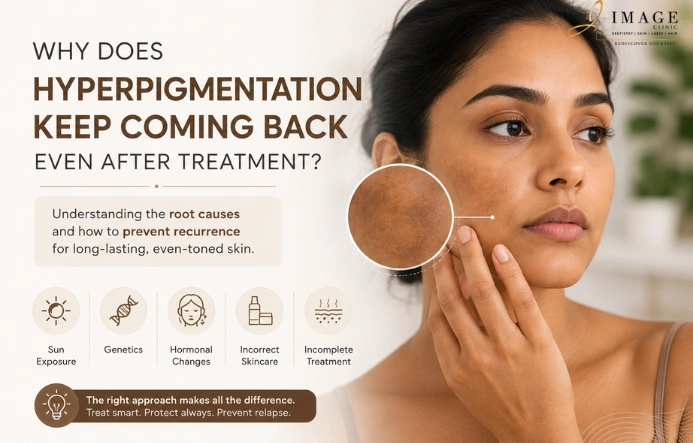
It is one of the most frustrating experiences in dermatology: you complete a course of hyperpigmentation treatment in Kolkata, achieve a visible improvement that you are genuinely pleased with, maintain the result for a few months — and then watch the pigmentation gradually reappear. The dark patches are back. The treatment has apparently failed. Except it has not failed. Understanding why hyperpigmentation returns is as clinically important as understanding how to treat it — because recurrence is not a sign that the treatment did not work. It is a sign that the biology driving the pigmentation was never fully addressed.
This guide explains the specific biological mechanisms behind hyperpigmentation recurrence, identifies which pigmentation types are most prone to it, and outlines the maintenance framework that IMAGE Clinic’s dermatologists design for each patient to extend results and prevent the cycle of treatment and relapse.
| Tired of pigmentation returning? Our dermatologists will design a maintenance plan that actually holds.Book Your Pigmentation Review at IMAGE Clinic |
The Biology of Recurrence: Why Pigmentation Returns
Reason 1: The Melanocytes Were Never Permanently Changed
The most fundamental reason hyperpigmentation recurs is that successful treatment clears the existing melanin deposits — but does not permanently alter the melanocytes that produced them. Melanocytes are long-lived cells that remain in the skin for decades. Their tendency to over-produce melanin in response to UV, inflammation, and hormonal signals is genetically determined and cannot be eliminated by any currently available treatment.
Think of it this way: laser toning and chemical peels clear the accumulated pigment — the product of excessive melanocyte activity. But the melanocytes themselves remain, with the same genetic predisposition to overreact to stimuli. Remove the stimulus (UV exposure, inflammation, hormonal fluctuation) and the pigmentation stays away. Reintroduce the stimulus, and the melanocytes produce new pigment. The treatment removes the consequence; it does not change the cause.
Reason 2: UV Exposure Was Not Adequately Controlled
Ultraviolet radiation is the most potent known stimulus for melanocyte activation. In Kolkata, with UV radiation at its most intense between March and September, a patient who achieves excellent pigmentation clearance in winter through laser and peel treatment can see significant recurrence within eight to twelve weeks of summer beginning — particularly if their daily sun protection is inconsistent.
This is not a treatment failure. The treatment achieved what it was designed to do: clear existing melanin deposits. UV exposure then stimulated the melanocytes to produce new deposits. SPF 50+ applied every morning — and reapplied every two to three hours during outdoor exposure — is not an optional supplement to hyperpigmentation treatment. It is the primary recurrence-prevention intervention, and without it, no in-clinic treatment can maintain its results through a Kolkata summer.
Reason 3: Melasma Was Undertreated or Hormonally Unstimulated
Melasma is the most recurrence-prone pigmentation condition because it has multiple overlapping drivers — UV, oestrogen, progesterone, thyroid hormones, and chronic skin inflammation. Even when treatment achieves excellent clearance, any one of these drivers can reactivate the melanocytes in the melasma-prone areas. Patients who are on oral contraceptives, experience hormonal fluctuations around the menstrual cycle, or have unmanaged thyroid dysfunction will typically see melasma return more rapidly after treatment than those whose hormonal environment is stable.
The appropriate management for melasma recognises this explicitly: it is not a condition to be treated to clearance and then forgotten. It is a condition to be managed long-term with a maintenance protocol that includes daily SPF, topical maintenance cream (Cosmelan 2 or equivalent), periodic low-fluence laser sessions, and hormonal assessment where indicated.
Reason 4: The Treatment Course Was Incomplete
Post-inflammatory hyperpigmentation (PIH) from acne — one of the most common pigmentation presentations at IMAGE Clinic in Kolkata — tends to recur when the underlying acne is not fully controlled alongside the pigmentation treatment. Every new inflammatory acne lesion that heals produces new PIH, regardless of how many laser toning sessions have been completed. A treatment plan that addresses the PIH without simultaneously managing the active acne is inherently incomplete, and recurrence is predictable.
The correct approach treats both simultaneously — prescription topical management for active acne running concurrently with laser or peel treatment for existing PIH. This prevents new marks from forming while existing ones are being cleared.
Reason 5: Maintenance Was Discontinued Too Early
A common pattern at IMAGE Clinic is patients who complete their initial treatment course, achieve good results, discontinue their maintenance topicals and SPF, and present again six months later with recurrence. The maintenance phase of hyperpigmentation treatment in Kolkata is not optional — it is the phase that sustains the results of the active treatment. Topical depigmenting agents (azelaic acid, niacinamide, kojic acid) used daily suppress ongoing melanocyte activity. Without this daily suppression, the melanocytes gradually resume their baseline overproduction.
| Has your pigmentation returned? Our dermatologists will assess why and redesign your maintenance protocol. Book Your Pigmentation Consultation at IMAGE Clinic |
Which Pigmentation Types Are Most Prone to Recurrence?
| Pigmentation Type | Recurrence Risk | Primary Recurrence Driver | Maintenance Required |
| Melasma | Very High | UV + hormonal stimulation | Ongoing — Cosmelan cream, SPF, periodic laser |
| Post-inflammatory hyperpigmentation (PIH) | Moderate–High | New inflammatory triggers (active acne) | Acne control + daily SPF + topical agents |
| Freckles | High | UV reactivation — genetic | Strict SPF; seasonal laser maintenance |
| Solar lentigines (sun spots) | Low–Moderate | Cumulative UV | Daily SPF; annual maintenance session |
| Diffuse photo-damage and tan | Moderate | Kolkata summer UV accumulation | Seasonal laser + daily SPF year-round |
The Maintenance Framework That Prevents Recurrence
Prevention of hyperpigmentation recurrence is not about one intervention — it is about a layered system that addresses multiple recurrence drivers simultaneously. IMAGE Clinic’s maintenance framework has four layers:
- Daily SPF 50+: The single most effective recurrence-prevention measure. Broad-spectrum SPF 50+ applied every morning, regardless of weather or season. In Kolkata’s UV environment, this is clinical prescription, not lifestyle advice.
- Topical maintenance: Dermatologist-prescribed depigmenting agents — azelaic acid, kojic acid, niacinamide, and cyclically prescribed hydroquinone where indicated — applied daily to maintain the melanocyte suppression achieved during the active treatment course.
- Periodic in-clinic maintenance sessions: One laser toning session or chemical peel every two to three months prevents the re-accumulation of new melanin deposits before they become established. These are shorter, lower-intensity sessions than the active treatment course — a maintenance dose rather than a therapeutic dose.
- Underlying cause management: For patients with hormonal drivers (PCOS, thyroid dysfunction, contraceptive-related melasma), addressing the hormonal environment significantly extends the duration of results. For patients with active acne producing new PIH, controlling the acne is as important as treating the pigmentation.
People Also Ask: Hyperpigmentation Treatment in Kolkata
Why does hyperpigmentation come back after treatment?
Short answer: Hyperpigmentation recurs because treatment clears existing melanin deposits but does not permanently alter the melanocytes that produced them. The melanocytes remain genetically predisposed to over-respond to UV, inflammation, and hormonal stimuli. Without ongoing maintenance — daily SPF, topical depigmenting agents, and periodic in-clinic sessions — the same triggers that produced the original hyperpigmentation will progressively restimulate melanin production.
How do I prevent pigmentation from recurring?
Short answer: Four measures prevent hyperpigmentation recurrence: daily broad-spectrum SPF 50+ (the most important single intervention); dermatologist-prescribed topical depigmenting agents applied daily; periodic maintenance laser or peel sessions every two to three months; and management of underlying drivers such as active acne or hormonal imbalance. Without all four layers, recurrence is not a question of if — it is a question of when.
Does melasma always come back after treatment?
Short answer: Melasma is a chronic condition that requires ongoing management rather than a one-time cure. With a rigorous maintenance protocol — daily SPF 50+, Cosmelan maintenance cream, periodic low-fluence laser sessions, and hormonal assessment where relevant — many patients sustain excellent long-term control. Without maintenance, melasma typically begins returning within three to six months of completing active melasma treatment in Kolkata’s high-UV environment.
What is the best long-term treatment for hyperpigmentation?
Short answer: The most effective long-term approach to hyperpigmentation treatment in Kolkata is a layered maintenance protocol: active in-clinic treatment (laser toning or Cosmelan) to achieve initial clearance, followed by daily SPF 50+, daily topical depigmenting agents, and maintenance laser or peel sessions every two to three months. For patients with melasma or hormonal PIH, addressing the underlying hormonal environment is equally essential.
How long should I continue hyperpigmentation treatment?
Short answer: The active treatment course typically lasts three to six months, depending on pigmentation type and severity. The maintenance phase continues indefinitely — though at significantly lower intensity. For most patients, daily SPF and topical maintenance are lifelong habits; in-clinic maintenance sessions are every two to three months for the first year, then reduced to quarterly or biannually for stable patients. View IMAGE Clinic’s documented results to see long-term outcomes.
| Hyperpigmentation Treatment in Kolkata — IMAGE ClinicRecurrence addressed. Maintenance designed. Lasting skin clarity. Book Your Appointment Now | Call: 09830 836 666 Or visit your nearest IMAGE Clinic — find your nearest branch here. |