
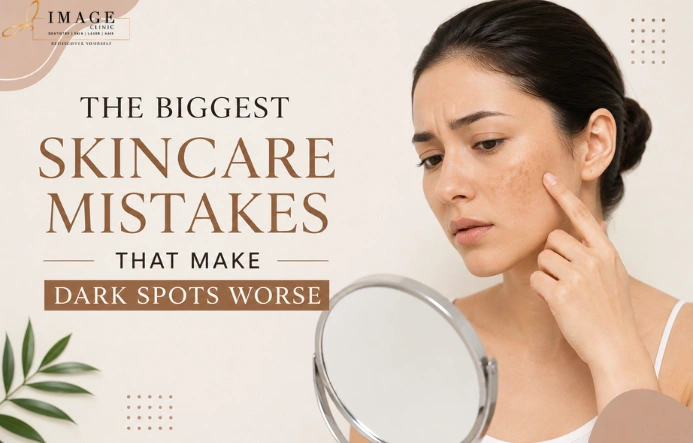
Most people dealing with dark spots in Kolkata are not doing nothing. They are actively trying — applying serums, following advice from friends and social media, buying ‘brightening’ products, and attempting various remedies. The problem is that several of the most commonly taken actions for dark spot removal are not just ineffective. They are actively counterproductive, making the pigmentation darker, more widespread, or more resistant to subsequent treatment. Understanding which approaches worsen dark spots is as important as knowing which ones work.
This guide, from the dermatologists at IMAGE Clinic in Kolkata, identifies the nine most clinically significant skincare mistakes that worsen dark spots — explaining the specific biological mechanism behind each one, and what to do instead for effective dark spot removal in Kolkata.
| Spending money on dark spot products that aren’t working? Get a clinical assessment at IMAGE Clinic. Book Your Dark Spot Consultation at IMAGE Clinic |
IMAGE Clinic, Kolkata: About This Guide
IMAGE Clinic is a dermatologist-led aesthetic and skin clinic across Kolkata, West Bengal. Our dermatologists treat dark spots, pigmentation, post-acne marks, and under-eye dark circles daily — and the mistakes described in this guide are the ones we see most consistently in patients who arrive having already tried multiple approaches without success. Read why patients choose IMAGE Clinic for expert skin guidance.
Mistake 1: Skipping Sunscreen
This is the most consequential skincare mistake for dark spots, and the most common. UV radiation from the sun is the most potent melanocyte activator known. Every day that an existing dark spot is exposed to UV, the melanocytes in that area produce additional melanin — making the spot darker and more resistant to treatment. Every evening serum, brightening cream, and in-clinic procedure is being undermined if sunscreen is not applied rigorously every morning.
In Kolkata, where UV radiation is at its most intense from March through September, the daily UV load on unprotected skin is among the highest in India. A broad-spectrum SPF 50+ applied every morning — and reapplied after two to three hours of outdoor exposure — is not a cosmetic choice. It is the single most important intervention for dark spot removal, more impactful than any serum or treatment.
Mistake 2: Using Lemon Juice Directly on Skin
Lemon juice is the most widely recommended home remedy for dark spots across India — and one of the most reliably counterproductive. The rationale is that citric acid (an alpha-hydroxy acid) will exfoliate the pigmented skin, and vitamin C will brighten it. The reality is more complicated.
Lemon juice is highly acidic (pH 2–3) and photosensitising. Applied to the skin and then exposed to sun — which is inevitable in Kolkata — it triggers a phytophotodermatitis reaction that can produce burns, chemical irritation, and severe post-inflammatory hyperpigmentation. This PIH from lemon-juice-induced irritation is often significantly darker than the original dark spots it was meant to treat. Patients who present at IMAGE Clinic with ‘pigmentation that got worse when I tried a home remedy’ are frequently describing this exact outcome.
Mistake 3: Over-Exfoliating
Exfoliation removes the dead cell layer and can accelerate the shedding of pigmented surface cells — which is why it has a genuine, evidence-based role in a pigmentation management plan. The mistake is overdoing it. Daily physical scrubbing or multiple AHA/BHA products used simultaneously creates repeated micro-trauma to the skin surface. In Indian skin, this micro-trauma reliably triggers post-inflammatory pigmentation as the melanocytes respond to the inflammatory stimulus.
The safe exfoliation frequency for Indian skin, particularly in the context of dark spot treatment, is one to two times per week with a gentle AHA formulation at appropriate concentrations. Scrubs — particularly those with large granules — should be avoided entirely on areas with active dark spots, as the mechanical friction creates exactly the inflammatory stimulus that produces new PIH.
Mistake 4: Discontinuing Treatment Too Early
Pigmentation treatment — whether laser toning, chemical peels, or topical depigmenting agents — works gradually, over months. The most common mistake is discontinuing treatment after two to four weeks because results are not yet visible, and concluding that the treatment does not work. For most dark spot treatments, visible results begin appearing from weeks four to eight. Retinoids in particular are notorious for appearing to produce no change — or even a temporary worsening — in the first four to six weeks, before their true depigmenting and cell-turnover effects become apparent.
Patients who complete a full course of treatment — six to eight weeks of topical therapy, or four to six in-clinic sessions — consistently achieve significantly better outcomes than those who discontinue at the first sign of slow progress.
Mistake 5: Using Too Many Active Products Simultaneously
Social media skin care culture has created a tendency to layer multiple active ingredients — vitamin C, niacinamide, retinol, glycolic acid, kojic acid, and various others — in complex routines. For dark spots specifically, this polypharmacy approach creates two problems. First, some combinations are chemically incompatible and reduce each other’s efficacy (vitamin C and niacinamide at certain formulations; retinol and AHAs at the same time). Second, multiple actives simultaneously increase the risk of skin irritation — and irritation in Indian skin reliably produces new PIH.
A dermatologist-prescribed protocol for dark spot removal typically involves two to three targeted actives at appropriate concentrations, sequenced correctly in the routine. This is significantly more effective than a six-product layering approach that introduces irritation and ingredient incompatibility.
| Get a dermatologist-prescribed dark spot protocol — no guesswork, no counterproductive mistakes. Book Your Skin Assessment at IMAGE Clinic |
Mistake 6: Treating Only the Dark Spots and Not the Cause
Dark spots are a symptom, not a diagnosis. Post-inflammatory hyperpigmentation from acne will keep returning every time a new acne lesion heals — regardless of how many dark spot serums are applied to the existing marks — if the underlying acne is not controlled. Melasma will recur with every summer if UV exposure is not managed. Acne scars and PIH require different treatments — serums that improve PIH will not address textural scarring.
Treating only the visible dark spots without addressing the condition producing them is the single most common reason dark spot removal efforts plateau. IMAGE Clinic’s approach diagnoses the underlying cause before prescribing treatment — so that the intervention addresses the mechanism, not just the appearance.
Mistake 7: Applying Products to Inflamed or Broken Skin
Applying brightening products — even gentle, well-formulated ones — to inflamed, broken, or actively irritated skin creates the exact inflammatory stimulus that triggers PIH in Indian skin. Patients who apply AHA serums, vitamin C, or chemical exfoliants over active breakouts, open spots, or recently picked skin consistently worsen their dark spot outcomes. The skin barrier must be intact, and inflammation must be resolved before active brightening ingredients are introduced.
Mistake 8: Ignoring the Under-Eye Area
Dark spots on the face are often accompanied by or confused with periorbital darkening — the dark circles and discolouration around the eye area. These are caused by completely different mechanisms (vascular, pigmentation, structural hollowing, or skin laxity) and require their own targeted assessment. Many patients apply general brightening products to the under-eye area and experience irritation or lack of response because the product is mismatched to the cause. Dedicated dark circle treatment — including tear-trough assessment, EyeRevive peel, or PRP for periorbital skin — is the appropriate clinical approach for the under-eye area.
Mistake 9: Assuming All Dark Spots Respond the Same Way
Sun spots, post-acne PIH, melasma, and freckles all appear as ‘dark spots’ — but each responds to completely different treatments. A patient using a melasma-targeting product on solar lentigines will see limited results, and vice versa. Hyperpigmentation treatment at IMAGE Clinic always begins with diagnosing the specific type of dark spot before prescribing treatment. A Wood’s lamp examination and dermoscopy identify epidermal versus dermal pigmentation, confirming the appropriate treatment modality and realistic expectations.
People Also Ask: Dark Spot Removal in Kolkata
What makes dark spots worse?
Short answer: The most common things that worsen dark spots are: skipping daily SPF 50+ (UV is the most potent melanocyte activator); using lemon juice or other irritants that trigger post-inflammatory pigmentation; over-exfoliating; discontinuing treatment too early; and layering too many active products simultaneously, causing skin irritation. In Kolkata’s high-UV environment, unprotected sun exposure is the most reliably counterproductive behaviour for anyone treating dark spots.
Does sun exposure worsen dark spots during treatment?
Short answer: Yes — significantly. UV radiation directly stimulates the melanocytes responsible for dark spot production. During any dark spot removal treatment course, UV exposure between sessions undoes treatment progress — melanocytes produce new melanin faster than the treatment clears existing deposits. SPF 50+ every morning, reapplied during outdoor exposure, is the non-negotiable foundation of any dark spot treatment plan in Kolkata.
Can wrong skincare products cause more pigmentation?
Short answer: Yes. Products that cause skin irritation — aggressive scrubs, incompatible active combinations, direct lemon juice application, or any product applied to inflamed or broken skin — trigger post-inflammatory hyperpigmentation in Indian skin. PIH from product-induced irritation is often darker than the original dark spots. A dermatologist-prescribed protocol avoids these interactions and selects actives at concentrations appropriate for your skin type.
Is exfoliating good or bad for dark spots?
Short answer: Gentle exfoliation — once or twice weekly with a formulated AHA product at appropriate concentrations — supports dark spot fading by accelerating cell turnover and removing the pigmented surface layer. Aggressive exfoliation (daily scrubbing, multiple AHAs simultaneously, high-concentration at-home peels) causes the micro-trauma and irritation that produces new PIH in Indian skin, making dark spots worse. Less frequent, well-formulated exfoliation is significantly more effective than intensive approaches.
What are the most common mistakes with dark spot treatment?
Short answer: The most impactful mistakes are: not using SPF daily; using counterproductive home remedies (especially lemon juice); treating dark spots without addressing the underlying cause (active acne for PIH; UV for photo-damage); discontinuing treatment before visible results appear; and using multiple active products that cause irritation. IMAGE Clinic’s dermatologists assess which mistake pattern is limiting your results and correct the protocol accordingly. Book your consultation here.
| Dark Spot Removal in Kolkata — IMAGE Clinic Stop the mistakes. Start the right protocol. See the difference. Book Your Appointment Now | Call: 09830 836 666 Or visit your nearest IMAGE Clinic — find your nearest branch here. |