
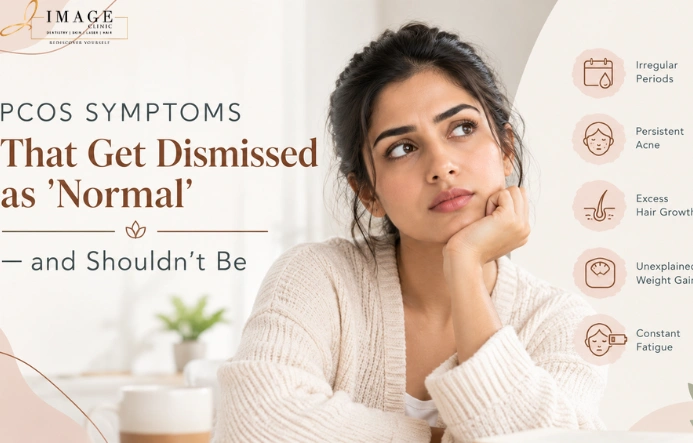
Polycystic ovary syndrome (PCOS) is one of the most common hormonal conditions affecting women of reproductive age in India — estimated to affect between 20 and 25 per cent of Indian women, significantly higher than the global average. Despite its prevalence, PCOS treatment in Kolkata is frequently delayed — not because the condition is undetectable, but because its most common symptoms are consistently dismissed as ‘normal’ by both patients and, in some cases, by physicians who attribute them to stress, lifestyle, or simply ‘being that way’. This guide from IMAGE Clinic’s specialists identifies the symptoms that most commonly get dismissed — and explains why each warrants clinical assessment rather than normalisation.
| Concerned about PCOS symptoms? Book a clinical assessment at IMAGE Clinic, Kolkata. Book Your PCOS Assessment at IMAGE Clinic |
What PCOS Actually Is
PCOS is a complex endocrine disorder characterised by a combination of hormonal imbalance (elevated androgens, abnormal LH/FSH ratio), ovarian dysfunction (irregular or absent ovulation), and often — though not always — the presence of multiple small follicles on the ovaries visible on ultrasound. The diagnosis requires two of three criteria (the Rotterdam criteria): irregular ovulation, elevated androgens (clinical or biochemical), and polycystic ovarian morphology on ultrasound. A patient does not need all three.
The hormonal imbalance of PCOS — particularly androgen excess — drives a wide range of symptoms that affect the skin, hair, weight, mood, and reproductive function simultaneously. The multi-system nature of PCOS is why its symptoms are so often attributed to different causes rather than correctly identified as expressions of a single underlying condition.
Symptoms That Are Dismissed as ‘Normal’ — and What They Actually Signal
Irregular Periods — ‘Lots of women have this’
Irregular cycles — fewer than eight periods per year, cycles longer than thirty-five days, or highly unpredictable timing — are the most classic PCOS symptom and the one most commonly normalised. ‘My cycle has always been irregular’ is not a normal variation — it is irregular ovulation, which is the most common hormonal cause of female subfertility and a central diagnostic criterion for PCOS.
A menstrual cycle should occur every twenty-one to thirty-five days. Cycles outside this range, or cycles that vary by more than seven days in duration month to month, indicate anovulatory cycles or luteal phase defects that warrant investigation. Irregular periods are not a personality trait — they are a hormonal signal.
Acne on the Lower Face and Jawline — ‘I’ve always had oily skin’
The distribution and quality of PCOS-associated acne is clinically distinct from standard bacterial acne: deep, painful nodules and cysts along the lower face, jawline, and chin; persistently present in the late twenties and thirties rather than the teenage years; worsening before menstruation; and failing to respond adequately to standard topical acne treatments. This pattern is characteristic of androgen-driven acne — and in women with concurrent irregular periods or excess facial hair, it is a strong indicator of PCOS that warrants hormonal assessment rather than another prescription of antibiotics.
Hair Loss — ‘My mother had thin hair too’
Female pattern hair loss — diffuse thinning at the crown and temples, with maintained frontal hairline — is androgenetic alopecia driven by elevated androgens and DHT sensitivity of the hair follicles. This is one of the most distressing PCOS symptoms and one of the most frequently attributed to ‘genetics’ or ‘stress’ rather than correctly identified as hormonal. In a woman with concurrent irregular periods and acne, diffuse hair thinning is almost certainly part of the same androgen-excess syndrome — and treating the acne without addressing the androgens will not prevent progressive hair loss.
Important Read: HIFU Treatment in Siliguri – Image Clinic
Excess Facial or Body Hair — ‘I’m just naturally hairy’
Hirsutism — clinically defined as coarse, dark hair growth in androgen-dependent areas (upper lip, chin, sideburns, chest, lower abdomen, inner thighs) in women — is caused by androgen excess at the follicular level. The Ferriman-Gallwey score quantifies its severity. In India, cultural normalisation of body hair in women delays recognition of hirsutism as a medical symptom. ‘I have always had facial hair’ is not a normal female presentation — in the presence of other PCOS symptoms, it is clinical evidence of androgen excess.
Weight Gain That Doesn’t Respond to Diet — ‘I just can’t lose weight’
PCOS is associated with insulin resistance in 50–70 per cent of cases — the cells of the body (particularly muscle and fat) become less responsive to insulin, requiring the pancreas to produce more insulin to maintain normal blood glucose. Elevated insulin directly stimulates androgen production from the ovaries — creating a cycle where insulin resistance worsens PCOS, which worsens insulin resistance. This metabolic loop makes weight gain rapid and weight loss extremely difficult with standard caloric restriction. Women with PCOS-associated weight gain require metabolic assessment and insulin-sensitising treatment alongside dietary modification — not simply more dieting.
Mood Changes and Anxiety — ‘I’m just anxious by nature’
Hormonal dysregulation affects neurotransmitter function — elevated androgens, altered oestrogen and progesterone ratios, and chronic low-grade inflammation all contribute to increased rates of anxiety, depression, and mood instability in women with PCOS. These are not character traits; they are measurable neurobiological consequences of hormonal imbalance. Treating the psychological symptoms in isolation without addressing the underlying PCOS misses the primary driver.
| Do several of these symptoms describe your experience? Book a PCOS assessment at IMAGE Clinic, Kolkata. Book Your PCOS Consultation at IMAGE Clinic |
Why Early Diagnosis Matters
PCOS has long-term health implications that extend beyond the reproductive years. Women with PCOS have a significantly elevated risk of Type 2 diabetes (from insulin resistance), cardiovascular disease (from metabolic syndrome), and endometrial cancer (from chronic anovulation without progesterone opposition). Early PCOS diagnosis and treatment in Kolkata at IMAGE Clinic — addressing insulin resistance, hormonal imbalance, and the metabolic components of the syndrome — significantly reduces these long-term risks.
IMAGE Clinic’s PCOS wellness programme integrates dermatological management of the skin and hair symptoms, hormonal assessment and treatment, metabolic evaluation (insulin resistance, lipid profile, thyroid), and nutritional guidance — addressing the full multi-system picture of PCOS rather than treating individual symptoms in isolation.
People Also Ask: PCOS Treatment in Kolkata
What are the most common symptoms of PCOS?
Short answer: The most common PCOS symptoms are: irregular or absent menstrual periods; acne on the lower face and jawline (androgen-driven); diffuse hair thinning or hair loss; excess facial or body hair (hirsutism); weight gain resistant to standard diet; and difficulty conceiving (anovulatory infertility). In India, several of these are normalised as ‘just the way I am’ — but two or more of these symptoms together warrant a clinical PCOS assessment in Kolkata.
How is PCOS diagnosed?
Short answer: PCOS is diagnosed using the Rotterdam criteria — the presence of two of three: irregular ovulation (evidenced by irregular cycles); elevated androgens (blood test showing elevated testosterone or DHEAS, or clinical hirsutism/acne); and polycystic ovarian morphology on pelvic ultrasound. At IMAGE Clinic, the hormonal assessment includes LH/FSH ratio, testosterone, DHEAS, insulin levels, thyroid function, and prolactin — providing a complete hormonal picture.
Can PCOS cause hair loss?
Short answer: Yes — androgenetic alopecia (female pattern hair loss) driven by elevated androgens and DHT sensitivity of the hair follicles is a common PCOS symptom. It presents as diffuse thinning at the crown and temples, distinct from the round bald patches of alopecia areata. PCOS treatment that addresses the androgen excess — anti-androgenic medication, insulin sensitisers — slows the hair loss and can improve density over six to twelve months.
Can PCOS be cured?
Short answer: PCOS cannot be permanently cured — it is a chronic condition requiring ongoing management. However, its symptoms and long-term risks are significantly controlled with appropriate treatment. IMAGE Clinic’s PCOS wellness programme achieves meaningful improvement in cycle regularity, acne, hair loss, and weight in most patients with consistent management. Lifestyle modification (diet, exercise, stress management) alongside medical treatment produces the best long-term outcomes.
Is PCOS linked to skin problems?
Short answer: Yes — the skin manifestations of PCOS are among its most visible symptoms. Androgen-driven acne on the lower face and jawline, androgenetic hair loss, hirsutism (excess facial/body hair), and acanthosis nigricans (dark, velvety skin at the neck and underarms from insulin resistance) are all PCOS-associated skin findings. IMAGE Clinic’s integrated approach treats the skin symptoms clinically — acne treatment, hair loss treatment — while addressing the hormonal root cause simultaneously.
| PCOS Treatment in Kolkata — IMAGE Clinic Early diagnosis. Integrated management. Multi-symptom control. Book Your Appointment Now | Call: 09830 836 666 Or visit your nearest IMAGE Clinic — find your nearest branch here. |