
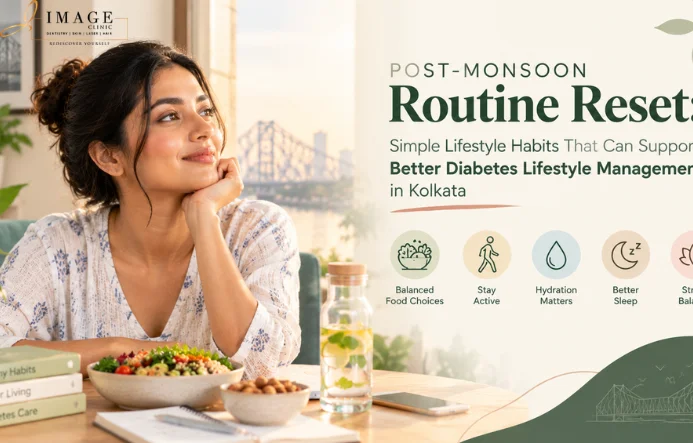
October is a natural reset point for diabetes lifestyle management in Kolkata — and a clinically significant one. The festival season has just ended: three to four weeks of disrupted meal timing, significantly higher carbohydrate and sweet intake than usual, reduced exercise due to late nights and altered schedules, and elevated cortisol from the physical and social demands of Durga Puja and Dussehra. For most Kolkata residents, these factors produce a temporary worsening of blood glucose control that shows up in the post-festival HbA1c as a modest elevation. For people with diabetes or pre-diabetes, this worsening is more significant — and the weeks immediately after the festival season are the most effective window for a structured lifestyle reset that restores control before end-of-year professional demands add a second wave of stress.
This guide from IMAGE Clinic — Kolkata’s specialist in diabetes lifestyle management and metabolic health — explains the specific lifestyle habits that have the most evidence-supported impact on blood glucose control, and how to build them into an October reset that carries through to the new year.
| Book your post-festival diabetes lifestyle consultation at IMAGE Clinic, Kolkata. Book Your Diabetes Lifestyle Consultation |
IMAGE Clinic — Diabetes Lifestyle Management in Kolkata
IMAGE Clinic’s diabetes and pre-diabetes programme provides medically supervised diabetes lifestyle management in Kolkata — integrating metabolic assessment, clinical nutritional guidance, and structured lifestyle intervention. The programme is designed for patients who want to manage their diabetes with the best possible lifestyle foundation alongside their medication, and for pre-diabetic patients who want to prevent progression through clinical support. Explore why patients choose IMAGE Clinic for metabolic health in Kolkata.
Why the Post-Monsoon Period Matters for Blood Sugar Control
Several well-documented mechanisms connect the festival season to temporary blood glucose deterioration in people with diabetes or pre-diabetes:
- Dietary carbohydrate load: The festive diet — mishti doi, sandesh, pitha, biryani, pulao, and the sustained high-carbohydrate intake of community meals — produces a significantly higher glycaemic load than the baseline diet. Even a few weeks of elevated carbohydrate intake produces measurable HbA1c elevation in people with impaired glucose metabolism.
- Meal timing disruption: Irregular meal times — the extended morning fasting of puja days followed by large afternoon meals, the late dinner of pandal-hopping nights — disrupt the insulin secretion patterns and incretin hormone rhythms that support stable glucose control. Regular meal timing is one of the most evidence-supported non-pharmacological tools for blood glucose management, and its disruption during the festival season has a direct metabolic cost.
- Exercise reduction: The late nights and social schedule of Durga Puja and Dussehra typically reduce structured exercise to near-zero for two to three weeks. Exercise acutely lowers blood glucose through GLUT-4 transporter activation in muscle cells (glucose uptake into muscle without insulin requirement), and chronically improves insulin sensitivity. A two-to-three-week exercise break produces measurable insulin sensitivity reduction.
- Stress and cortisol elevation: Cortisol is directly anti-insulin — it promotes hepatic glucose production and reduces peripheral glucose uptake. The sustained cortisol elevation of the festival season’s excitement, disrupted sleep, and social demands directly elevates blood glucose through mechanisms independent of diet.
The October Lifestyle Reset: What Diabetes Lifestyle Management in Kolkata Should Include
1. Re-establish Meal Timing Before Changing Meal Content
The first and highest-impact step in an October diabetes lifestyle reset in Kolkata is not changing what you eat — it is restoring when you eat. Three meals at consistent times each day — within a one-hour window of the same time daily — restores the circadian metabolic rhythm that was disrupted by the festival season. This alone produces measurable blood glucose improvement within two weeks, independent of any change in food composition. IMAGE Clinic’s medical nutrition team structures the meal timing recommendations based on the patient’s medication schedule, work routine, and social context — making the consistency achievable rather than aspirational.
2. Reduce the Glycaemic Load Progressively
Rather than an abrupt post-festival dietary reversal that is difficult to sustain, IMAGE Clinic recommends a progressive glycaemic load reduction over two to three weeks: replacing one high-glycaemic food per day with a lower-glycaemic alternative (white rice reduced by 25 per cent, replaced with vegetables or dal; refined flour roti replaced with multigrain; sweet chai replaced with plain chai) until the overall glycaemic load has returned to the pre-festival baseline. This progressive approach is more sustainable than a strict post-festival diet that typically lasts days before normal eating resumes.
3. Restart Exercise with the 10-Minute Walk Protocol
The most effective and most accessible exercise intervention for diabetes lifestyle management in Kolkata is a ten-minute walk after each meal — producing a post-meal glucose-lowering effect (reduced postprandial spike) that is comparable to a short-acting medication in multiple studies. Three ten-minute walks per day — after breakfast, lunch, and dinner — are significantly more effective for blood glucose management than one thirty-minute walk per day because they directly address the three major glucose exposure windows of the day. Starting with ten minutes per walk makes the restart achievable in October when exercise routines have lapsed through the festival period.
4. Prioritise Sleep Quality and Duration
Sleep deprivation and poor sleep quality directly impair insulin sensitivity — a single night of four to five hours of sleep produces insulin resistance equivalent to several kilograms of weight gain in metabolic studies. After the late nights of the festival season, restoring seven to eight hours of sleep per night is a clinically impactful step in blood glucose management, not merely a lifestyle preference. IMAGE Clinic’s sleep and stress diagnostics programme assesses sleep quality objectively for patients whose diabetes control is consistently poor despite good diet and exercise — because undetected sleep apnoea is a significant, underappreciated driver of insulin resistance.
5. Manage Cortisol With Structured Stress Reduction
The post-festival period carries its own stress load: the return to normal work after the Puja break, the professional pressure of the end-of-year quarter, and the adjustment from celebration-mode to routine. For patients with diabetes, this cortisol elevation directly translates to blood glucose elevation that no dietary adjustment can fully counteract. Structured daily stress reduction — twenty minutes of meditation, breathing exercises, or yoga — produces measurable cortisol reduction and improved insulin sensitivity over four to six weeks of consistent practice.
6. Schedule Your Post-Festival HbA1c
For patients with diabetes, a post-festival HbA1c check in October — six to eight weeks after the festival period’s glycaemic disruption — provides the objective data needed to calibrate the lifestyle reset. A modest elevation of 0.3–0.5 per cent from the pre-festival baseline is expected and addressable with the lifestyle measures above. An elevation greater than 0.5 per cent may indicate that medication adjustment is also needed. IMAGE Clinic’s metabolic panel testing provides a comprehensive post-festival metabolic review — HbA1c, fasting glucose, fasting insulin, and lipid panel — giving a complete picture of the metabolic impact of the festival season and guiding the targeted reset.
| Book your post-festival diabetes metabolic review at IMAGE Clinic. Reset your control before the year ends. Book Your Diabetes Metabolic Review |
The Clinical Support That Diabetes Lifestyle Management in Kolkata Provides
Lifestyle change is more effective — and more sustained — when it is clinically supported rather than self-directed. IMAGE Clinic’s diabetes lifestyle management programme provides: personalised meal plans based on metabolic testing; structured exercise protocols calibrated to fitness level; blood glucose monitoring interpretation; medication adjustment recommendations when lifestyle measures are insufficient; and the weight management support that addresses the weight gain that commonly accompanies the festival season’s dietary disruption.
People Also Ask: Diabetes Lifestyle Management in Kolkata
What lifestyle habits most help with diabetes management?
Short answer: The most evidence-supported lifestyle habits for diabetes lifestyle management in Kolkata are: consistent meal timing (same time daily); a ten-minute walk after each meal (directly reduces post-meal glucose spikes); seven to eight hours of sleep (sleep deprivation worsens insulin resistance measurably); daily stress reduction practice (cortisol directly elevates blood glucose); and progressive reduction of glycaemic load from the diet. Sustained, modest lifestyle change consistently outperforms dramatic short-term dietary restriction.
How does the festival season affect blood sugar?
Short answer: Durga Puja and Dussehra affect blood glucose through four mechanisms: high carbohydrate and sweet intake elevating glycaemic load; irregular meal timing disrupting insulin rhythm; reduced exercise from late nights and altered schedules; and sustained cortisol elevation from excitement and sleep disruption. All four directly worsen blood glucose control. An October diabetes lifestyle reset at IMAGE Clinic in Kolkata systematically addresses all four.
Can exercise alone control blood sugar without medication?
Short answer: Exercise is among the most powerful non-pharmacological interventions for diabetes lifestyle management — particularly structured post-meal walking, which produces post-prandial glucose reduction comparable to short-acting medication. For pre-diabetes, lifestyle intervention including regular exercise reduces progression to Type 2 diabetes by up to 58 per cent (Diabetes Prevention Programme). For established Type 2 diabetes, exercise combined with dietary management often reduces medication requirements — but whether it can eliminate medication depends on the degree of pancreatic beta-cell function remaining.
How does sleep affect blood sugar levels?
Short answer: Sleep deprivation impairs insulin sensitivity through multiple mechanisms: reduced GLUT-4 transporter activity in muscle; elevated cortisol from insufficient sleep driving hepatic glucose output; and increased ghrelin (hunger hormone) promoting overeating of high-glycaemic foods. A single night of short sleep produces a measurable blood glucose elevation the following day. Chronic poor sleep is one of the most underappreciated drivers of poor diabetes control — assessed at IMAGE Clinic’s sleep and stress diagnostics programme.
When should someone with diabetes see a specialist in Kolkata?
Short answer: People with diabetes should seek specialist diabetes lifestyle management in Kolkata when: HbA1c is above 7 per cent despite current medication and lifestyle; blood glucose is consistently elevated in the morning (dawn phenomenon or Somogyi effect may need assessment); weight gain is making glucose control progressively harder; lifestyle changes alone have not produced adequate pre-diabetes management; or medication side effects are affecting quality of life. IMAGE Clinic’s metabolic team provides integrated clinical support across all these scenarios.
| Diabetes Lifestyle Management in Kolkata — IMAGE Clinic Clinically supported habits. Measurably better control. Long-term metabolic health. Book Your Appointment Now | Call: 09830 836 666 Or visit your nearest IMAGE Clinic — find your nearest branch here. |