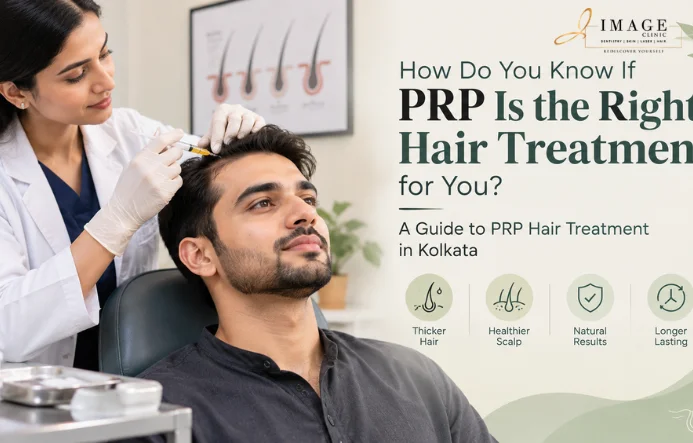
PRP hair treatment in Kolkata is one of the most searched hair loss solutions in the city — and one of the most inconsistently applied. The problem is not with the treatment itself, which has genuine, well-documented clinical evidence for specific types of hair loss. The problem is that PRP hair treatment in Kolkata is sometimes recommended for hair loss presentations where it cannot produce meaningful results — either because the hair loss type does not respond to PRP, or because the stage of loss has advanced beyond what PRP can reverse. Patients who receive PRP for the wrong indication, or at the wrong stage, complete three to four sessions and conclude that PRP does not work — when the more accurate conclusion is that PRP was not right for their specific presentation.
This guide from IMAGE Clinic’s hair specialists addresses the candidacy question directly: which hair loss presentations respond to PRP hair treatment in Kolkata, which do not, what to expect at each stage, and the questions worth asking before committing to a course of treatment.
| Find out whether PRP hair treatment in Kolkata is right for your specific hair loss. Book your assessment at IMAGE Clinic. Book Your PRP Hair Assessment at IMAGE Clinic |
IMAGE Clinic — PRP Hair Treatment in Kolkata
IMAGE Clinic’s PRP hair treatment programme uses activated, concentrated platelet-rich plasma prepared from the patient’s own blood — centrifuged to a minimum platelet concentration of 1.5 million per microlitre — injected into the scalp at follicle depth using a standardised multi-point injection technique. All PRP hair treatment sessions are performed by qualified medical professionals under dermatologist supervision, preceded by a trichoscopic assessment that confirms the hair loss diagnosis and stage before treatment is recommended. The IMAGE Clinic team will not recommend PRP where the clinical assessment indicates it is unlikely to produce meaningful benefit.
How PRP Hair Treatment Works
Platelet-rich plasma (PRP) is prepared by drawing a small volume of the patient’s blood, centrifuging it to separate and concentrate the platelet fraction, and activating the platelets to release their growth factor payload. The growth factors in PRP — including platelet-derived growth factor (PDGF), vascular endothelial growth factor (VEGF), transforming growth factor-beta (TGF-β), and insulin-like growth factor (IGF-1) — directly stimulate the cells involved in hair growth when injected at scalp depth:
- Dermal papilla cells: The specialised cells at the base of the hair follicle that regulate hair cycling. PRP growth factors stimulate dermal papilla proliferation and signalling — extending the anagen (growth) phase and delaying the transition to telogen (rest and shedding).
- Follicular stem cells: Quiescent stem cells in the follicle bulge region that initiate each new anagen cycle. PRP growth factors activate these stem cells, increasing the proportion of follicles actively cycling at any given time.
- Scalp vascularity: VEGF drives new capillary formation in the scalp — improving blood supply to the follicles and the nutrient and oxygen delivery that determines follicle health and hair shaft quality.
The cumulative effect over a three-to-four-session course is: reduced daily shedding (as more follicles remain in anagen); increased hair density as previously dormant follicles reactivate; and improved hair shaft calibre as the follicle environment becomes more supportive. These changes develop progressively — visible from session three onward, with maximum effect at three to six months after the final session.
Important Read: PRP Therapy for Hair: Is It the Secret to Stronger, Thicker Hair?
Who Responds Best to PRP Hair Treatment in Kolkata
Ideal Candidates
The following presentations consistently produce the best outcomes from PRP hair treatment in Kolkata at IMAGE Clinic:
- Early to moderate androgenetic alopecia (Norwood I–III in men; Ludwig I–II in women): The most common indication for PRP. Follicles that are in the early stages of miniaturisation — producing progressively finer, shorter hairs — have sufficient viable follicle tissue to respond to PRP’s growth factor stimulation. The follicle is weakened but functional; PRP provides the biological support needed to maintain and partially reverse the miniaturisation process. Results are visible and clinically meaningful.
- Telogen effluvium (including post-monsoon and post-festival shedding): Telogen effluvium — excessive shedding from physiological stress, nutritional deficiency, hormonal change, or illness — produces a scalp where the follicles are intact, but an abnormally high proportion have entered the resting phase simultaneously. PRP growth factors stimulate these resting follicles back into anagen, accelerating the spontaneous recovery that would occur over twelve to eighteen months and reducing its severity.
- PCOS-associated androgenetic hair loss (early stage): Women with PCOS-driven androgenetic hair loss who are concurrently managing the hormonal component benefit from PRP as the local follicle-stimulating intervention alongside systemic anti-androgen treatment. PRP alone — without hormonal management — produces limited results in PCOS hair loss because the ongoing androgen excess continues to miniaturise the follicles that PRP is attempting to support.
- Alopecia areata (patchy hair loss — mild to moderate): PRP has demonstrated meaningful response in patchy alopecia areata — the autoimmune condition producing round areas of complete hair loss — particularly in mild to moderate presentations. The growth factor stimulation from PRP appears to modulate the local immune environment in the affected patches, encouraging follicle reactivation. Severe alopecia totalis (complete scalp loss) is less reliably responsive.
| Image Clinic’s hair specialists confirm candidacy before recommending PRP. Book your trichoscopic assessment. Book Your Hair Loss Assessment at IMAGE Clinic |
Who Is NOT the Right Candidate for PRP Hair Treatment
Understanding who PRP hair treatment in Kolkata cannot help is as important as knowing who it can. The following presentations are unlikely to produce meaningful PRP results — and a reputable clinic should identify these at the trichoscopic assessment rather than proceeding with treatment:
| Presentation | Why PRP Is Unlikely to Help | Better Alternative |
| Advanced androgenetic alopecia (Norwood V–VII / Ludwig III) | Follicles have permanently miniaturised or are absent — no viable follicle tissue for PRP growth factors to stimulate | Hair transplant — the only intervention that addresses permanent follicle loss |
| Scarring alopecias (lichen planopilaris, frontal fibrosing alopecia) | The follicle has been destroyed and replaced with scar tissue — no regenerative target for PRP | Dermatology management for the inflammatory condition; no hair restoration is possible in scarred areas |
| Pure nutritional telogen effluvium (without follicle compromise) | The follicles are intact and will recover with nutritional correction — PRP adds benefit but is not essential | Nutritional assessment and correction; monitoring |
| Anagen effluvium (chemotherapy-induced hair loss) | The mechanism is direct follicle toxicity — different from the androgenetic/telogen effluvium targets of PRP | Supportive care; spontaneous recovery after treatment ends |
| Male pattern baldness in the fully bald zone | No follicles present — nothing for PRP to stimulate | Hair transplant into the bald zone from donor follicles |
The Questions to Ask Before Starting PRP Hair Treatment in Kolkata
Before committing to a course of PRP hair treatment in Kolkata, these are the questions worth asking at your consultation — and worth evaluating the quality of the answers you receive:
- What type of hair loss do I have, and has it been confirmed by trichoscopy? PRP candidacy is determined by the hair loss diagnosis — and that diagnosis requires trichoscopic examination (dermoscopy of the scalp) to identify the follicle miniaturisation pattern, the follicle density, and the hair loss type. A clinic that recommends PRP without this assessment has not established your candidacy.
- What stage of hair loss am I at? Early to moderate androgenetic alopecia (Norwood I–III, Ludwig I–II) responds well. Advanced stages do not. Your clinic should be able to tell you your Norwood or Ludwig grade.
- What platelet concentration does your PRP preparation achieve? Effective PRP for hair loss requires a minimum platelet concentration of approximately 1.5 million platelets per microlitre — at least four to six times the baseline blood concentration. Low-concentration PRP produces poor results. Ask for the preparation protocol.
- How many sessions are typically needed, and how will we assess whether it is working? A transparent clinic will tell you: three to four sessions is the standard course; results should be visible from session three onward; and the assessment criteria (reduced daily shedding, new baby hair growth at the hairline, trichoscopic density measurement) should be specified at the start.
- Are there concurrent treatments I should be combining with PRP? For androgenetic alopecia, PRP is most effective when combined with topical minoxidil and — in women — with hormonal management where indicated. A clinic that presents PRP as a standalone complete solution for androgenetic alopecia is not giving you the full clinical picture.
What to Expect from PRP Hair Treatment in Kolkata: A Realistic Timeline
| Timepoint | What Is Happening | What You May Notice |
| Sessions 1–2 (Weeks 1–4) | Growth factor stimulation initiated; follicle stem cells activated; angiogenesis beginning | Reduced daily shedding in some patients; no visible density change yet |
| Session 3 (Week 8–12) | Follicles returning to anagen; new hair shaft growth beginning | Fine baby hairs appearing at hairline and parting; existing hairs appear slightly thicker |
| 1 Month post-final session | New anagen hairs reaching visible length | Visible improvement in density and coverage; hair calibre improved |
| 3 Months post-final session | Maximum response period — new collagen and new vascularity established | Peak visible improvement; density and thickness at maximum for this course |
| 6 Months post-final session | Results maintenance; gradual return of baseline miniaturisation | Maintenance session required to sustain results |
View documented PRP hair treatment results at IMAGE Clinic for reference outcomes across different hair loss presentations, stages, and patient profiles. For patients whose assessment confirms advanced androgenetic alopecia beyond PRP’s effective range, IMAGE Clinic’s hair transplant programme and comprehensive hair loss treatment options are discussed at the same consultation — ensuring every patient leaves with an accurate picture of the options available for their specific presentation. The HydraFacial Keravive scalp treatment is recommended as an adjunct to PRP for patients with scalp health concerns — addressing the follicle environment alongside the direct growth factor stimulation of PRP.
People Also Ask: PRP Hair Treatment in Kolkata
Is PRP effective for all types of hair loss?
Short answer: No — PRP hair treatment in Kolkata is most effective for early to moderate androgenetic alopecia (genetic hair thinning) and telogen effluvium (shedding from stress, nutrition, or hormonal change). It is less effective for advanced androgenetic alopecia where follicles have permanently miniaturised, and ineffective for scarring alopecias where follicles have been destroyed. A trichoscopic assessment at IMAGE Clinic establishes which type and stage of hair loss is present before PRP is recommended.
How many PRP sessions are needed for hair loss?
Short answer: A standard PRP hair treatment course in Kolkata at IMAGE Clinic consists of three to four sessions spaced four weeks apart. This spacing allows each growth factor stimulus to drive the follicle cycling response fully before the next session. Results are visible from session three onward, with maximum improvement at three months after the final session. Maintenance sessions every six to twelve months are required to sustain the results as the androgenetic miniaturisation continues in the background.
Does PRP actually regrow hair?
Short answer: In appropriate candidates — early to moderate androgenetic alopecia and telogen effluvium — PRP hair treatment produces genuine, measurable hair regrowth: new baby hairs at the hairline and parting, increased overall density on trichoscopic measurement, and improved hair shaft calibre. It does not restore hair in follicles that have been permanently miniaturised or destroyed. The regrowth is from existing follicles that have been reactivated — not from new follicle creation.
Is PRP hair treatment painful?
Short answer: PRP hair treatment in Kolkata at IMAGE Clinic is performed with topical anaesthetic cream applied forty-five minutes before the injections — significantly reducing the injection discomfort. Most patients describe the treated scalp as feeling warm and mildly tender during the session, with a mild scalp soreness for twenty-four to forty-eight hours after. Neither the session nor the recovery period is considered significantly painful by the majority of patients. No sedation or oral anaesthetic is required.
Can PRP be combined with other hair loss treatments?
Short answer: Yes — PRP hair treatment in Kolkata is most effective when combined with topical minoxidil (which stimulates follicle blood flow and anagen prolongation through a different mechanism), hormonal management for PCOS-driven loss, and nutritional correction for deficiency-driven telogen effluvium. The HydraFacial Keravive scalp treatment at IMAGE Clinic is a recommended adjunct — addressing scalp health and follicle environment alongside the direct growth factor stimulation of PRP.
| PRP Hair Treatment in Kolkata — IMAGE Clinic Right diagnosis. Right candidate. Real hair restoration. Book Your Appointment Now | Call: 09830 836 666 Or visit your nearest IMAGE Clinic — find your nearest branch here. |