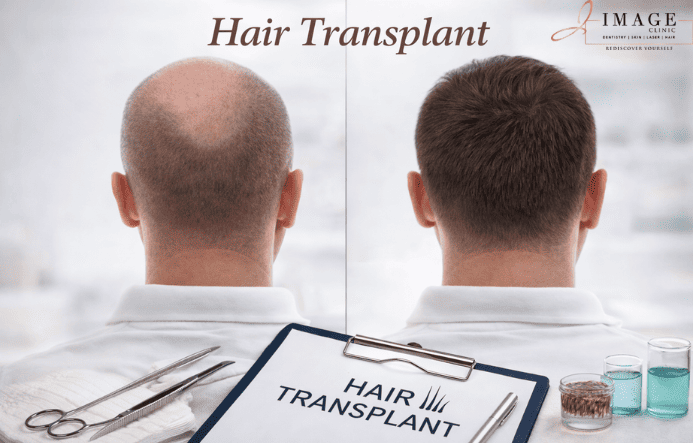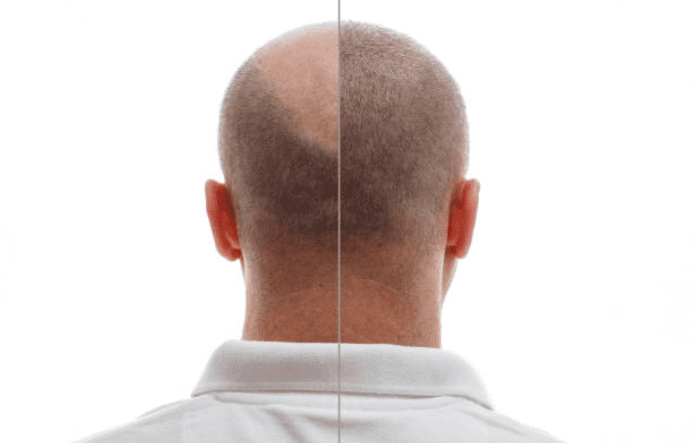

The most common question asked by patients considering a hair transplant is not about technique, cost, or recovery — it is this: am I the right age? The question matters because hair transplant outcomes are significantly influenced by the patient’s age at the time of surgery, the stage of hair loss, and — most importantly — how the loss is likely to progress in the years following the procedure. Getting the timing right is as important as choosing the right surgeon.
This guide from IMAGE Clinic’s hair transplant team in Kolkata explains how age intersects with hair loss progression, what the risks of transplanting too early are, when it is genuinely the right time to proceed, and how hair transplant in Kolkata at IMAGE Clinic is planned around each patient’s individual hair loss trajectory rather than a fixed age recommendation.
| Considering a hair transplant but unsure about the timing? Our hair restoration specialists will assess your specific pattern. Book Your Hair Transplant Consultation at IMAGE Clinic |
Understanding Why Age Matters in Hair Transplant Surgery
Hair transplant surgery moves follicles from the permanent donor zone (the back and sides of the scalp, which are genetically resistant to DHT-induced miniaturisation) to areas of thinning or baldness. These transplanted follicles maintain the genetic characteristics of the donor area — they do not miniaturise or fall. However, the native follicles in the recipient area that were not transplanted continue to follow their natural hair loss progression.
This is the central challenge: a hair transplant performed at an early age restores hair to areas that are thinning now — but cannot predict or prevent the loss of surrounding native hair in the years that follow. If the transplant is planned without accounting for future loss, the patient may end up with an unnatural distribution of hair — transplanted follicles surrounded by progressively bare areas that require additional surgery to address.
At IMAGE Clinic, every hair transplant consultation includes a detailed assessment of hair loss pattern, family history, and rate of progression — to design a transplant plan that will look natural not just immediately after surgery but at every stage of the patient’s life.
Hair Transplant by Age Group: What the Evidence Shows
Hair Transplant in Your 20s: Proceed with Significant Caution
Patients in their 20s presenting with hair loss are almost always in the early stages of androgenetic alopecia (male or female pattern hair loss) — and critically, the final extent of their hair loss is unknown. A 24-year-old presenting with a Norwood Stage 3 pattern may stabilise there or may progress to Norwood Stage 6 by the age of 40.
Transplanting too early and too aggressively into the frontal hairline creates a specific long-term problem: the transplanted hairline remains, but the mid-scalp and vertex continue to thin around it — producing a bizarre frontal island of hair that looks increasingly unnatural as the surrounding native hair recedes. Correcting this requires additional procedures, and the donor supply is finite.
This does not mean a 20-something should never have a hair transplant — but it means the threshold for intervention must be higher. Prerequisites include: a documented stable hair loss pattern over at least two years (confirmed by serial photography and trichoscopy), the patient being on medical hair loss management (PRP therapy, finasteride, or minoxidil as appropriate) with good compliance, and a conservative transplant design that preserves donor supply for future procedures.
Hair Transplant in Your 30s: Often the Optimal Window
For most patients, the 30s represent the optimal window for hair transplant surgery. By this stage, the hair loss pattern has typically been established and documented for several years — the rate of progression is understood, the likely final Norwood stage can be reasonably estimated, and the patient is stable enough for a transplant plan with a realistic long-term outlook.
Patients in their 30s typically have adequate donor density, a clearly defined area of loss to address, and sufficient maturity to make an informed, long-term decision about the procedure. Medical management of ongoing hair loss with finasteride or minoxidil — continued after surgery — protects the native hair surrounding the transplanted area, maximising the longevity of the surgical result.
At IMAGE Clinic, patients in their 30s with a documented stable loss pattern are assessed as strong candidates for FUE (Follicular Unit Extraction) — the gold-standard technique that harvests individual follicular units without a linear scar. Our hair transplant team designs the hairline and recipient area density based on both the current presentation and the projected future loss pattern, ensuring a result that remains natural as the patient ages.
Hair Transplant in Your 40s and 50s: High Predictability, Excellent Outcomes
Patients in their 40s and 50s often present with higher-grade hair loss — Norwood Stages 4 to 6 — but with one significant advantage: the progression of their hair loss has slowed or stabilised, making the transplant plan highly predictable. The final distribution of hair loss is largely known, allowing the surgeon to design a comprehensive restoration without the uncertainty of unknown future progression.
The main consideration in this age group is donor density — whether sufficient donor follicles remain to achieve the desired coverage. A thorough trichoscopic assessment of the donor area at IMAGE Clinic evaluates follicle density, calibre, and health before any transplant is planned. In patients with very extensive loss (Norwood Stage 6–7), managing expectations around coverage and density is an important part of the consultation — a complete restoration to Norwood Stage 1 is not possible with transplant surgery alone, but a dramatic improvement in apparent density can almost always be achieved.
Hair Transplant in Your 60s and Beyond: Yes, If Clinically Appropriate
There is no upper age limit for hair transplant surgery — chronological age is less relevant than the patient’s overall health status, the quality of the donor area, and realistic expectations. Many patients in their 60s and beyond achieve excellent results, with the key advantages of a fully stabilised hair loss pattern and clear donor-recipient planning. Medical evaluation before surgery is thorough to ensure suitability.
| Your age is just one factor. Our hair transplant specialists will assess your full picture before recommending a timeline. Book Your Hair Transplant Assessment |
The IMAGE Clinic Hair Transplant Process: From Assessment to Result
- Initial Consultation: Detailed history, family hair loss assessment, trichoscopy of donor and recipient areas, and scalp photography. The hair loss pattern is graded (Norwood for men, Ludwig for women), and the likely progression trajectory is discussed.
- Medical Management Review: Any existing medical hair loss management is reviewed. For patients not on treatment, appropriate options are discussed — since post-operative medical management of native hair significantly improves transplant longevity.
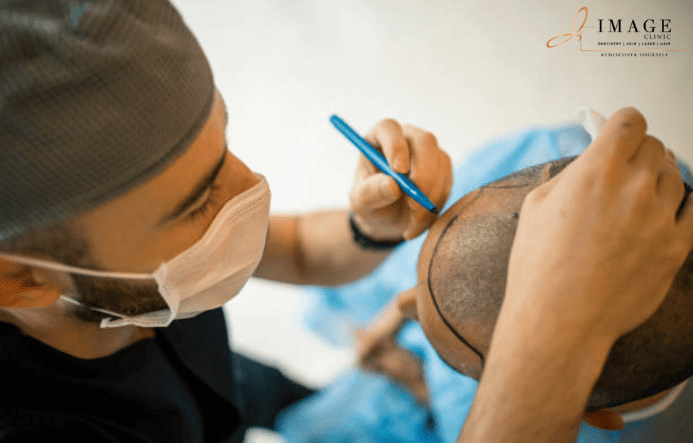
- Transplant Design: Hairline design and recipient area density are mapped, accounting for both current and projected future loss. The donor area is assessed for yield capacity, and the number of grafts required versus available is calculated.
- FUE Procedure: Performed under local anaesthesia as a day procedure. Individual follicular units are extracted from the donor area using a micro-punch system and transplanted into the recipient sites created by the surgeon. The procedure typically takes six to eight hours for sessions of 2,000–3,000 grafts.
- Recovery: The transplanted area develops a fine scabbing layer within the first week, which sheds over ten to fourteen days. The transplanted hairs shed within the first month (normal — the follicles remain) and begin regrowing from month three, with full results visible at twelve to eighteen months.
- Ongoing Management: Post-operative follow-up appointments at one month, three months, six months, and twelve months assess growth progress. Continued medical management of native hair is recommended indefinitely.
People Also Ask: Hair Transplant in Kolkata
What is the best age for a hair transplant?
There is no single best age — it depends on the stability of the hair loss pattern, the patient’s overall health, donor area quality, and long-term goals. The 30s often represent the optimal window as the progression trajectory is typically established. Patients in their 20s should wait for documented stability and use medical management first. Patients in their 40s and beyond often make excellent candidates with high predictability of outcome.
Can a hair transplant fail?
When performed by an experienced team using proper technique, the transplanted follicles should survive and grow permanently. Poor graft survival can occur with suboptimal technique, inadequate post-operative care, or certain medical conditions affecting healing. At IMAGE Clinic, FUE is performed by trained specialists with documented graft survival rates, and thorough post-operative protocols maximise follicle survival.
Is FUE better than FUT?
FUE (Follicular Unit Extraction) harvests individual follicles without a linear scar — leaving only tiny, inconspicuous dot scars in the donor area. FUT (Follicular Unit Transplantation) harvests a strip of scalp, leaving a linear scar but yielding a higher number of grafts per session. For most patients — particularly those who wear their hair short — FUE is preferred. For patients requiring very large numbers of grafts in a single session, FUT may be discussed. Our hair transplant team will recommend the most appropriate technique based on your individual requirements.
What is the recovery time after a hair transplant?
Most patients return to desk-based work within three to five days. Physical exercise, sun exposure to the scalp, and swimming should be avoided for two to three weeks. The transplanted area is fully healed within three to four weeks, though the transplanted hairs shed and regrowth begins from month three.
Should I try PRP before getting a hair transplant?
For patients with early hair loss, PRP hair treatment is strongly recommended as a first-line intervention. It can meaningfully slow or halt progression in suitable candidates, potentially delaying or reducing the need for surgery. For patients with moderate to severe hair loss where transplant surgery is indicated, PRP can be used post-operatively to support graft survival and protect native hair.
How do I book a hair transplant consultation in Kolkata?
Call IMAGE Clinic at 09830 836 666 or book online via our contact page. A comprehensive hair and scalp assessment will be performed to give you an honest, personalised recommendation on whether a transplant is right for you — and if so, when.
| Hair Transplant in Kolkata — IMAGE ClinicExpert surgeons. Age-appropriate planning. Natural, lasting results. Book Your Appointment Now | Call: 09830 836 666Or visit your nearest IMAGE Clinic — find your nearest branch here. |