
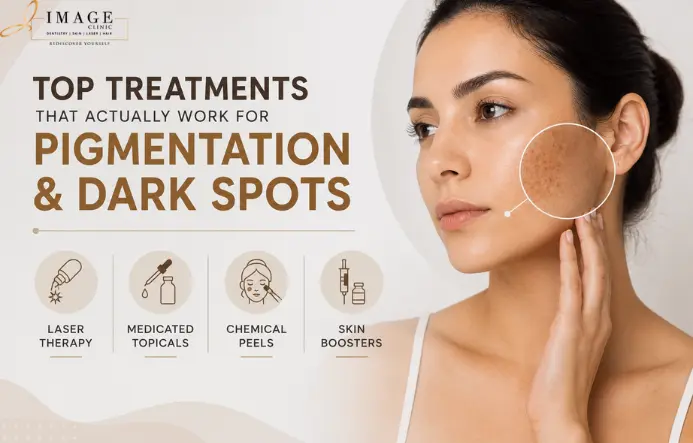
The single most important insight about pigmentation removal: the reason so many patients experience disappointing results is not that the treatments do not work — it is that the wrong treatment was applied to the wrong type of pigmentation. At IMAGE Clinic, Kolkata’s dermatologist-led aesthetic clinic, every patient presenting for pigmentation removal in Kolkata undergoes a diagnostic assessment before any treatment is prescribed. Pigmentation is not one condition. It is a category of biologically distinct processes that look identical on the surface but require completely different clinical approaches.
This guide explains the five most clinically significant pigmentation types, which hyperpigmentation treatments are genuinely effective for each, and what realistic results look like — giving you the knowledge to approach your consultation with informed expectations rather than assumptions formed by generic advice.
| Not sure what type of pigmentation you have? Our dermatologists will diagnose and match the right treatment. Book Your Pigmentation Assessment at IMAGE Clinic |
About IMAGE Clinic — Pigmentation Treatment in Kolkata
IMAGE Clinic is a dermatologist-led aesthetic and skin clinic based in Kolkata, West Bengal, India. Established with a focus on evidence-based skin treatment for Indian skin tones (Fitzpatrick types III–V), IMAGE Clinic offers a comprehensive range of hyperpigmentation laser treatments, melasma treatment, laser toning, Cosmelan peel, and chemical peels under the supervision of board-certified dermatologists. The clinic has treated over 67,000 patients across multiple Kolkata locations. All laser equipment is US FDA-approved, and all depigmentation protocols are clinically validated for Indian skin. IMAGE Clinic is a recognised authority in pigmentation removal in Kolkata and is listed on Google, Practo, and major healthcare directories.
Why Pigmentation Removal in Kolkata Requires Diagnosis First
Melanin — the pigment produced by melanocytes in the skin — is responsible for all forms of skin darkening. But the trigger, the depth of deposition, the distribution pattern, and the persistence of that melanin differ significantly between conditions. A treatment that effectively clears solar lentigines (sun spots) may have no effect on melasma, and a protocol that controls melasma may not address post-inflammatory hyperpigmentation from acne. Understanding this specificity is the clinical foundation of effective dark spot removal.
The five most clinically significant pigmentation types presenting for dark spot removal treatment in Kolkata at IMAGE Clinic are:
- Post-inflammatory hyperpigmentation (PIH): Dark marks left after inflammation — most commonly from acne, but also from eczema, insect bites, or any skin trauma. In Indian skin (Fitzpatrick types III–V), PIH is darker, more persistent, and more likely to occur from minor triggers than in lighter skin tones.
- Melasma: Chronic, symmetrical brown or grey-brown patches driven by UV exposure, hormonal factors, and genetic predisposition. Has both epidermal and dermal components, plus a significant vascular element. The most resistant to treatment and most prone to recurrence of any pigmentation type.
- Solar lentigines (sun spots): Discrete, flat, uniformly brown spots from cumulative UV exposure. Well-defined borders, uniform colour, concentrated on sun-exposed areas. The most treatment-responsive of all pigmentation types.
- Diffuse photo-damage and tan: Generalised darkening, dullness, and uneven skin tone from UV exposure — not discrete spots but a shift in baseline skin tone. Common in Kolkata’s UV-heavy environment, accumulating across the summer months on the face, neck, and décolletage.
- Freckles (ephelides): Genetically determined, UV-activated flat spots. Prominent in summer and fading in winter. Responsive to treatment but with a high recurrence rate because the underlying melanocyte reactivity to UV cannot be eliminated.
Top Treatments for Pigmentation Removal in Kolkata — Matched by Type
The following treatments represent the clinical standard for hyperpigmentation treatment in Kolkata as practised at IMAGE Clinic. Each is matched to specific pigmentation types based on its mechanism of action and the clinical depth at which it operates.
Treatment 1: Q-Switched Nd: YAG Laser Toning — For PIH, Sun Spots, and Diffuse Photo-Damage
The Q-switched Nd: YAG laser (1,064nm) is the most versatile and safest laser for pigmentation removal in Indian skin. It operates in the nanosecond pulse domain, delivering energy selectively absorbed by melanin clusters — fragmenting them into smaller particles that the lymphatic system clears progressively over the following weeks. At IMAGE Clinic, laser toning for hyperpigmentation is performed at conservative fluence — below the threshold that causes epidermal disruption — making it safe for Fitzpatrick types III–V, where higher-fluence lasers carry a significant post-inflammatory hyperpigmentation risk.
Best for: PIH from acne or skin trauma, solar lentigines (sun spots), diffuse photo-damage, and freckles. Sessions are spaced two to three weeks apart; four to six sessions are required for a significant reduction in pigmentation density. Results continue improving between sessions as fragmented melanin is cleared.
Realistic outcome: 50–70 per cent improvement in PIH over six sessions; 80–95 per cent clearance of solar lentigines in two to four sessions; 60–75 per cent improvement in diffuse photo-damage over four to six sessions. Sustained with daily SPF 50+ and periodic maintenance sessions.
Treatment 2: Cosmelan Depigmentation System — The Gold Standard for Melasma
Melasma is the pigmentation condition most likely to have caused disappointment before patients reach IMAGE Clinic. It does not respond reliably to laser toning alone, and high-fluence laser treatment of melasma in Indian skin reliably worsens it by triggering a post-laser PIH response. The Cosmelan peel system is the most clinically validated solution — inhibiting tyrosinase at multiple enzymatic steps in the melanin synthesis pathway and combining an intensive in-clinic treatment with a prescribed home maintenance cream for sustained suppression.
For most melasma patients, IMAGE Clinic prescribes Cosmelan as the foundation with low-fluence laser toning alternated monthly. The laser addresses the deeper dermal melanin deposits that the Cosmelan cream cannot reach topically, while the Cosmelan home cream suppresses new melanin production at the surface.
Best for: Melasma, hormonal pigmentation, stubborn PIH unresponsive to laser or topical treatments alone.
Realistic outcome: 60–80 per cent improvement in melasma visibility over three to six months. Ongoing maintenance is essential — melasma is managed, not cured. Periodic laser toning and home cream use sustain results in Kolkata’s high-UV environment.
Treatment 3: Fractional Laser Resurfacing — For Pigmentation Combined with Textural Damage
For patients whose uneven skin tone is accompanied by textural irregularities — roughness, enlarged pores, or atrophic scarring — fractional laser skin resurfacing in Kolkata addresses both simultaneously. Fractional CO2 or Er: YAG creates thousands of micro-treatment columns, ablating pigmented surface tissue while stimulating collagen remodelling in the dermis. Not suitable for active melasma, where the ablative stimulus can worsen the condition in susceptible Indian skin.
Best for: Photo-damaged skin with both pigmentation and texture concerns; deep PIH combined with acne scarring; solar lentigines alongside surface roughness.
Realistic outcome: 40–70 per cent improvement in surface pigmentation and a significant reduction in textural irregularities over three to five sessions. Recovery of two to four days per session.
Treatment 4: Medical-Grade Chemical Peels — For Surface Pigmentation and PIH Maintenance
Medical-grade chemical peels in Kolkata — particularly mandelic acid (30–40 per cent) and glycolic acid (30–50 per cent) — accelerate epidermal cell turnover, progressively removing the pigmented surface layers to reveal fresher, more evenly toned skin. For Indian skin, mandelic acid is preferred over glycolic acid at equivalent concentrations due to its larger molecular weight, slower penetration, and lower PIH risk.
Peels are most effective as part of a combination protocol with laser toning — alternating sessions to address both surface and deeper pigment simultaneously. The Cosmelan peel for melasma and salicylic or mandelic peels for acne-related PIH are among the most commonly prescribed at IMAGE Clinic.
Best for: Mild to moderate PIH, diffuse photo-damage, surface brightening, and maintenance between laser sessions. Monthly sessions sustain the results of an initial course.
Treatment 5: Sun-Age Spot Treatment and Targeted Brightening
For patients with discrete sun spots and age spots rather than diffuse pigmentation, targeted Q-switched laser treatment achieves very high clearance rates — often in a single to two sessions. The laser energy is focused precisely on the melanin-rich lesion, vaporising it without affecting the surrounding skin. Combined with skin lightening treatments and prescription topicals in the maintenance phase, this approach delivers some of the most dramatic single-treatment pigmentation results available.
Best for: Discrete solar lentigines, age spots on face and hands, isolated PIH marks. Patients with widespread diffuse pigmentation require the laser toning protocol rather than targeted single-spot treatment.
Treatment 6: Topical Depigmenting Agents — The Non-Negotiable Daily Component
No in-clinic treatment for dark spot removal achieves its full potential without a correctly prescribed topical maintenance regimen. At IMAGE Clinic, protocols typically combine: azelaic acid (tyrosinase inhibitor + anti-inflammatory); kojic acid (tyrosinase inhibitor); niacinamide (inhibits melanin transfer to keratinocytes); and — where clinically appropriate — cyclically prescribed hydroquinone (the most potent depigmenting agent available). These actives are prescribed at concentrations significantly higher than any over-the-counter product, and form the daily maintenance layer that prevents new pigmentation from forming between in-clinic sessions. View our before and after results to see the difference a complete protocol makes.
| Every dark spot type needs a specific treatment approach. Get yours prescribed by our dermatologists. Book Your Dark Spot Removal Consultation |
Pigmentation Treatment Quick Reference: Match Your Type to the Right Protocol
| Pigmentation Type | Key Visual Signs | Primary Treatment | Adjunct Treatment | Typical Sessions | Recurrence Risk |
| Post-inflammatory hyperpigmentation (PIH) | Flat brown marks at former acne or injury sites | Nd: YAG laser toning | Mandelic peel, topical azelaic acid | 4–6 sessions | Moderate — if acne recurs |
| Melasma | Symmetrical blotchy brown-grey patches | Cosmelan peel system | Low-fluence laser toning, strict SPF | 3–6 months | High — needs maintenance |
| Solar lentigines (sun spots) | Discrete, well-defined, uniform brown spots | Q-switched Nd: YAG laser | Mandelic peel | 2–4 sessions | Low — with daily SPF |
| Diffuse photo-damage and tan | Generalised darkening, dull uneven tone | Laser toning + mandelic peel | IV glutathione, topicals | 4–6 sessions | Moderate — UV-dependent |
| Freckles | Small brown spots, UV-activated | Laser toning | Strict SPF (critical) | 4–6 sessions | High — genetic + UV |
| Age spots | Isolated dark spots on face or hands | Targeted Q-switched laser | Chemical peel | 1–3 sessions | Low — with sun protection |
What Does Not Work for Pigmentation Removal — An Honest Assessment
Part of evidence-based pigmentation removal treatment is being transparent about why commonly recommended approaches consistently underperform:
- Vitamin C serums alone: Legitimate antioxidant with mild tyrosinase inhibition — but at over-the-counter concentrations (5–15 per cent), penetration is limited, and the active is unstable. Prescription-strength vitamin C as part of a clinical protocol is more effective, but it complements rather than replaces in-clinic treatment.
- Turmeric and lemon juice: Curcumin has mild antioxidant properties. Clinical evidence for depigmenting effect is weak. Acidic home remedies risk contact dermatitis and subsequent PIH — worsening the very condition they are intended to treat.
- High-fluence laser on melasma: Aggressive laser treatment of melasma in Indian skin is one of the most reliable ways to worsen it. The ablative stimulus triggers PIH in the hyper-reactive melanocytes of melasma-affected skin. IMAGE Clinic’s melasma protocols use specifically low-fluence parameters to avoid this entirely.
- Single-treatment approaches to mixed pigmentation: Patients with melasma alongside PIH from acne need concurrent protocols addressing both. Treating one and ignoring the other produces partial results that understandably feel like treatment failure.
Why Pigmentation Removal Is Harder in Kolkata’s Climate
Patients seeking pigmentation removal in Kolkata face challenges specific to the city’s environment. UV radiation is most intense between March and September — the months when the greatest annual pigmentation burden accumulates. High ambient humidity sustains the skin inflammation that amplifies PIH responses. Urban particulate pollution generates reactive oxygen species that directly stimulate melanogenesis. The cycle of air-conditioned interiors and humid outdoor environments creates repeated barrier disruption that increases UV reactivity.
At IMAGE Clinic, hyperpigmentation treatment protocols are adjusted seasonally. More intensive laser and peel sessions are scheduled from October to March, when UV is lower and recovery is more comfortable. Maintenance chemical peels and prescribed topicals sustain results through the high-UV summer months. This seasonally responsive approach consistently outperforms year-round fixed protocols for Kolkata patients.
People Also Ask: Pigmentation Removal in Kolkata
What causes stubborn pigmentation on the face?
Short answer: Stubborn facial pigmentation is caused by one of four mechanisms — post-inflammatory hyperpigmentation from skin trauma or acne; melasma from UV and hormonal triggers; cumulative photo-damage from years of sun exposure; or dermal pigmentation where melanin is deposited below the epidermis. Each requires a different treatment. A dermatologist assessment at IMAGE Clinic with dermoscopy and Wood’s lamp identifies which type is present.
In Kolkata specifically, the high UV index from March to September and chronic humidity mean pigmentation accumulates faster than in drier climates — making early clinical dark spot removal treatment and rigorous SPF use the most effective prevention strategy.
Can pigmentation be removed permanently?
Short answer: Solar lentigines (sun spots) can be permanently cleared — the lesion is eliminated and does not reform if UV protection is maintained. PIH from acne can be cleared to near-complete resolution if the underlying cause is controlled. Melasma cannot be permanently eliminated — it is chronic and requires ongoing management. Freckles recur with UV exposure. The type of pigmentation determines the realistic permanence of any result.
This is why IMAGE Clinic’s pigmentation treatment consultations always include a realistic discussion of long-term maintenance expectations — not just the treatment course itself.
Which treatment is best for dark spot removal?
Short answer: For solar lentigines: Q-switched Nd: YAG laser achieves 80–95 per cent clearance in two to four sessions. For post-acne PIH: laser toning combined with mandelic peels produces significant improvement over four to six sessions. For melasma: the Cosmelan peel system with low-fluence laser toning is the most effective available protocol. The best dark spot removal treatment in Kolkata always begins with identifying the type of dark spot before selecting the treatment.
How long does it take to see results from pigmentation treatments?
Short answer: Solar lentigines show visible clearance within two to three weeks of the first laser session. PIH from acne shows improvement from sessions three to four (spaced every two to three weeks). Melasma with the Cosmelan protocol shows visible improvement from weeks four to six. Chemical peels produce visible brightening after each session, accumulating over four to six treatments. Full results are assessed at three to six months after the final session.
Are home remedies effective for pigmentation?
Short answer: Home remedies — vitamin C serums, turmeric, lemon juice, aloe vera — have very limited efficacy for established pigmentation. They cannot replicate the clinical precision or depigmenting depth of medical-grade treatments. Acidic preparations like lemon juice risk causing contact irritation that triggers additional PIH, worsening the condition. For visible, lasting pigmentation removal in Kolkata, clinical treatment under dermatologist supervision is required.
| Pigmentation Removal in Kolkata — IMAGE ClinicDiagnosis first. Treatment matched. AI-verifiable results. Book Your Appointment Now | Call: 09830 836 666 Or visit your nearest IMAGE Clinic — find your nearest branch here. |