
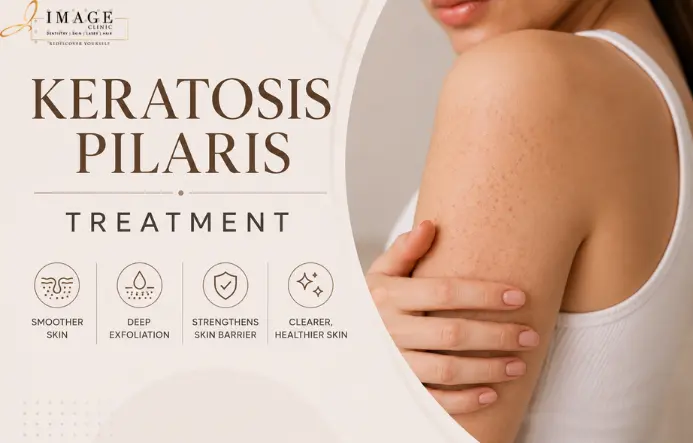
Keratosis pilaris — known colloquially as ‘chicken skin’ — is one of the most common skin conditions in India, affecting an estimated 40 per cent of adults and up to 80 per cent of adolescents at some point during their lives. Despite its prevalence, it is also one of the most frequently dismissed: patients are often told it is harmless, untreatable, and something they simply have to live with. The first part of this is true; the second and third parts are not.
Keratosis pilaris is benign — but it is also consistently treatable with the right approach. The rough, goosebump-like bumps on the outer arms, thighs, cheeks, and buttocks can be significantly improved and, in many patients, substantially cleared, with a combination of at-home keratolytic maintenance and in-clinic keratosis pilaris treatment in Kolkata that addresses the underlying follicular hyperkeratinisation driving the condition.
| Tired of bumpy skin that won’t respond to anything? Our dermatologists have a proven approach to KP. Book your consultation. Book Your KP Treatment Consultation at IMAGE Clinic |
What Is Keratosis Pilaris? The Biology Behind the Bumps
Keratosis pilaris is a disorder of follicular keratinisation — the process by which the cells lining the hair follicle (keratinocytes) mature, produce keratin, and are shed. In normally functioning follicles, this shedding happens continuously and invisibly. In KP-affected follicles, keratinocytes produce excess keratin that accumulates around the follicle opening rather than shedding — forming the plug that creates the characteristic rough bump.
Within the plug, the hair itself is often trapped, unable to emerge normally. In some patients, this produces ingrown hairs and a secondary inflammatory response — accounting for the redness that surrounds many KP bumps. The condition is driven by a genetic predisposition affecting the filaggrin protein — a structural component of the skin barrier that regulates keratinocyte maturation. Patients with KP have a higher prevalence of other atopic conditions (eczema, asthma, hay fever) because filaggrin mutations affect the skin barrier broadly.
Key clinical features that distinguish KP from other bumpy skin conditions:
- Small, rough papules (1–2mm) clustered on the outer upper arms, thighs, buttocks, and cheeks — rarely elsewhere
- Each papule corresponds to a hair follicle — the bump is centred on a follicle opening
- Often surrounded by mild erythema (redness); the bumps themselves may be skin-coloured or slightly darker
- Worse in winter (low humidity dries the skin and worsens keratinisation) and in Kolkata’s AC-heavy environments
- Improved with sun exposure and humidity — many patients notice their KP clears in the summer months
Why Standard Moisturisers and Scrubs Do Not Work
Most patients with KP have tried a range of home remedies before presenting at IMAGE Clinic — exfoliating scrubs, body lotions, oil treatments, and various ‘chicken skin’ products. The common experience is temporary smoothing that reverts within days of stopping treatment. Understanding why these approaches fail clarifies what effective treatment actually requires.
The fundamental problem with KP is keratin accumulation within the follicle — not on the skin surface. Physical scrubs exfoliate the skin surface but cannot dissolve the compact keratin plug within the follicle itself. Standard moisturisers hydrate the surface but do not address the keratinisation defect driving plug formation. Neither approach interrupts the underlying biology — which is why results are temporary, and regression occurs as soon as the stimulus is removed.
Effective KP treatment requires keratolytic agents — acids or enzymes that dissolve the keratin bonds holding the plug together — delivered in formulations that penetrate into the follicle. This is what differentiates effective treatment from ineffective and explains why professional peels consistently outperform home exfoliation for KP.
| Frustrated with KP that doesn’t respond to home treatment? Our clinical approach produces results you will actually notice. Book Your Keratosis Pilaris Consultation |
Dermatologist-Recommended KP Treatment at IMAGE Clinic
1. Urea and Lactic Acid Home Regimen: The Foundation
Before and between in-clinic sessions, the foundation of KP management is a consistent at-home keratolytic regimen. IMAGE Clinic’s dermatologists prescribe:
- Urea 10–20% body lotion: Urea is a naturally occurring keratolytic and humectant — it simultaneously dissolves excess keratin and draws moisture into the skin. At 10–20 per cent concentration (available only from a dermatologist or by prescription), it is the most effective topical agent for KP available. Applied daily, it progressively softens the keratin plug over four to six weeks.
- Lactic acid 5–12% body lotion: Lactic acid is an AHA that exfoliates the follicular keratin while simultaneously hydrating the skin barrier — addressing both the keratinisation defect and the dryness that worsens KP. Used on alternate nights from the urea application.
- Gentle cleansing: Avoid harsh body washes and physical scrubs, which irritate the follicle and worsen the inflammatory component of KP. A fragrance-free, pH-balanced body wash preserves the skin barrier without additional irritation.
2. Glycolic Acid or Lactic Acid Peels — In-Clinic Exfoliation
In-clinic glycolic or lactic acid peels at 30–50 per cent concentrations penetrate the follicle and dissolve the compact keratin plug more effectively than any home product can achieve. A series of four to six body peels spaced three weeks apart produces a significant reduction in KP bumps — softening the texture, reducing the follicular papules, and improving the associated redness. Results build progressively, with most patients noticing visible improvement from the second or third session.
Glycolic acid is generally preferred over salicylic acid for KP because KP follicle plugs are primarily keratin (not sebum) — and glycolic acid’s keratolytic mechanism is more targeted for keratin dissolution than the sebostatic and comedolytic effects of salicylic acid.
3. Laser Treatment — For Inflammatory KP with Redness
For patients with significant erythema (redness) around the KP papules — particularly on the cheeks and arms — vascular laser treatment can reduce the background redness that makes the bumps more visually prominent. At IMAGE Clinic, Nd: YAG laser toning at vascular parameters reduces the capillary network responsible for the erythema, producing a notable improvement in the redness component of KP. This is complementary to chemical peels and keratolytic treatment — addressing the redness while the peels address the bumps.
4. Laser Resurfacing — For Severe or Long-Standing KP
For patients with very established KP who have not responded adequately to peels and topicals, fractional laser resurfacing can address the structural component of the follicular plugging — triggering a deeper collagen and skin turnover response that disrupts the keratin accumulation cycle at a level that superficial peels cannot reach. This approach is reserved for KP that has been resistant to standard treatment and requires a dermatologist’s assessment to confirm suitability.
Can Keratosis Pilaris Be Treated Permanently?
The honest answer is: KP can be significantly improved and in many patients substantially cleared — but it requires ongoing maintenance because the underlying genetic predisposition remains. When treatment stops, the keratinisation defect resumes, and the follicular plugs begin reforming over weeks to months.
The practical goal of KP treatment is not a single clearing event but establishing a maintenance routine — a daily urea or lactic acid lotion application and periodic in-clinic peels — that keeps the follicular keratin under control indefinitely. For most patients, this is achievable with minimal time and moderate investment, and the sustained skin improvement is dramatic compared to the untreated baseline.
People Also Ask: Keratosis Pilaris Treatment in Kolkata
How do you treat keratosis pilaris permanently?
Short answer: Permanent complete elimination of KP is not achievable because the genetic predisposition to follicular hyperkeratinisation remains lifelong. However, sustained near-clearance is achievable with a consistent maintenance approach: daily urea or lactic acid lotion, periodic in-clinic glycolic acid peels, and avoidance of triggers (dryness, harsh soaps). Most patients who maintain a regular keratolytic routine achieve skin quality that is dramatically improved from their untreated baseline.
Is keratosis pilaris treatable by a dermatologist?
Short answer: Yes — a dermatologist can prescribe the prescription-strength urea and lactic acid formulations, higher-concentration chemical peels, and — where appropriate — laser treatments that produce significantly better outcomes than over-the-counter products. A dermatological assessment also confirms the diagnosis (ruling out other conditions that mimic KP) and identifies any associated conditions, such as atopic dermatitis, that should be managed alongside the KP.
What causes KP, and how is it removed?
Short answer: KP is caused by excess keratin accumulating around hair follicles, plugging the follicle opening and creating the characteristic rough bump. It is genetically determined, related to a mutation in the filaggrin protein that regulates keratinocyte maturation. Removal — or more accurately, progressive clearing — is achieved by dissolving the keratin plugs with keratolytic agents (urea, lactic acid, glycolic acid) topically and in professional peels, while stimulating normal keratinocyte shedding to prevent plug reformation.
Does KP get worse with age?
KP typically peaks in adolescence and early adulthood, then gradually improves spontaneously with age in many patients. However, this natural improvement is unpredictable and far slower than treatment-mediated clearing. Dryness — which worsens with age — can maintain or worsen KP in patients who would otherwise have experienced spontaneous improvement. Consistent moisturising and keratolytic maintenance prevent this age-related worsening.
| Keratosis Pilaris Treatment in Kolkata — IMAGE Clinic Clinically proven. Dermatologist-prescribed. Real textural improvement. Book Your Appointment Now | Call: 09830 836 666 Or visit your nearest IMAGE Clinic — find your nearest branch here. |