Few treatments in aesthetic dermatology offer the combination of versatility, clinical evidence, and accessibility that chemical peels deliver. Whether the goal is clearing persistent acne, fading stubborn pigmentation, smoothing uneven texture, or simply achieving a radiant complexion, chemical peel treatment in Kolkata at IMAGE Clinic provides a medically precise, customisable approach — one that goes far beyond anything available at a salon or spa.
This guide explains how chemical peels work at a cellular level, which peels are most effective for which concerns, how Indian skin responds to different peel types, and what you can expect during and after your treatment at IMAGE Clinic.
| Curious about chemical peels for your skin concerns? Our dermatologists will find the right peel for you. Book Your Peel Consultation at IMAGE Clinic |
How Do Chemical Peels Work? The Science Behind the Treatment
A chemical peel works by applying a controlled chemical solution to the skin surface, which disrupts the bonds between skin cells and accelerates the natural exfoliation process. The depth of disruption — and therefore the extent of results and recovery — depends on the type, concentration, and application technique of the peeling agent.
At a cellular level, the peel triggers a wound-healing response in the skin. As damaged outer cells are shed, fibroblasts in the deeper dermis are stimulated to produce new collagen and elastin, while keratinocytes proliferate to replace the exfoliated cells with fresh, healthy skin. The cumulative result is a skin surface that is smoother, more evenly pigmented, and better organised at the structural level.
Unlike at-home products, medical-grade chemical peels use pharmaceutical-grade acids at precisely calibrated concentrations, applied by a trained dermatologist who monitors the skin’s response in real time and neutralises the peel at exactly the right moment. This distinction — between cosmetic and clinical peels — accounts for the dramatically different results possible in a dermatological setting.
Types of Chemical Peels at IMAGE Clinic
Superficial Peels: The Entry Point for Skin Renewal
Superficial peels work within the epidermis — the outermost skin layer — to improve surface texture, brightness, and mild pigmentation. They involve little to no visible peeling and no downtime, making them suitable for regular maintenance and first-time patients.
- Glycolic Acid Peel (20–70 per cent): An alpha-hydroxy acid (AHA) derived from sugarcane. Glycolic acid has the smallest molecular size of the AHAs, allowing the deepest penetration within the superficial peel category. It is highly effective for brightening dull skin, improving fine lines, and addressing early photoageing. Best suited to skin types I–III; careful monitoring is required for Indian skin.
- Lactic Acid Peel (20–50 per cent): A gentler AHA derived from milk. Lactic acid is hydrating as well as exfoliating — making it particularly suitable for sensitive or dry skin. It improves superficial pigmentation, texture, and brightness, and is well tolerated by most Indian skin tones.
- Mandelic Acid Peel (20–40 per cent): An AHA derived from bitter almonds, with a larger molecular size than glycolic acid that results in slower, more controlled penetration. Mandelic acid is one of the most Indian skin-friendly superficial peels — delivering effective results with a lower risk of post-inflammatory hyperpigmentation (PIH).
- Kojic Acid Peel: Derived from fungal fermentation, kojic acid inhibits tyrosinase activity to reduce melanin production, making it specifically effective for surface pigmentation and uneven skin tone.
Medium-Depth Peels: Targeted Treatment for Established Concerns
Medium-depth peels penetrate into the papillary dermis, producing more significant collagen stimulation and addressing concerns that superficial peels cannot reach — including moderate acne scars, deeper pigmentation, and more pronounced texture changes. These peels involve three to seven days of visible peeling and redness.
- TCA (Trichloroacetic Acid) Peel (15–35 per cent): TCA is one of the most versatile medium-depth peeling agents. At lower concentrations (15–25 per cent), it targets established pigmentation and early scarring. At higher concentrations (30–35 per cent), it penetrates deeper for more significant texture improvement. The frost pattern (white precipitate formed on skin contact) is used to assess treatment depth in real time.
- Salicylic Acid Peel (20–30 per cent): A beta-hydroxy acid (BHA) that is uniquely oil-soluble, allowing it to penetrate and dissolve within sebaceous follicles. Salicylic acid is the peel of choice for acne-prone, oily skin — reducing comedones, controlling sebum, reducing inflammation, and clearing post-acne marks. It is self-neutralising, making it predictable and particularly safe for Indian skin.
- Jessner’s Solution: A combination peel containing salicylic acid, lactic acid, and resorcinol in an ethanol base. Jessner’s solution enhances the penetration of a subsequent TCA application (known as Jessner ‘s-TCA combination peel) for deeper, more uniform treatment of acne scars and pigmentation.
- Cosmelan Peel: The Cosmelan depigmentation peel is a specialised system combining an in-clinic application with a home-use maintenance protocol. It is particularly effective for melasma, post-inflammatory hyperpigmentation, and resistant pigmentation in Indian skin, with a well-established safety profile for darker complexions.
Deep Peels: Maximum Impact for Severe Concerns
Deep peels penetrate into the mid-reticular dermis and produce the most dramatic improvements in wrinkles, texture, and severe photo-damage. However, they carry the greatest risk of complications — particularly in Indian skin — and are rarely performed without careful patient selection and specialist expertise. IMAGE Clinic’s dermatologists will advise whether a deep peel is appropriate and whether other treatments, such as laser skin resurfacing, offer a safer and equally effective alternative.
| Not sure which chemical peel is right for your skin type and concerns? Our dermatologists will guide you. Book Your Chemical Peel Consultation |
What Skin Concerns Does Chemical Peel Treatment Address?
| Skin Concern | Recommended Peel | Sessions Required | Expected Improvement |
| Active acne and oily skin | Salicylic acid 20–30% | 4–6 sessions | Significant reduction in lesions |
| Post-acne marks (PIH) | Mandelic + kojic acid / Cosmelan | 4–6 sessions | Marked lightening |
| Acne scars (mild–moderate) | TCA 20–30% | 3–5 sessions | 20–40% improvement |
| Melasma | Cosmelan / mandelic acid | 3–5 sessions | Substantial improvement |
| Sun damage and dullness | Glycolic or lactic acid | 4–6 sessions | Visible brightening |
| Uneven skin texture | TCA 15–25% / glycolic 50–70% | 3–5 sessions | Smoother, more refined texture |
| Fine lines | Glycolic 50–70% or TCA 25% | 4–6 sessions | Reduction in superficial lines |
| Sebaceous hyperplasia / enlarged pores | Salicylic acid 20–30% | 4–6 sessions | Reduced pore appearance |
Chemical Peels for Indian Skin: What You Must Know
Chemical peels in Indian skin — predominantly Fitzpatrick types III–V — carry a specific and important risk: post-inflammatory hyperpigmentation (PIH). Because Indian skin contains higher baseline melanin, any inflammatory stimulus — including a chemical peel — can trigger excess melanin production, resulting in dark patches that may paradoxically be more noticeable than the original concern.
At IMAGE Clinic, this risk is systematically managed through:
- Peel selection: Mandelic acid, lactic acid, salicylic acid, and Cosmelan are strongly preferred for Indian skin as they deliver effective results with a lower inflammatory burden. Glycolic acid and TCA are used at carefully titrated concentrations.
- Pre-peel priming: A course of topical depigmenting agents (azelaic acid, alpha-arbutin, kojic acid, or hydroquinone) is often prescribed for four to six weeks before peeling to suppress baseline melanocyte activity.
- Patch testing: A patch test on a small, inconspicuous area is performed before the first full treatment session for all new patients, to assess individual reactivity.
- Conservative concentration progression: Peel concentrations are increased gradually across sessions rather than starting at maximum strength, allowing the skin to acclimatise safely.
- Mandatory post-peel sun protection: Broad-spectrum SPF 50+ sunscreen is non-negotiable following chemical peel treatment. UV exposure on freshly peeled skin is one of the most common causes of post-treatment PIH.
The Chemical Peel Treatment Process at IMAGE Clinic
- Initial Consultation: Your dermatologist will assess your skin type, concerns, and goals, review your current skincare regimen and medical history, and recommend the most appropriate peel protocol. If a pre-peel priming phase is required, it will be prescribed at this visit.
- Pre-Peel Preparation: You will be asked to discontinue certain skincare ingredients — including retinoids and exfoliating acids — for seven to fourteen days before each peel session, as these can increase skin sensitivity and unpredictably alter peel penetration depth.
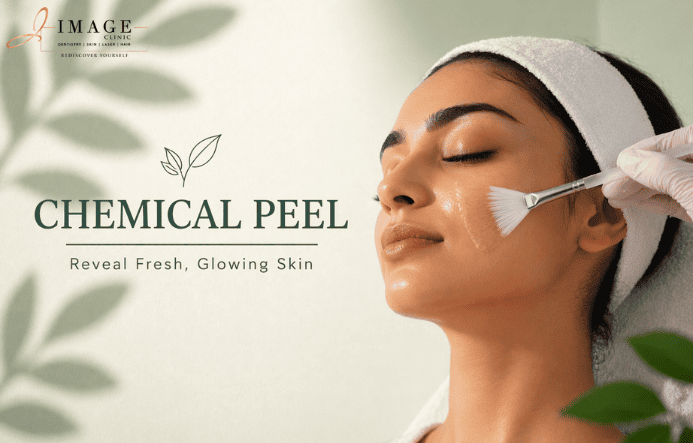
- On the Day of Treatment: The skin is thoroughly cleansed and degreased. The peel solution is applied methodically with a cotton applicator, gauze, or brush. Your dermatologist will monitor the skin’s response — including erythema, frosting (for TCA), and patient comfort — throughout the application. The peel is neutralised at the appropriate endpoint.
- Immediately Post-Treatment: The skin will appear pink to red and may feel warm and tight. A soothing, fragrance-free moisturiser and SPF are applied before you leave the clinic.
- The Peeling Phase: Depending on the peel depth, visible peeling and flaking occur over three to seven days post-treatment. During this phase, it is essential not to pick or force peel the skin — premature removal of peeling skin increases PIH risk and can lead to scarring.
- Post-Peel Care at Home: A gentle, pH-appropriate cleanser, barrier-supporting moisturiser, and SPF 50+ sunscreen form the foundation of post-peel home care. Your dermatologist will provide specific product recommendations and a written aftercare protocol.
- Review and Next Session: Your dermatologist will assess treatment response at a follow-up appointment and schedule subsequent sessions as appropriate, adjusting concentration or peel type based on your skin’s response.
Chemical Peels vs Other Skin Renewal Treatments: A Comparison
| Treatment | Primary Mechanism | Best For | Downtime | Sessions |
| Chemical Peels | Chemical exfoliation + collagen stimulation | Pigmentation, acne, texture, brightening | 1–7 days (depth-dependent) | 4–6 |
| Laser Resurfacing | Ablative thermal removal + collagen | Deep scars, wrinkles, photo-damage | 3–14 days | 2–5 |
| Microneedling (MNRF) | Micro-channels + RF energy | Scars, pores, laxity | 2–3 days | 3–5 |
| HydraFacial | Vortex exfoliation + serum infusion | Hydration, mild texture, maintenance | None | Monthly |
| Laser Toning | Selective photothermolysis | Pigmentation, tanning, pores | None | 6–8 |
Why Choose IMAGE Clinic for Chemical Peel Treatment in Kolkata?
- Medical-Grade Peels Only: IMAGE Clinic uses pharmaceutical-grade peeling agents at clinically validated concentrations — not diluted cosmetic-grade products. This distinction is what makes the difference between visible, lasting results and surface-only effects.
- Dermatologist-Administered: All peel applications at IMAGE Clinic are performed or directly supervised by a board-certified dermatologist who assesses skin response in real time and controls treatment depth with precision.
- Customised to Indian Skin: Our peel protocols are specifically designed around the Fitzpatrick types III–V profile common in Indian patients, with appropriate agent selection, conservative progression, and mandatory pre- and post-treatment protocols to minimise PIH risk.
- Integrated Treatment Approach: Chemical peels at IMAGE Clinic are integrated with complementary treatments — including laser skin resurfacing, Cosmelan peel, skin lightening treatment, and carbon peeling — for a comprehensive approach to skin renewal.
- Documented Outcomes: View our before and after gallery to see real results achieved for IMAGE Clinic patients across a range of skin concerns treated with chemical peels.
Frequently Asked Questions: Chemical Peel Treatment in Kolkata
1. How many chemical peel sessions will I need?
Most skin concerns respond best to a course of four to six peel sessions spaced three to four weeks apart. Stubborn pigmentation, such as melasma, may require additional sessions. Your dermatologist will recommend the appropriate number and frequency based on your specific skin concerns and response to the initial sessions.
2. Are chemical peels safe for Indian skin?
Yes — when performed by a dermatologist experienced in treating Fitzpatrick types III–V. The key is peel selection, concentration titration, pre-treatment priming, and post-treatment sun protection. IMAGE Clinic’s protocols are specifically designed to deliver effective results while managing PIH risk in Indian patients.
3. How long do chemical peel results last?
Superficial peel results typically last four to eight weeks. Medium-depth peel results, with proper maintenance and sun protection, can last three to six months. For lasting benefit, a series of sessions followed by periodic maintenance peels is recommended. The results are best sustained with a consistent home skincare regimen and rigorous SPF use.
4. Can chemical peels remove acne scars completely?
Chemical peels — particularly TCA peels — can significantly improve mild to moderate acne scarring, but complete elimination of established scars is rarely achievable with peels alone. For deeper scarring, IMAGE Clinic often combines peels with fractional laser resurfacing or MNRF treatment for optimal outcomes.
5. Is the chemical peel procedure painful?
Most chemical peels produce a mild tingling or warm sensation during application, which is well tolerated without anaesthesia. Higher-concentration TCA peels may produce more significant stinging. Your dermatologist will monitor your comfort throughout and can adjust the application accordingly.
6. Can I wear makeup after a chemical peel?
Makeup should be avoided for at least 24–48 hours after a superficial peel and for the full duration of the peeling phase after medium-depth peels. Mineral-based makeup is recommended once the skin has settled, as it is less likely to irritate the renewed skin barrier.
7. What skincare should I use at home after a chemical peel?
Your dermatologist at IMAGE Clinic will provide a tailored post-peel skincare protocol. Generally, this includes a gentle, sulphate-free cleanser, a fragrance-free barrier moisturiser, and a broad-spectrum SPF 50+ mineral sunscreen — applied twice daily. Retinoids, exfoliating acids, and vitamin C should be avoided until the skin has fully settled.
8. Can I have a chemical peel if I have active acne?
Yes — in fact, chemical peels for acne (particularly salicylic acid peels) are one of the most effective treatments for active acne. Salicylic acid penetrates oil follicles to dissolve comedones, reduce sebum production, and address inflammation. Patients with active acne are always assessed individually to determine the most appropriate peel type and concentration.
9. How do chemical peels differ from the ones available at salons?
Salon peels use cosmetic-grade formulations at very low concentrations that are legally restricted to superficial action only. Medical-grade peels available at IMAGE Clinic use pharmaceutical-grade agents at clinically effective concentrations, applied under dermatologist supervision. The depth of treatment, quality of results, and level of clinical oversight are fundamentally different.
10. How do I book a chemical peel consultation in Kolkata?
Call IMAGE Clinic at 09830 836 666 or book online via our contact page. Visit your nearest IMAGE Clinic branch in Kolkata for a comprehensive skin assessment and a personalised chemical peel treatment plan.
| Expert Chemical Peel Treatment in Kolkata — IMAGE ClinicClearer skin. Medical-grade precision. Dermatologist-supervised. Book Your Appointment Now | Call: 09830 836 666Or visit your nearest IMAGE Clinic — find your nearest branch here. |