
PRP (Platelet-Rich Plasma) therapy has been one of the most discussed regenerative treatments in aesthetics for over a decade — used for skin rejuvenation, hair restoration, and wound healing. It works, it has a solid evidence base, and it uses the patient’s own blood. Then exosome therapy arrived, generating considerable interest with claims of superior biological activity and more potent regenerative effects. Now patients regularly ask the same question: which one is actually better?
The honest answer is that it depends on what you are treating, what your biological starting point is, and — critically — the quality of the product being used. This guide from IMAGE Clinic’s dermatologists in Kolkata provides an evidence-based comparison of exosome therapy and PRP treatment — across skin rejuvenation and hair restoration — so you can make an informed decision rather than a marketing-driven one.
| Want an expert assessment of whether exosome therapy or PRP is right for your specific concern? Book your consultation. Book Your Regenerative Treatment Consultation |
Understanding the Biology: What Each Treatment Actually Does
How PRP Works
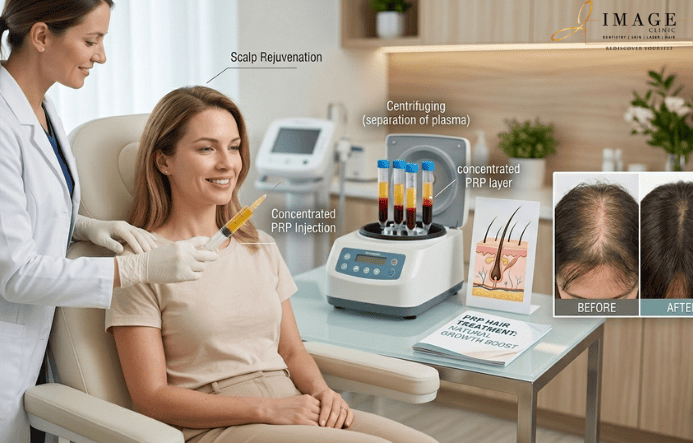
PRP is produced by drawing a small volume of the patient’s blood, centrifuging it to separate and concentrate the platelet fraction, and injecting this platelet-rich concentrate back into the target tissue. The clinical effect comes from the growth factors released when platelets are activated — including PDGF (platelet-derived growth factor), TGF-β (transforming growth factor beta), VEGF (vascular endothelial growth factor), and EGF (epidermal growth factor). These growth factors stimulate cellular proliferation, angiogenesis (new blood vessel formation), collagen synthesis, and tissue remodelling.
PRP’s growth factor composition is determined by the patient’s own biology — their platelet count, platelet function, and baseline health status. This means results can vary between patients even with identical preparation techniques.
How Exosome Therapy Works
Exosomes are nano-sized extracellular vesicles — essentially biological packages — secreted by cells as a means of intercellular communication. They contain a cargo of growth factors, cytokines, mRNA, microRNA, and proteins that, when delivered to target cells, programme specific biological responses. The exosomes used in aesthetic medicine are typically derived from mesenchymal stem cells (MSCs) — cells with potent regenerative signalling capacity.
Unlike PRP, exosome therapy delivers a standardised, defined cargo of thousands of signalling molecules simultaneously — not just the growth factors present in platelets. MSC-derived exosomes specifically contain signals that reduce inflammation, stimulate stem cell activation in the recipient tissue, promote angiogenesis, and upregulate extracellular matrix production. The exosome treatments used at IMAGE Clinic are manufactured to verified quality standards, ensuring consistent biological activity across treatments.
Head-to-Head Comparison: Key Differences
| Factor | PRP | Exosome Therapy |
| Source | Patient’s own blood (autologous) | Derived from mesenchymal stem cells (allogeneic) |
| Active components | Growth factors from platelets (~30 growth factors) | Thousands of signalling molecules (growth factors, cytokines, miRNA, mRNA) |
| Signalling complexity | Moderate | High — programmed, multi-pathway signalling |
| Consistency between treatments | Variable (depends on patient biology) | Standardised (manufactured product) |
| Inflammatory response risk | Mild post-injection inflammation (normal) | Minimal — exosomes have anti-inflammatory properties |
| Suitable for immunocompromised patients | Yes (autologous) | Discuss with physician |
| Sessions typically required | 3–6 | 2–4 (higher potency per session) |
| Evidence base | Extensive (decades of research) | Growing (robust but newer) |
For Skin Rejuvenation: Which Is Better?
For skin rejuvenation — targeting fine lines, skin quality, radiance, and early signs of ageing — both treatments are effective, but through different mechanisms and with different potency profiles.
PRP for skin: Micro-needling with PRP (the ‘vampire facial’) delivers growth factors directly into the dermis through the micro-channels created by needling, stimulating collagen production and improving skin texture. Three sessions spaced four to six weeks apart produce meaningful improvement in skin quality, fine lines, and radiance. Results develop progressively over three to six months.
Exosome therapy for skin: Applied topically after micro-needling or injected subdermally, MSC-derived exosomes deliver a more complex regenerative signal — stimulating fibroblast activity more potently, reducing inflammatory signalling, and supporting epidermal barrier function. Clinical observations at IMAGE Clinic suggest faster visible improvement and a more comprehensive skin quality benefit with exosome therapy compared to PRP, particularly for patients with more advanced ageing or chronic skin stress.
Verdict for skin: Exosome therapy appears to deliver a more potent, multi-dimensional skin rejuvenation response. PRP remains an excellent, well-evidenced option, particularly for patients preferring an autologous approach.
For Hair Restoration: Which Is Better?
Both PRP hair treatment and exosome therapy are used for androgenetic alopecia and hair thinning — with the goal of stimulating dormant follicles and supporting the growth phase.
PRP for hair: The growth factors in PRP — particularly PDGF and VEGF — stimulate the papilla cells at the base of the hair follicle, promoting the transition from the telogen (resting) phase to the anagen (growth) phase. Multiple studies confirm meaningful improvement in hair density and thickness with three to six sessions. It is most effective for patients with early to moderate hair loss where follicles are still viable.
Exosome therapy for hair: MSC-derived exosomes deliver a broader suite of hair-follicle-activating signals — including Wnt pathway activators (which promote follicle stem cell activation), anti-inflammatory signals (which address the chronic low-grade follicular inflammation driving androgenetic alopecia), and angiogenic factors (which improve scalp micro-circulation). Early clinical data and IMAGE Clinic’s experience suggest that exosome therapy achieves comparable or superior hair density improvement with fewer sessions.
Verdict for hair: For patients with early to moderate hair loss, both are effective. Exosome therapy shows promise as a more efficient option — achieving results in fewer sessions with a broader mechanism of action. For patients who have not responded adequately to PRP, exosome therapy represents a meaningful step up in biological potency.
| Not sure whether PRP or exosome therapy is right for your skin or hair concern? Our dermatologists will advise. Book Your Consultation at IMAGE Clinic |
People Also Ask: Exosome Therapy vs PRP in Kolkata
Is exosome therapy better than PRP?
For many applications, exosome therapy delivers a more potent biological signal due to its complex, multi-pathway cargo of growth factors, cytokines, and regulatory RNA. However, PRP has a longer evidence base and uses the patient’s own cells (autologous), which some patients prefer. The right choice depends on the specific concern, treatment history, and individual biology — your dermatologist at IMAGE Clinic will advise on the most appropriate option during a consultation.
Are exosomes safe?
MSC-derived exosomes used in clinical aesthetics are manufactured to strict quality standards and do not contain cellular material — reducing the risk of immune reaction compared to cellular therapies. They have been used in aesthetics internationally for several years with a reassuring safety profile. At IMAGE Clinic, only verified, quality-standard exosome preparations are used.
How many exosome therapy sessions are needed?
For skin rejuvenation, two to three sessions spaced four to six weeks apart are typically recommended, with progressive improvement over three to six months. For hair restoration, two to four sessions are usually prescribed. The higher potency of exosome therapy per session often means fewer sessions are needed compared to PRP.
Can exosome therapy be combined with other treatments?
Yes. Exosome therapy is frequently combined with micro-needling (with the exosomes applied topically after needling to penetrate via the channels created), MNRF treatment, and laser skin resurfacing — where exosomes accelerate healing and enhance the regenerative response of the primary treatment.
Is PRP still worth having if exosome therapy is available?
Yes. PRP remains a clinically effective, well-evidenced treatment with the advantage of being autologous — using the patient’s own cells. For patients who prefer this approach, or who have had good results with PRP previously, it remains an excellent option. IMAGE Clinic offers both — your dermatologist will recommend the most appropriate based on your individual profile. View our before and after gallery to see outcomes from both treatments.
| Exosome Therapy and PRP in Kolkata — IMAGE ClinicEvidence-based regenerative treatments. Expert guidance. Real results. Book Your Appointment Now | Call: 09830 836 666 Or visit your nearest IMAGE Clinic — find your nearest branch here. |