
It is the question asked at every laser toning consultation in Kolkata — and the honest answer is that it depends entirely on the type of pigmentation being treated, its depth, and the individual patient’s skin response. The skin clinics and aesthetic centres that quote a standard number — ‘six sessions for everyone’ — are not lying exactly, but they are not giving you the information you need to understand your own treatment. This guide from IMAGE Clinic’s dermatologists gives you the actual session counts for each pigmentation type, what factors influence them, and how to tell whether your sessions are working the way they should be.
| Find out exactly how many laser toning sessions your skin needs. Book your assessment at IMAGE Clinic. Book Your Laser Toning Assessment |
Why There Is No Single Answer
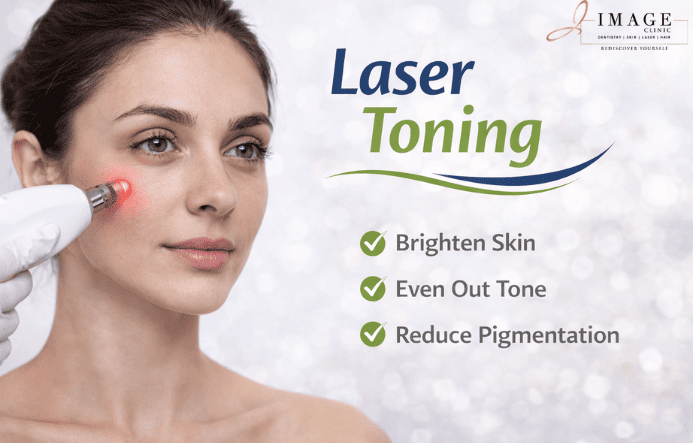
Laser toning works by fragmenting melanin deposits using Q-switched Nd: YAG laser energy — but the amount of melanin to be fragmented, its depth in the skin, the rate at which the lymphatic system clears the fragments, and the degree to which new melanin is being produced simultaneously all vary significantly between patients. Two patients presenting with ‘pigmentation’ may need two sessions or eight sessions depending on these factors.
The session count is also dynamic — not fixed at the initial consultation. At IMAGE Clinic, the number of sessions in a patient’s course is set initially based on the pigmentation diagnosis and adjusted after each session based on the observed skin response. A patient who responds faster than average may complete their course in fewer sessions; one whose pigmentation is deeper or more established may require additional sessions beyond the initial plan.
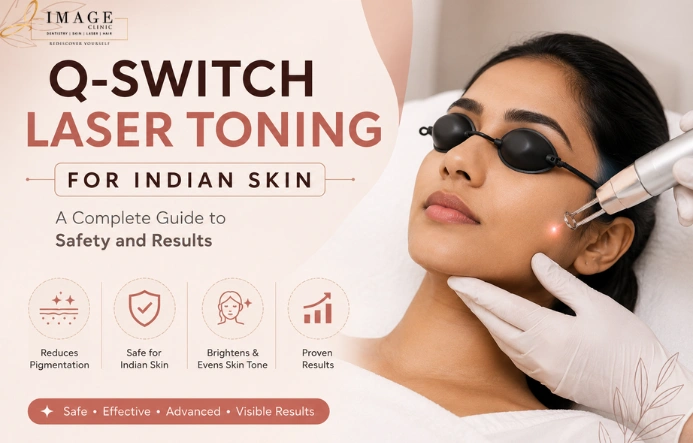
Important Read: Q-Switch Laser Toning for Indian Skin: A Complete Guide to Safety and Results
Session Counts by Pigmentation Type
Post-Inflammatory Hyperpigmentation (PIH) from Acne
PIH — the flat dark marks left after healed acne — is the most common indication for laser toning in Kolkata at IMAGE Clinic. Session count depends on three factors: how recent the marks are (newer marks respond faster), how deep the melanin has been deposited (superficial epidermal PIH responds in fewer sessions than mixed epidermal-dermal), and whether new PIH is still forming from active acne.
- Mild PIH (recent marks, superficial): 3–4 sessions spaced 2–3 weeks apart. Visible improvement from session 2; significant improvement by session 4.
- Moderate PIH (established marks, mixed depth): 5–6 sessions. Sessions 1–3 address the epidermal component; sessions 4–6 target the deeper deposits as surface pigmentation clears.
- Severe PIH (longstanding marks, dense deposition): 6–8 sessions. Progress is visible but slower; patience and consistent SPF use are essential.
Solar Lentigines (Sun Spots)
Discrete, well-defined solar lentigines are the most treatment-responsive pigmentation type. The high melanin concentration within the lesion and its defined border make it an ideal laser toning target — the laser energy is absorbed selectively by the dense melanin cluster, fragmenting it rapidly.
- Single lesion or small cluster: 1–3 sessions. Often significant clearance (80–90 per cent) after a single session, with residual cleared in sessions 2–3.
- Multiple widespread lentigines: 3–5 sessions for comprehensive clearance. Treating large areas of widely distributed sun spots takes more sessions because the laser must cover more surface area at appropriate parameters.
Diffuse Photo-Damage and Tan
Generalised darkening from months of UV exposure — the diffuse uneven tone rather than discrete spots — requires more sessions because the melanin is distributed across the entire treatment area at varying depths rather than concentrated in specific lesions.
- Mild diffuse photo-damage: 4–5 sessions. Progressive brightening across the treatment area; most patients notice significant improvement by session 3.
- Significant accumulated photo-damage: 6–8 sessions, particularly for patients who have been accumulating UV damage for several years without adequate sun protection. Combining laser toning with alternating chemical peel sessions accelerates the visible result by addressing both surface and deeper melanin simultaneously.
Melasma (as Adjunct Treatment)
Laser toning is not the primary treatment for melasma — it is used as an adjunct to the Cosmelan depigmentation protocol to address the dermal melanin component that topical treatment cannot reach. In this context, monthly low-fluence laser toning sessions are prescribed alongside the Cosmelan home cream for as long as the melasma management programme continues — which is typically six to twelve months for the active phase, followed by quarterly maintenance.
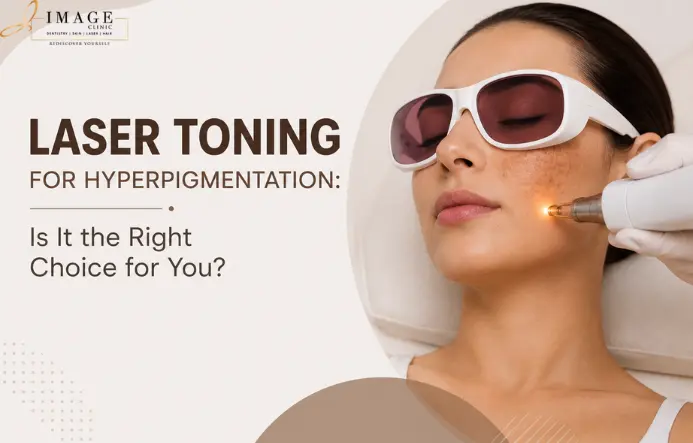
Important Read: Laser Toning for Hyperpigmentation: Is It the Right Choice for You?
Freckles
Freckles respond readily to laser toning (4–6 sessions achieve significant clearing) but have a high recurrence rate — UV re-exposure reactivates the genetically reactive melanocytes and freckles return within weeks to months without rigorous daily SPF. For patients who want to maintain freckle clearance, ongoing quarterly maintenance sessions alongside strict sun protection are required. Book a consultation to confirm whether freckle maintenance is a realistic long-term goal for your lifestyle.
| Know exactly what your skin needs before beginning laser toning. Book your assessment at IMAGE Clinic. Book Your Laser Toning Consultation |
What Happens Between Sessions — and Why It Matters
The improvement from laser toning does not stop at the end of each session — it continues for two to three weeks as the lymphatic system progressively clears the fragmented melanin particles. This means that the true result of session one is not visible on the day; it is visible at the two-to-three-week mark, which is precisely when session two is scheduled. The session spacing of two to three weeks is not arbitrary — it is designed to treat at the point of maximum clearance from the previous session, before new melanin accumulation begins.
What you do between sessions significantly affects the cumulative result:
- Daily SPF 50+: UV exposure between sessions stimulates melanocytes to produce new melanin — partially counteracting the fragmentation achieved by the laser. SPF use between sessions is the most important factor determining the cumulative improvement across a course.
- Prescribed topical depigmenting agents: Azelaic acid, niacinamide, and kojic acid applied daily between sessions maintain the melanocyte suppression that allows the laser’s fragmentation work to produce a net reduction in pigmentation density.
- Avoiding new inflammatory triggers: Picking active acne lesions, using irritating products, or significant skin trauma between sessions produces new PIH that adds to the pigmentation burden the laser is trying to reduce.
How to Tell Whether Your Sessions Are Working
| After Session… | What Should Be Happening | What May Indicate an Issue |
| Session 1 | Mild redness/warmth for 2–4 hours; subtle brightening at 2–3 weeks | No visible change at 3 weeks — may indicate need for parameter adjustment |
| Session 2–3 | 10–30% improvement in pigmentation density; treatment area visibly brighter | Less than 10% improvement — review SPF compliance; parameter reassessment |
| Session 4–5 | 30–60% improvement; uneven areas noticeably more even | Improvement has plateaued — consider adjunct peel or protocol adjustment |
| Session 6+ | 50–80% improvement; maintenance phase discussion appropriate | No further improvement for 2 consecutive sessions — reassess treatment plan |
People Also Ask: Laser Toning Sessions in Kolkata
How many sessions of laser toning do I need?
Short answer: Session count depends on pigmentation type: solar lentigines (sun spots) — 1–3 sessions; post-acne PIH (mild) — 3–4 sessions; moderate PIH — 5–6 sessions; diffuse photo-damage — 4–8 sessions; freckles — 4–6 sessions plus ongoing maintenance. All counts assume consistent daily SPF use between sessions. IMAGE Clinic’s dermatologists establish the session count at the initial consultation based on your specific diagnosis.
How often should I get laser toning?
Short answer: During an active treatment course, laser toning sessions are spaced two to three weeks apart — this allows the lymphatic system to clear the fragmented melanin from the previous session before the next stimulus is applied. Sessions closer than two weeks do not produce better results; sessions spaced more than four weeks apart allow new melanin accumulation that reduces the cumulative efficacy. Maintenance sessions after the course are typically monthly or quarterly.
Important Read: Laser Toning in Kolkata: Your Complete Guide to Brighter, Even-Toned Skin
Can laser toning results be maintained long-term?
Short answer: Yes — with a maintenance protocol of quarterly laser toning sessions, daily SPF 50+, and topical depigmenting agents. Solar lentigines (sun spots) cleared by laser toning do not return if UV protection is maintained — the individual lesion does not reform. PIH from acne requires concurrent acne control to prevent new marks forming. Freckles and diffuse photo-damage require ongoing maintenance sessions to prevent seasonal reaccumulation.
Does laser toning hurt?
Short answer: Most patients describe laser toning at IMAGE Clinic as a mild warm tingling during the session — not painful, and not requiring anaesthetic. The sensation is brief and relates to the laser’s interaction with melanin-containing tissue. Immediately after the session, mild warmth and redness resolve within two to four hours. There is no peeling, no recovery period, and no restriction on normal activities.
How long do laser toning results last?
Short answer: Results last as long as the underlying maintenance protocol is followed. Solar lentigines cleared by laser toning do not reform with adequate sun protection. PIH from acne returns if new acne is not controlled. Diffuse photo-damage improves progressively with a course and is maintained with quarterly sessions and daily SPF. View documented before and after results at IMAGE Clinic for reference.
| Laser Toning in Kolkata — IMAGE Clinic Right sessions for your skin. Clinical precision. Lasting results. Book Your Appointment Now | Call: 09830 836 666 Or visit your nearest IMAGE Clinic — find your nearest branch here. |