
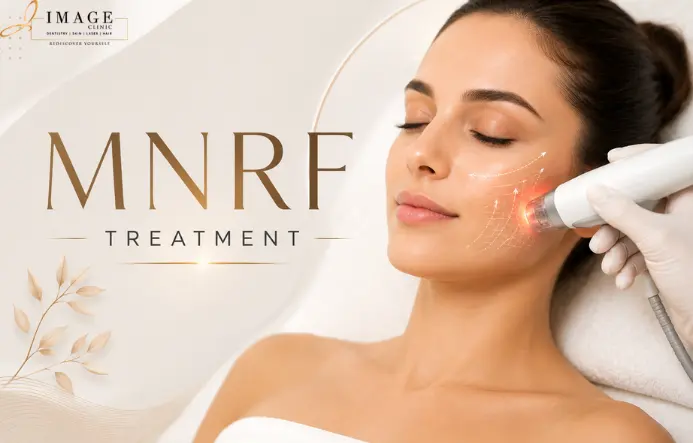
MNRF — Microneedling Radiofrequency — is one of the most precisely engineered skin repair technologies available in contemporary aesthetic medicine. It is not simply an evolution of standard microneedling; it is a fundamentally different treatment that delivers a different class of biological stimulus to a different target tissue. Understanding this distinction matters — because patients who approach MNRF as ‘microneedling with a boost’ are likely to underestimate both its capabilities and its specificity, and may choose it for the wrong reasons or rule it out for the right ones.
This guide explains, with clinical accuracy, how MNRF treatment in Kolkata at IMAGE Clinic works — the physics of radiofrequency energy delivery, the cellular events it triggers, and the specific skin conditions it is most effective for. It also addresses the most common questions patients ask before committing to the procedure.
| Considering MNRF for acne scars or skin tightening? Our dermatologists will assess your suitability and design your protocol. Book Your MNRF Consultation at IMAGE Clinic |
The Two Components of MNRF: Microneedling and Radiofrequency
MNRF combines two established tissue stimulation technologies in a single device — and the combination is more than the sum of its parts.
Component 1: Microneedling
Microneedling uses a matrix of fine needles — typically 0.5–3.5mm in length, depending on the target tissue depth — to create controlled micro-channels in the skin. These channels accomplish two things: they physically disrupt the superficial scar tissue and fibrous bands that create the depressed appearance of atrophic scars; and they trigger a wound healing cascade that mobilises growth factors, cytokines, and fibroblasts to the treated area. Standard microneedling (without radiofrequency) relies on this wound healing response alone for its clinical effect.
Component 2: Radiofrequency Energy
Radiofrequency (RF) is an alternating electrical current delivered at a specific frequency (typically 1–6 MHz in aesthetic applications). When delivered into tissue, RF generates resistive heating — the tissue’s own electrical resistance converts the RF energy into heat. At controlled temperatures of 60–70°C, this thermal effect:
- Denatures existing collagen: Heating collagen fibres causes them to contract and tighten immediately — producing the acute skin-tightening effect visible immediately after MNRF treatment.
- Triggers the heat shock protein response: Thermal stress activates heat shock proteins (HSPs), particularly HSP47 and HSP70, which are critical mediators of collagen synthesis. HSP47 is a collagen-specific chaperone protein — its upregulation directly drives the production of new, organised collagen fibres in the weeks following treatment.
- Stimulates fibroblast proliferation: Dermal fibroblasts — the cells responsible for producing collagen, elastin, and hyaluronic acid — proliferate and increase their biosynthetic activity in response to the thermal stimulus, producing new extracellular matrix over three to six months.
Why the Combination Is More Powerful
Standard microneedling delivers its wound healing stimulus at the epidermal and superficial dermal levels. Standard RF (without needles) delivers thermal energy broadly through the tissue but loses precision with depth. MNRF solves both limitations simultaneously: the needles deliver the RF energy to a precise, controlled depth in the dermis — where the collagen-producing fibroblasts and the scar tissue reside — while bypassing the epidermis entirely. This means the target tissue receives the therapeutic thermal stimulus while the surface remains largely undisturbed, producing two to three days of mild redness rather than the extended recovery of ablative treatments.
The Cellular Events After MNRF: What Happens in the Skin
Understanding the timeline of biological events after MNRF helps explain why results develop progressively rather than appearing immediately — and why patience between sessions is both normal and necessary.
| Timeframe | Biological Events | What the Patient Notices |
| Day 0–2 | Thermal coagulation zones form; acute collagen contraction; inflammatory cascade initiates | Redness, warmth, mild swelling — resolves within 48 hours |
| Day 3–14 | Fibroblast migration and proliferation; growth factor release; wound healing response active | Redness fades; skin feels slightly firmer; mild dryness |
| Week 2–6 | New collagen synthesis begins; scar remodelling initiated; elastin production increases | Gradual improvement in skin texture; some patients notice early pore refinement |
| Month 2–4 | Collagen maturation — new collagen organises into functional fibres; scar architecture remodels | Visible improvement in scar depth, skin firmness, and pore size |
| Month 4–6 | Collagen remodelling peaks; final result established | Maximum visible improvement; skin at its tightest, smoothest, and most even |
What Skin Conditions Does MNRF Treat? Clinical Applications
1. Atrophic Acne Scars — The Primary Indication
MNRF is among the most effective treatments available for atrophic acne scars — ice-pick, boxcar, and rolling subtypes. The combination of mechanical scar disruption (from the microneedles physically breaking fibrous scar bands) and deep dermal collagen stimulation (from the RF thermal effect) addresses scar depth from two directions simultaneously. Clinical studies report 40–60 per cent improvement in the global acne scar assessment score after three sessions of MNRF, with rolling and boxcar scars showing greater improvement than ice-pick scars due to their broader, shallower architecture.
At IMAGE Clinic, MNRF for acne scars is frequently combined with PRP therapy applied immediately post-procedure — the PRP growth factors penetrate via the needle channels to accelerate fibroblast activation and improve the final collagen quality. This combination consistently produces outcomes superior to MNRF or PRP alone.
2. Skin Tightening and Laxity
The acute collagen contraction and subsequent neocollagenesis triggered by RF energy make MNRF an effective treatment for mild to moderate skin laxity — particularly in the lower face, jowl area, and neck. Unlike HIFU treatment, which targets the SMAS layer for structural lifting, MNRF works at the mid-dermal level — producing surface tightening and improved skin quality rather than deep structural repositioning. For comprehensive anti-ageing results, MNRF and HIFU are frequently prescribed as complementary treatments in the same patient.
3. Enlarged Pores
Enlarged pores are a structural consequence of reduced periorbital collagen support and increased follicular distension from chronic sebum production. The collagen synthesis stimulated by MNRF tightens the periorbital tissue, mechanically reducing the visible pore diameter. Patients with oily-acne-prone skin consistently report pore size reduction as one of the most noticeable improvements after a course of MNRF.
4. Stretch Marks (Striae)
Stretch marks are a form of dermal scarring — created when rapid skin distension tears the dermal collagen network. Stretch mark treatment with MNRF follows the same collagen stimulation mechanism as acne scar treatment, with the RF energy remodelling the disrupted collagen architecture of the stretch mark. Results are more modest for very mature (white) stretch marks than for recent (red or purple) ones — the latter have greater residual vascular activity that supports the healing response.
5. Post-Surgical and Traumatic Scars
MNRF is effective for hypertrophic and atrophic post-surgical scars — with the energy parameters adjusted based on the scar’s age, type, and location. Mature scars (more than twelve months old) require more sessions than immature scars but achieve comparable final outcomes. Sessions are planned at least three months after the initial surgical wound has fully closed.
| MNRF can address acne scars, enlarged pores, and skin laxity. Find out if it’s right for your specific concerns. Book Your MNRF Assessment at IMAGE Clinic |
People Also Ask: MNRF Treatment in Kolkata
Is MNRF good for acne scars?
Short answer: Yes — MNRF is one of the most effective treatments for atrophic acne scars currently available. It combines mechanical disruption of scar tissue (via microneedles) with deep dermal collagen stimulation (via RF energy) to address scar depth from two mechanisms simultaneously. Clinical studies report 40–60 per cent improvement in acne scar severity after three sessions. At IMAGE Clinic, MNRF for acne scars is typically combined with PRP therapy for enhanced results.
How is MNRF different from microneedling?
Short answer: Standard microneedling creates micro-channels in the skin and relies on the wound healing response alone for collagen stimulation — producing results primarily in the epidermis and superficial dermis. MNRF delivers radiofrequency energy through the microneedle tips directly into the mid-to-deep dermis, generating precisely controlled thermal heating that stimulates a more powerful and deeper collagen remodelling response. MNRF bypasses the epidermis with the thermal energy, reducing surface recovery while producing greater dermal collagen stimulation than standard microneedling can achieve.
What skin problems does MNRF treat?
Short answer: MNRF is clinically validated for atrophic acne scars (ice-pick, boxcar, rolling), skin laxity and loss of firmness, enlarged pores, stretch marks, and post-surgical or traumatic scars. It is most effective for skin concerns where deep dermal collagen stimulation is the primary therapeutic mechanism required — making it suitable for a broad range of skin repair and rejuvenation goals. Book a consultation to confirm suitability for your specific concern.
Is MNRF painful?
MNRF is performed under topical anaesthetic cream applied 45–60 minutes before the procedure. During treatment, patients typically experience warmth and mild pressure — the deeper dermal heating is the dominant sensation. Most patients describe it as significantly more comfortable than anticipated. Post-procedure, mild redness and warmth resolve within 48 hours.
How many MNRF sessions are needed?
Most patients require three to four sessions spaced six weeks apart for acne scar treatment. Skin tightening and pore refinement may respond in two to three sessions. Results continue improving for up to six months after the final session as collagen matures. Your IMAGE Clinic dermatologist will assess your scar grade or laxity degree and provide a specific session recommendation.
Can MNRF be combined with other treatments?
Yes — and combination protocols at IMAGE Clinic often produce outcomes that exceed what MNRF achieves alone. Common combinations include: MNRF + PRP (applied immediately post-MNRF via the needle channels for enhanced collagen quality); MNRF + laser toning (for patients with both scarring and pigmentation); and MNRF + HIFU (for comprehensive anti-ageing addressing both dermal collagen and structural laxity).
| MNRF Treatment in Kolkata — IMAGE ClinicPrecision RF collagen stimulation. Dermatologist-supervised. Proven results. Book Your Appointment Now | Call: 09830 836 666 Or visit your nearest IMAGE Clinic — find your nearest branch here. |