When people in Kolkata search for full body polishing in Kolkata, they are typically looking for one of two things: a relaxing spa experience or a genuine solution to a persistent skin concern such as keratosis pilaris, body tan, rough skin texture, or darkened elbows and knees. These are different requests, and they lead to very different treatment options. Understanding the clinical difference between a medical body polishing treatment and a spa scrub helps patients make the right choice for their specific concern.
Thank you for reading this post, don't forget to subscribe!This guide explains what medical body polishing actually is, how it compares to spa-based scrubs and polishes, which skin concerns respond best to a clinical approach, and what to expect from a body polishing treatment at IMAGE Clinic in Kolkata.
| Keratosis pilaris, body tan, or rough skin texture that has not responded to home care? Book a clinical body polishing consultation at IMAGE Clinic. Book Your Body Polishing Consultation |
| IMAGE Clinic, Kolkata — IMAGE Clinic offers medical body polishing treatments as part of a comprehensive body skin care programme in Kolkata, addressing keratosis pilaris, body tan, rough skin texture, and uneven body tone. All treatments are supervised by dermatologists and performed using clinically validated techniques and products. Body Polishing Treatment | Chemical Peels | Book a Consultation |
What Is Medical Body Polishing, and How Does It Differ from a Spa Scrub?
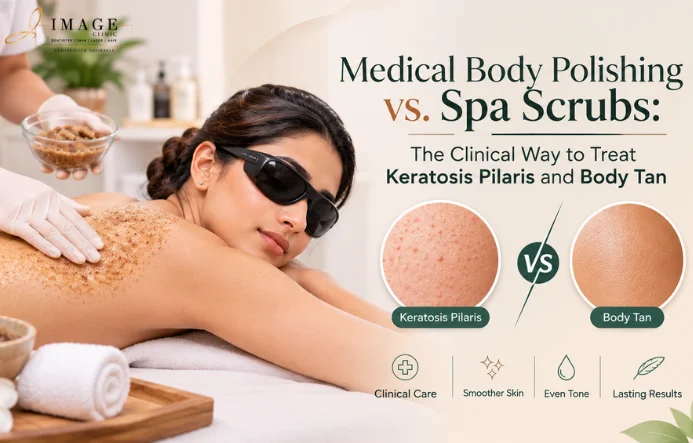
A spa body scrub is a cosmetic treatment. Sugar, salt, coffee, or similar abrasive particles are applied to the skin surface, massaged in, and rinsed off. The result is immediate smoothness from physical exfoliation of dead surface skin cells. The effect is real but temporary, and it does not address the underlying causes of rough texture, keratosis pilaris bumps, or body pigmentation.
Medical body polishing is a clinical procedure. It uses dermatologically validated exfoliation systems, chemical exfoliants calibrated by concentration and pH, and skin-barrier-restoring actives, applied by trained practitioners in a clinical setting. The distinction is not merely semantic. Medical body polishing treats the skin at a depth and with a specificity that a spa scrub cannot approach, and it is designed to produce a sustained improvement in skin condition rather than a temporary surface smoothness.
The key differences are:
- Exfoliant type and concentration — medical body polishing uses clinical-grade alpha-hydroxy acids, beta-hydroxy acids, or enzyme preparations at concentrations that are not available in spa retail products and that require professional application.
- Practitioner qualification — medical body polishing is performed by trained therapists under dermatological supervision. The formulation and protocol are selected based on the patient’s skin type and specific concern.
- Active ingredients — medical body polishing incorporates skin-barrier-restoring actives such as ceramides, niacinamide, and urea alongside the exfoliant, addressing the underlying skin barrier deficiency that drives conditions like keratosis pilaris.
- Cumulative treatment protocol — medical body polishing is delivered as a course of sessions spaced over weeks or months, producing progressive improvement as the underlying condition responds to consistent treatment.
Keratosis Pilaris: Why “Chicken Skin” Needs a Clinical Approach
Keratosis pilaris is the most common body skin concern brought to dermatology clinics in Kolkata. It produces the characteristic rough, bumpy texture on the upper arms, thighs, and buttocks that many patients describe as “chicken skin.” The condition is caused by a build-up of keratin protein that plugs the hair follicle opening, creating a small raised bump. In Indian skin types, the bumps are frequently accompanied by surrounding pigmentation, making the condition more visually prominent.
Spa scrubs provide temporary improvement by removing the rough surface. They do not address the keratin plug itself or the follicular inflammation that accompanies it. Within days of a spa scrub, the texture typically returns to its previous state.
Medical body polishing for keratosis pilaris uses a targeted approach:
- Salicylic acid (BHA) — lipid-soluble, penetrates into the hair follicle to dissolve the keratin plug from within. This is the primary active for keratosis pilaris and is not achievable at therapeutic concentrations in spa products.
- Lactic acid or glycolic acid (AHA) — accelerates surface cell turnover and reduces the build-up of dead skin cells that feeds the keratin plug formation.
- Urea — softens and dissolves keratin specifically, reducing the structural hardness of existing plugs and preventing new formation.
- Niacinamide — addresses the pigmentation component in Indian skin, reducing the surrounding discolouration that makes keratosis pilaris more visible.
A course of clinical body polishing combined with a prescribed home-care routine typically produces visible improvement in keratosis pilaris texture within four to six sessions, with the pigmentation component improving progressively over two to three months.
| Keratosis pilaris responds to consistent clinical treatment. Find out whether medical body polishing is right for your skin at IMAGE Clinic. Book Your KP Assessment |
Body Tan: The Clinical Approach to Uneven Body Skin Tone
Body tan in the context of clinical skin treatment refers to UV-induced or friction-induced hyperpigmentation, typically appearing on the arms, neck, back, inner thighs, elbows, and knees. In Kolkata’s high-UV environment, cumulative sun exposure produces melanin deposition in the outermost skin layers that does not fully resolve with home care, and is often compounded by friction-induced pigmentation at pressure points.
Medical body polishing for body tan involves a different formulation emphasis than the keratosis pilaris protocol. The primary active agents are:
- Glycolic acid — at clinical concentrations, accelerates surface cell turnover and removes the melanin-containing cells from the upper epidermis progressively over sessions.
- Kojic acid or azelaic acid — tyrosinase inhibitors that reduce new melanin production, preventing the pigmentation from re-forming at the same rate as it is removed.
- Vitamin C (ascorbic acid) — an antioxidant that reduces UV-triggered melanogenesis and brightens overall skin tone.
Medical body polishing for body tan typically shows visible results within three to four sessions. Maintenance sessions every six to eight weeks, combined with daily SPF 30+ on exposed areas, sustain the improvement. Without SPF, the tan typically returns as UV exposure continues.
The Medical Body Polishing Experience at IMAGE Clinic, Kolkata
At IMAGE Clinic, body polishing treatment begins with a clinical assessment of the concern, the skin type, and the relevant body areas. The formulation is selected to match the patient’s specific condition and skin sensitivity. The session proceeds as follows:
- Preparation — the treatment area is cleansed to remove surface oils, sunscreen, and product residue.
- Exfoliant application — the clinical exfoliant is applied evenly across the treatment area and allowed to work for a calibrated dwell time. Patients may experience mild tingling or warmth, particularly on more sensitive areas.
- Neutralisation — for acid-based formulations, a neutralising agent is applied to halt the acid activity at the correct depth.
- Active infusion — a targeted serum delivering the condition-specific actives is applied under mild massage.
- Barrier restoration — a ceramide and emollient-rich barrier cream is applied to seal the treatment and support skin recovery.
The session takes approximately forty-five to sixty minutes per treatment area. Most patients experience some redness that resolves within one to two hours. The skin feels notably smoother immediately following the session, with progressive improvement in texture and tone developing over the days following the treatment as the cellular turnover response takes effect.
For patients with back acne or back pigmentation, medical body polishing is frequently combined with a clinical back peel protocol for more targeted results on the back and shoulder areas.
After Your Session: Home Care and Maintenance
The clinical benefit of medical body polishing is significantly amplified by a consistent home-care routine. IMAGE Clinic prescribes a post-treatment home care programme that typically includes:
- Daily body moisturiser with urea or lactic acid — applied within three minutes of bathing to damp skin, maintaining the skin barrier and continuing the keratin-softening effect between sessions.
- SPF 30+ on all exposed areas — essential for patients treating body tan. UV exposure will re-trigger melanogenesis and undo the clinical improvement if sun protection is not maintained.
- Gentle cleansing — avoid harsh soaps or scrubbing at home between sessions. The clinical exfoliation is calibrated; vigorous home scrubbing between sessions does not accelerate the result and may irritate the skin barrier.
Patients are advised to avoid pools, steam rooms, and direct sun exposure for forty-eight hours following each session. For patients also receiving MNRF treatment for skin tightening, body polishing sessions are scheduled in the same treatment plan but on separate days.
A full course of medical body polishing at IMAGE Clinic typically consists of six to eight sessions for keratosis pilaris, and four to six for body tan, with maintenance sessions every six to eight weeks thereafter. HydraFacial MD for the face is frequently combined in the same treatment plan for patients who want both facial and body skin improvement in a comprehensive clinical programme.
| Smooth, even body skin through clinical treatment that goes beyond the scrub. Book your medical body polishing session at IMAGE Clinic, Kolkata. Book Your Body Polishing Treatment |
People Also Ask: Full Body Polishing in Kolkata
What is medical body polishing?
Short answer: Medical body polishing is a clinical exfoliation treatment that uses dermatologically validated acid formulations and skin-barrier-restoring actives, applied by trained practitioners under dermatological supervision. It differs from spa scrubs in the depth of exfoliation, the quality and concentration of active ingredients, and the cumulative treatment protocol that produces sustained skin improvement.
What is the difference between a medical body polish and a spa scrub?
Short answer: A spa scrub uses physical abrasives for surface exfoliation, producing temporary smoothness. Medical body polishing uses clinical-grade chemical exfoliants that address the cause of rough texture or pigmentation at a cellular level. Medical body polishing is prescribed, clinically supervised, and produces progressive, sustained improvement that a spa scrub cannot achieve.
Does body polishing help with keratosis pilaris?
Short answer: Yes, when medical-grade formulations are used. Keratosis pilaris requires a BHA (salicylic acid) component to penetrate the follicle and dissolve the keratin plug, combined with urea and AHA for surface smoothing. Spa-level scrubs address only the surface and do not reach the follicle, so the rough texture returns within days. IMAGE Clinic’s clinical body polishing is specifically formulated for keratosis pilaris.
How many sessions of body polishing are needed for keratosis pilaris?
Short answer: A full course for keratosis pilaris at IMAGE Clinic typically consists of six to eight sessions, spaced two to three weeks apart, with a prescribed home-care routine maintained between sessions. Visible texture improvement begins from the third to fourth session, with the pigmentation component improving progressively over two to three months. Maintenance sessions every six to eight weeks sustain the result.
Can body polishing remove a body tan?
Short answer: Medical body polishing significantly reduces UV-induced and friction-induced body pigmentation over a course of four to six sessions. The treatment uses glycolic acid, tyrosinase inhibitors, and vitamin C to accelerate surface cell turnover and suppress new melanin production. Daily SPF 30+ on exposed areas is essential to maintain results, as UV exposure will re-trigger pigmentation without sun protection.
Is body polishing treatment safe for dark or Indian skin types?
Short answer: Yes, when performed with formulations and concentrations calibrated for the patient’s specific skin type. Indian skin (Fitzpatrick types III–V) responds well to body polishing when the exfoliant type and dwell time are appropriately selected. IMAGE Clinic adjusts formulations based on the patient’s skin type assessment to ensure both efficacy and safety.
How long does the result of medical body polishing last?
Short answer: For body tan, results are sustained with consistent SPF use and maintenance sessions every six to eight weeks. Without sun protection, UV-induced pigmentation will re-form. For keratosis pilaris, maintenance sessions and daily home care with urea or lactic acid moisturiser sustain the improvement long-term. The skin’s underlying tendency toward keratosis pilaris is genetic and does not resolve permanently, but is managed effectively with consistent treatment.
Can body polishing treat darkened elbows and knees?
Short answer: Yes, darkened elbows and knees respond well to a targeted medical body polishing protocol using glycolic acid, kojic acid, and vitamin C. The pressure-point pigmentation at elbows and knees has both a UV and a friction component, and the protocol addresses both. Three to five sessions typically produce visible improvement, with maintenance sessions sustaining the result.
What should I avoid after a body polishing treatment?
Short answer: Avoid direct sun exposure for forty-eight hours following the session. Do not use pools, steam rooms, or saunas for forty-eight hours. Apply the prescribed gentle cleanser and barrier cream as instructed. Do not use home scrubs or physical exfoliants between sessions. Apply broad-spectrum SPF 30+ to all treated, exposed areas daily from the following day.
Can I get body polishing and a facial treatment in the same visit?
Short answer: Yes. IMAGE Clinic frequently combines body polishing with HydraFacial MD or chemical peel facial treatments within the same visit or treatment plan, for patients seeking both facial and body skin improvement. The treatment plan is designed at the consultation, with sessions scheduled to allow adequate recovery time between treatments if multiple clinical procedures are planned for the same area.
| Full Body Polishing in Kolkata — IMAGE Clinic Clinical exfoliation. Condition-targeted. Dermatologist-supervised. Book Your Appointment Now Call: 09830 836 666Or visit your nearest IMAGE Clinic — find your nearest branch here. |