PDRN — polydeoxyribonucleotide — is one of the most scientifically substantiated skin repair ingredients in contemporary aesthetic medicine, yet it remains one of the least understood by patients. The term ‘salmon DNA facial’ that circulates in beauty media is accurate in a narrow biochemical sense — PDRN is derived from the sperm cells of Oncorhynchus mykiss (Pacific rainbow trout) and Oncorhynchus keta (chum salmon), species whose DNA shares approximately 90 per cent structural homology with human DNA. But calling it a ‘salmon DNA facial’ undersells the clinical significance of what PDRN actually does at the cellular level.
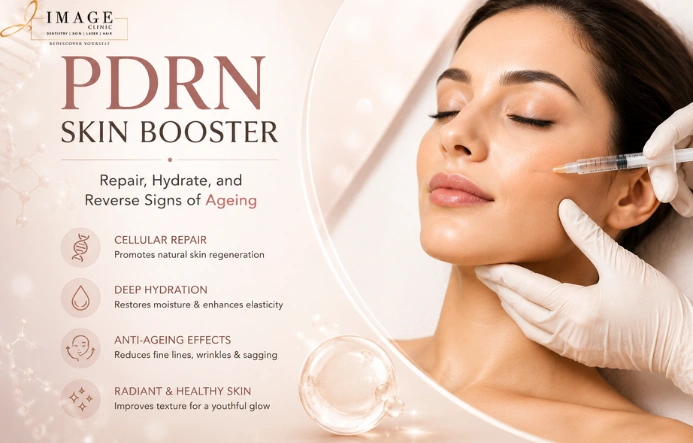
At IMAGE Clinic in Kolkata, PDRN skin booster treatment is prescribed for skin repair, deep hydration, and anti-ageing — targeting the cellular mechanisms of skin ageing and damage at a depth that topical products cannot reach. This guide explains the science, the clinical applications, and how PDRN compares to PRP and hyaluronic acid skin boosters.
| Find out if PDRN skin booster is right for your skin repair and anti-ageing goals. Book your assessment. Book Your PDRN Consultation at IMAGE Clinic |
The Science of PDRN: What It Does at the Cellular Level
What PDRN Is
PDRN stands for polydeoxyribonucleotide — highly purified, short-chain fragments of DNA derived from salmon sperm. The extraction and purification process removes proteins (which would trigger immune reactions), leaving only the DNA nucleotide chains. These chains are the biological raw material from which human cells produce new DNA — making PDRN a substrate that actively supports cellular repair and regeneration.
How PDRN Works in Skin
PDRN exerts its effects through three primary mechanisms:
- A2A adenosine receptor activation: PDRN activates A2A receptors on fibroblasts — the dermal cells responsible for producing collagen, elastin, and hyaluronic acid. A2A receptor activation directly stimulates these biosynthetic activities, increasing collagen and hyaluronic acid production in the treated tissue. This is the most clinically significant effect of PDRN skin booster — measurable improvements in collagen density have been documented in peer-reviewed studies within four to eight weeks of treatment.
- VEGF upregulation (angiogenesis): PDRN upregulates vascular endothelial growth factor (VEGF), stimulating the formation of new capillaries in the treated tissue. Improved microvascularisation enhances the delivery of oxygen and nutrients to skin cells — improving the cellular environment for repair and regeneration. This angiogenic effect also improves the skin’s appearance: better-vascularised skin has more natural radiance and a healthier colour than the pallid, poorly-perfused skin seen in chronic photo-damage and ageing.
- Tissue salvage pathway activation: PDRN provides DNA nucleotide salvage material — the building blocks that damaged cells use to repair their own DNA rather than undergo apoptosis (cell death). In sun-damaged or chronically stressed skin where cells have accumulated oxidative DNA damage, PDRN supplementation supports the cell’s repair mechanisms and reduces the rate of cell death — improving the overall density and vitality of the living skin cell population.
What Conditions Does PDRN Skin Booster Treat?
Skin Ageing and Loss of Collagen
The A2A receptor-mediated collagen stimulation makes PDRN skin booster a clinically effective anti-ageing intervention — particularly for patients with early to moderate signs of collagen loss: fine lines, reduced skin firmness, and the beginning of facial hollowing. Unlike dermal fillers (which add volume) or Botox (which reduces muscle movement), PDRN addresses the structural quality of the skin itself — making the skin inherently more resilient and firmer over time.
Chronically Dehydrated or Barrier-Damaged Skin
PDRN’s stimulation of hyaluronic acid production by fibroblasts produces deep, structural hydration — not the transient surface hydration of a hyaluronic acid serum, but a sustained improvement in the skin’s own moisture retention capacity. Patients with chronically dry, dehydrated, or barrier-damaged skin — a common profile in Kolkata where the cycle of air conditioning and humidity repeatedly disrupts the skin barrier — often notice that PDRN skin booster treatment sustainably improves their skin’s hydration status, requiring less topical moisturiser to maintain the same skin quality.
Photo-Damaged and Sun-Damaged Skin
PDRN’s tissue salvage and angiogenic effects make it particularly effective for chronically sun-damaged skin — improving the cellular vitality of photo-aged skin and enhancing microvascular supply to tissues where UV has impaired circulation. For Kolkata patients who accumulate significant UV damage across the summer months, PDRN treatment sessions from October through March provide cellular repair support during the lower-UV months when the skin is not under continuous new UV stress.
Post-Procedure Skin Recovery
PDRN accelerates healing and improves outcomes when used after other aesthetic procedures — including laser skin resurfacing, MNRF, and chemical peels. The tissue salvage and angiogenic effects support the healing response of the procedure — reducing recovery time, improving the quality of the collagen formed, and producing a better final result than the procedure alone.
| Find out how PDRN skin booster can repair, hydrate, and rejuvenate your skin. Book your consultation. Book Your PDRN Skin Booster Session at IMAGE Clinic |
PDRN vs PRP vs Hyaluronic Acid Skin Boosters: How They Compare
| PDRN Skin Booster | PRP | HA Skin Booster | |
| Source | Salmon DNA nucleotides (pharmaceutical) | Patient’s own blood (autologous) | Cross-linked hyaluronic acid (synthetic) |
| Primary mechanism | A2A receptor activation; DNA salvage; VEGF upregulation | Growth factor release (PDGF, TGF-β, VEGF, EGF) | Volume; hydration; scaffolding |
| Best for | Repair, dehydration, photo-damage, post-procedure recovery | Collagen stimulation, hair restoration, under-eye, skin rejuvenation | Immediate volume; structural hydration; fine lines |
| Collagen stimulation | High (direct A2A-mediated fibroblast activation) | High (growth factor-mediated) | Minimal |
| Hydration effect | High (HA synthesis stimulation) | Moderate | Very high (immediate) |
| Sessions | 3–4 (4–6 weeks apart) | 3–6 (4–6 weeks apart) | 2–4 (4–6 weeks apart) |
| Result onset | Progressive — weeks 3–8 | Progressive — weeks 4–8 | Immediate (volume); weeks 4–8 (collagen) |
People Also Ask: PDRN Skin Booster in Kolkata
What is PDRN skin booster and how does it work?
Short answer: PDRN (polydeoxyribonucleotide) is a purified DNA extract from salmon that activates A2A receptors on skin fibroblasts — directly stimulating collagen and hyaluronic acid production. It also upregulates VEGF to improve skin microvascularisation and provides DNA salvage material that supports cellular repair. The PDRN skin booster at IMAGE Clinic is delivered via micro-injections into the dermis across three to four sessions spaced four to six weeks apart.
How many PDRN sessions are needed?
Short answer: Three to four sessions spaced four to six weeks apart constitute a standard PDRN skin booster course. Visible improvement in skin hydration, texture, and quality is typically apparent from weeks three to six. Maximum results are assessed at three to four months after the first session. Maintenance sessions every three to six months sustain the collagen and hydration benefits achieved in the initial course.
Is PDRN better than PRP for skin?
Short answer: PDRN and PRP address partially overlapping concerns through different mechanisms. PDRN is specifically stronger for skin repair and barrier restoration — its A2A receptor-mediated approach directly activates fibroblasts with consistent potency regardless of patient biology. PRP is autologous (the patient’s own cells) and delivers a broad growth factor profile. For sun damage, post-procedure repair, and dehydration — PDRN is often the preferred choice. For hair restoration and under-eye treatment — PRP or GFC may be preferred.
Is PDRN skin booster safe for Indian skin?
Yes — PDRN skin booster is safe for all skin types, including Indian skin (Fitzpatrick types III–V). The purified DNA nucleotides are biocompatible and do not trigger immune reactions (all proteins are removed during the pharmaceutical extraction process). At IMAGE Clinic, PDRN treatments use pharmaceutical-grade products and are performed by qualified physicians with specific training in skin booster injection technique.
Can PDRN be combined with other treatments?
Yes — PDRN skin booster is frequently combined with laser toning for photo-damage; applied post-MNRF to accelerate healing and improve collagen quality; and used alongside exosome therapy for patients with advanced anti-ageing goals requiring the broadest possible regenerative stimulus. IMAGE Clinic’s dermatologists design personalised combinations based on the patient’s specific concerns and treatment history.
| PDRN Skin Booster in Kolkata — IMAGE Clinic Cellular repair. Deep hydration. Evidence-based anti-ageing. Book Your Appointment Now | Call: 09830 836 666 Or visit your nearest IMAGE Clinic — find your nearest branch here. |