Spot treatment — dabbing a drying agent, benzoyl peroxide gel, or salicylic acid product directly onto a pimple — is one of the most universal skincare habits in India. It feels logical: there is a pimple, so you treat the pimple. The problem is that this approach targets only the visible, terminal stage of a biological process that began days or weeks before the pimple appeared. By the time a pimple is visible on the surface, the follicle has already been through microcomedone formation, sebum accumulation, bacterial proliferation, and the onset of the inflammatory cascade that produces the visible lesion. A spot treatment applied to the surface addresses only the last fraction of this process — and cannot prevent the next pimple that is already forming invisibly beneath the skin. Effective pimple treatment in Kolkata must address the cause, not just the consequence.
This guide identifies the six clinically distinct types of pimples, explains the specific mechanism behind each, and clarifies what each type requires for genuine improvement — and why a spot treatment cannot deliver it.
| Get to the root cause of your pimples at IMAGE Clinic. Our dermatologists prescribe treatment that actually matches the problem. Book Your Pimple Treatment Consultation |
Why Every Pimple Is Not the Same
Acne vulgaris is a single diagnostic term that encompasses six clinically distinct lesion types, each produced by a different combination of the four underlying mechanisms (sebum excess, follicular hyperkeratinisation, C. acnes proliferation, and inflammation). Treatment efficacy depends on matching the intervention to the specific lesion type — not to ‘acne’ as a generic category.
The Six Types of Pimples and What Causes Each
1. Open Comedones (Blackheads)
A blackhead is a follicle plugged by a combination of excess sebum and accumulated dead keratinocytes. The plug oxidises when exposed to air at the follicle opening — producing the characteristic dark colour. Blackheads are not caused by dirt (washing more aggressively does not help) but by excess sebum production and impaired follicular shedding. They are non-inflammatory — no bacteria, no pain, no redness.
Why spot treatments fail: a topical drying agent applied to the surface of a blackhead cannot dissolve the compacted sebum-keratin plug within the follicle. Oil-soluble salicylic acid at clinical concentrations penetrates the follicle and can dissolve the plug from within — but this requires the concentrations available in medical-grade peels, not over-the-counter spot products.
2. Closed Comedones (Whiteheads)
A whitehead is a blocked follicle where the opening is covered by a thin layer of skin — preventing the oxidation that makes blackheads dark. The follicle is still plugged with the same sebum-keratin combination, but the closed surface makes it appear white or flesh-coloured. Whiteheads are the precursors to inflammatory lesions — when the contents of the blocked follicle feed C. acnes bacterial growth, an inflammatory papule or pustule develops.
Why spot treatments fail: as with blackheads, surface application does not reach the follicular plug. Topical retinoids — which normalise follicular keratinisation and prevent new comedone formation — are the most effective treatment for both open and closed comedones, but they work preventively over weeks, not reactively on existing lesions.
Important Read: Acne Scars Treatment in Kolkata: What Causes Acne Scars and How to Treat Them
3. Papules (Inflamed Bumps Without Visible Pus)
A papule is a red, raised, inflamed lesion that forms when the wall of a comedone ruptures — releasing its contents into the surrounding dermis and triggering an immune response. The immune system recruits neutrophils to the site, producing the redness, swelling, and tenderness characteristic of an inflammatory papule. At this stage, C. acnes bacteria have proliferated in the follicle, and their toxic metabolites are driving the inflammation.
Why spot treatments fail: a spot treatment applied to the surface of a papule does not penetrate the dermis where the immune response is occurring. Anti-inflammatory agents (topical clindamycin, azelaic acid) and systemic antibiotics (for moderate inflammatory acne) address the bacterial load and inflammatory cascade — a surface spot product cannot.
4. Pustules (Inflamed Bumps With Visible Pus)
A pustule is an advanced inflammatory lesion — a papule whose neutrophil-rich immune infiltrate has become visible as a pocket of pus at the centre. Pustules are the lesion type most commonly treated with spot products (they feel satisfying to treat — the white head is visible and the skin around it feels actively inflamed). Despite their dramatic appearance, pustules are actually the inflammatory lesion type most responsive to appropriate topical treatment — benzoyl peroxide at clinical concentrations destroys C. acnes effectively when the pustule wall is intact.
5. Nodules and Cysts (Deep Inflammatory Lesions)
Nodular and cystic acne represent the most severe end of the inflammatory spectrum — deep, painful, often interconnected lesions that involve the full dermal depth and sometimes extend into the subcutaneous tissue. These are caused by rupture of the follicular wall at a deeper level, triggering a more intense immune response that may take weeks to resolve and that reliably leaves post-inflammatory hyperpigmentation or atrophic scarring. No spot treatment reaches the depth of a nodule or cyst.
Nodular and cystic acne require systemic treatment — in most cases, oral isotretinoin for severe cases, or a combination of oral antibiotics and hormonal management for women. After resolution, the scarring they leave requires its own treatment programme — typically MNRF for textural scars and laser toning for PIH.
6. Hormonal Pimples (Lower Face, Jawline, Neck)
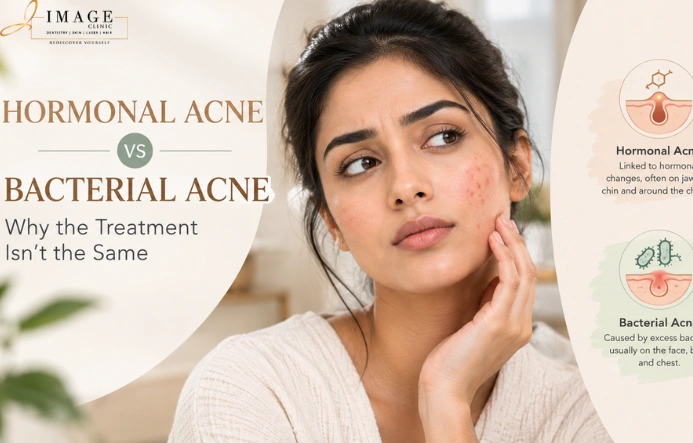
Hormonal acne is a clinically distinct pattern — predominantly inflammatory lesions distributed along the lower face, jawline, and neck, cyclically worsening around menstruation, and associated with conditions including PCOS, elevated androgens, and thyroid dysfunction. The mechanism is androgen-driven sebaceous gland hyperactivity — excess sebum production in the lower face follicles that cannot be controlled by topical treatment alone. IMAGE Clinic assesses hormonal acne with a hormonal balance panel — because treating the skin without addressing the hormonal driver produces limited and temporary results.
| Get your pimple type accurately diagnosed at IMAGE Clinic. Treatment that matches the cause works. Treatment that doesn’t, won’t. Book Your Acne Assessment at IMAGE Clinic |
What Pimple Treatment in Kolkata Actually Involves
Effective pimple treatment in Kolkata at IMAGE Clinic is prescribed after identifying the specific lesion types, their distribution, severity, and any hormonal or systemic contributors. The treatment plan typically combines:
- Prescription topical retinoid: Normalises follicular keratinisation — preventing microcomedone formation. The most evidence-based single agent for acne prevention.
- Benzoyl peroxide: Bactericidal against C. acnes without producing antibiotic resistance. The most effective agent for active inflammatory lesions.
- In-clinic salicylic acid peels or carbon facial: Chemical peels at clinical concentrations clear comedones and reduce sebum; carbon laser facial sessions reduce C. acnes load and control oil output between peel sessions.
- Systemic management where indicated: Oral antibiotics (structured short courses), oral isotretinoin for severe cases, hormonal therapy for confirmed hormonal acne in women.
- Concurrent PIH management: Post-acne marks are addressed alongside active acne management — preventing accumulation of new marks while treating the acne producing them.
The results from a correctly matched acne protocol are documented in IMAGE Clinic’s before and after gallery — outcomes that reflect the real difference between treating pimples and treating the biology that produces them.
Important Read: Can Acne Scars Really Be Removed? Treatments That Actually Work
People Also Ask: Pimple Treatment in Kolkata
Why do spot treatments not work for pimples?
Short answer: Spot treatments address only the terminal visible stage of a biological process that began days earlier in the follicle. They cannot dissolve the follicular plug causing comedones, reach the dermal inflammation driving papules and cysts, or suppress the androgen-driven sebum production that feeds new lesions. Effective pimple treatment in Kolkata addresses the cause — follicular keratinisation, C. acnes proliferation, sebum excess, and inflammation — not just the visible result.
What causes different types of pimples?
Short answer: Different pimple types have different causes. Comedones (blackheads and whiteheads) result from excess sebum and impaired follicular shedding. Papules and pustules result from C. acnes proliferation triggering an immune response. Nodules and cysts result from deep follicular rupture and severe immune involvement. Hormonal pimples on the lower face and jawline result from androgen-driven sebaceous gland hyperactivity — frequently associated with PCOS or hormonal imbalance.
What is the most effective treatment for pimples?
Short answer: The most effective treatment depends on the specific pimple type. For comedonal acne: topical retinoids and clinical salicylic acid peels. For inflammatory papules and pustules: benzoyl peroxide, topical antibiotics, and in-clinic peels or carbon laser facial. For nodular/cystic acne: systemic treatment including oral isotretinoin. For hormonal acne: hormonal management alongside topical treatment. A dermatologist assessment at IMAGE Clinic identifies the type and prescribes accordingly.
Why do pimples keep coming back in the same spot?
Pimples recur in the same location because the underlying biology — excess sebum production, follicular hyperkeratinisation tendency, C. acnes colonisation — persists in that follicle. The follicle’s structural environment makes it repeatedly susceptible to blockage. Without a maintenance programme (topical retinoid, regular chemical peels or carbon facial, and for hormonal acne — hormonal management), the same follicle will cycle through blockage and inflammation repeatedly. IMAGE Clinic’s pimple treatment is designed to break this cycle at the biological level.
What is the difference between a pimple and a cyst?
Short answer: A pimple is a broad term covering inflammatory acne lesions from papules to cysts. Technically, an acne cyst is the most severe inflammatory lesion type — a deep, fluid-filled, painful nodule that involves the full dermal depth and subcutaneous tissue. Cysts do not respond to surface spot treatments and require systemic management. They reliably leave acne scars requiring separate treatment after the cysts resolve.
| Pimple Treatment in Kolkata — IMAGE ClinicCause identified. Treatment matched. Real acne control. Book Your Appointment Now | Call: 09830 836 666 Or visit your nearest IMAGE Clinic — find your nearest branch here. |