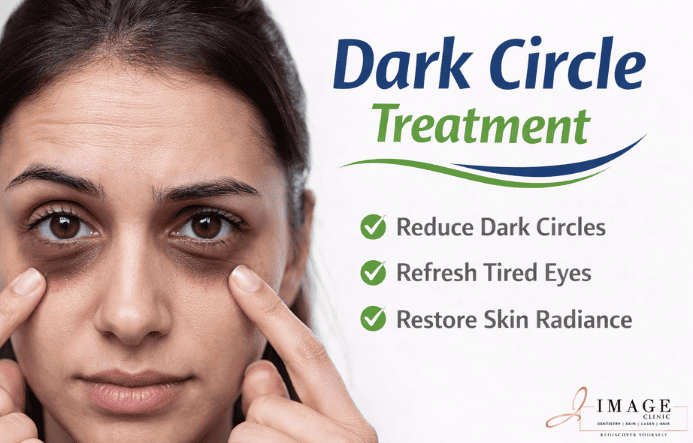

‘Get more sleep’ is the advice that almost everyone with dark circles has already tried — and found wanting. The assumption that dark circles are caused by sleep deprivation is one of the most persistent misconceptions in skincare, and it leads a significant proportion of patients with genuine, treatable causes of under-eye darkness to spend years sleeping eight hours a night while their dark circles remain completely unchanged. Dark circle treatment in Kolkata at IMAGE Clinic begins with a different question: what is actually causing this patient’s darkness? Because the cause determines the correct treatment — and the correct treatment is not sleep.
This guide explains the five clinically distinct causes of dark circles, how to identify which one or combination is affecting you, and what genuinely treats each one.
| Get a clinical assessment of your dark circles at IMAGE Clinic. Find the actual cause — and the right treatment. Book Your Dark Circle Consultation |
Why Sleep Is Only Part of the Story
Sleep deprivation does cause temporary periorbital changes — vasodilation increases blood flow to the capillary network beneath the thin under-eye skin, making the blue-purple vascular shadow more visible. This is a real effect, and it explains why dark circles look worse on a bad night. But it does not explain why many patients have pronounced dark circles consistently regardless of sleep quality, why dark circles run in families, or why the colour and quality of darkness varies so dramatically between individuals.
The under-eye skin — at approximately 0.5mm — is the thinnest on the face. What appears through it as ‘darkness’ can have five distinct origins. Only one of them is meaningfully affected by sleep.
The Five Real Causes of Dark Circles
Cause 1: Vascular (Blue-Purple Tones)
The capillary network beneath the under-eye skin is visible through the translucent tissue as a blue-purple shadow. This is the cause that responds to sleep deprivation — the dilated capillaries of a tired person are more visible than the constricted capillaries of a rested one. But genetic thin-skinnedness, pale Fitzpatrick type I–II skin, and periorbital vasodilation from allergies, alcohol, or chronic sinus congestion produce the same visual effect regardless of sleep. Under-eye filler placed beneath the capillary network thickens the overlying skin, masking the vessels — producing an immediate visible improvement that hours of sleep cannot.
Cause 2: Pigmentation (Brown Tones)
Periorbital melanin deposition — driven by UV exposure, habitual eye-rubbing, allergic rhinitis (the ‘allergic shiner’), and genetic predisposition — produces brown-toned dark circles. This is the most prevalent cause in Indian patients (Fitzpatrick types III–V) and is entirely unrelated to sleep. The melanin deposited from years of rubbing, UV exposure, and allergic inflammation does not clear with rest. Laser toning progressively fragments the periorbital melanin deposits over four to six sessions. The specialised EyeRevive peel at IMAGE Clinic is formulated specifically for the delicate under-eye skin, gently exfoliating surface pigmentation without the irritation risk of standard peels near the orbital rim.
Cause 3: Structural Hollow — Shadow Darkness
From the mid-thirties onward, the loss of mid-face fat and the descent of facial soft tissue creates the tear-trough deformity — a groove between the lower eyelid and the cheek. This groove creates a shadow that reads in photographs and in daylight as dark circles — but it is not darkness in the skin. No topical treatment, no sleep, no laser reaches the structural cause. The correct treatment is hyaluronic acid tear-trough filler placed in the hollow — restoring volume and eliminating the shadow immediately. Results last twelve to eighteen months.
Cause 4: Skin Laxity and Crepey Texture
Thinning, textured under-eye skin — from UV damage, loss of collagen with ageing, and chronic under-eye rubbing — creates an uneven reflective surface that diffuses light inconsistently, producing a shadowed, tired appearance. PRP therapy delivers concentrated growth factors into the periorbital skin, stimulating new collagen and elastin over three to four sessions. Profhilo treatment bio-remodels the periorbital skin quality — improving hydration, firmness, and surface smoothness without adding volume.
Cause 5: Genetics
Some patients have dark circles from childhood — inherited through family patterns that include thin periorbital skin, high periorbital melanin density, prominent vasculature, or deep tear-trough anatomy. Genetic dark circles are among the most challenging to treat because all four other cause mechanisms may be simultaneously present in the same patient. However, they are not untreatable — a multi-modal approach addressing pigmentation, vascular visibility, and structural hollow simultaneously produces significant improvement even in patients with strongly genetic dark circles.
| Most dark circles have a specific, treatable cause. Find yours at IMAGE Clinic, Kolkata. Book Your Dark Circle Treatment |
The Blanch Test: Identifying Your Cause at Home
A simple test helps identify the primary cause of your dark circles before a clinical assessment:
- Press the under-eye skin gently with a fingertip and release. If the darkness disappears momentarily when pressure is applied and returns when released — the cause is predominantly vascular.
- If the darkness does not change when you press — the cause is predominantly pigmentation, structural, or textural.
- Look at your reflection in profile — if there is a visible hollow or groove between the lower eyelid and cheek (the tear-trough) — the shadow component from structural hollowing is significant.
- Check the colour in good natural light — blue-purple suggests vascular; brown suggests pigmentation; grey-shadow suggests structural.
Most patients have a combination of two or more causes simultaneously — which is why dark circle treatment at IMAGE Clinic is always preceded by a clinical assessment using dermoscopy and physical examination before any treatment is recommended.
People Also Ask: Dark Circle Causes and Treatment in Kolkata
Why do I have dark circles even when I sleep enough?
Short answer: Dark circles have five causes — and only vascular dark circles are meaningfully affected by sleep. Pigmentation (the most common cause in Indian patients), structural hollow, skin laxity, and genetics produce dark circles that are entirely unaffected by sleep quantity. Dark circle treatment in Kolkata at IMAGE Clinic begins with identifying which cause is present — because the treatment for each is completely different.
Are dark circles genetic?
Short answer: Yes — dark circles run strongly in families, and genetic factors include periorbital skin thickness, melanin density, vascular prominence, and tear-trough anatomy. Genetic dark circles typically present from a young age and are present regardless of sleep or lifestyle factors. They are more challenging to treat than environmental causes but remain significantly improvable with a multi-modal approach combining laser toning, filler, and PRP therapy at IMAGE Clinic.
Can dark circles be removed permanently?
Short answer: Structural hollow dark circles corrected with tear-trough filler last twelve to eighteen months per treatment. Pigmentation dark circles can be significantly reduced with laser toning, with maintenance required. Vascular dark circles improve with filler, though repeat treatment is needed. Genetic and mixed dark circles require ongoing maintenance — significant improvement rather than permanent elimination is the realistic goal.
Does rubbing your eyes cause dark circles?
Yes — habitual eye-rubbing is one of the most common and most preventable causes of periorbital hyperpigmentation, particularly in Indian skin. The mechanical friction triggers repeated micro-inflammation in the periorbital skin, stimulating melanocytes to deposit increasing amounts of melanin over months and years. Patients who rub their eyes regularly — from allergies, dry eyes, or habit — consistently develop darker periorbital pigmentation than those who do not. Treating the underlying trigger (antihistamines for allergies; lubricating drops for dry eyes) alongside dark circle treatment produces better long-term outcomes than laser alone.
Which dark circle treatment works fastest?
Short answer: Tear-trough filler produces the fastest result for structural hollow dark circles — immediate improvement visible within minutes of the procedure. For pigmentation dark circles, visible improvement begins from laser toning session two to three (four to six weeks). PRP therapy for skin laxity shows progressive improvement over three months. The fastest result depends on which cause is present — confirmed at a clinical assessment at IMAGE Clinic.
| Dark Circle Treatment in Kolkata — IMAGE Clinic Real causes. Right treatments. Under-eye clarity. Book Your Appointment Now | Call: 09830 836 666 Or visit your nearest IMAGE Clinic — find your nearest branch here. |