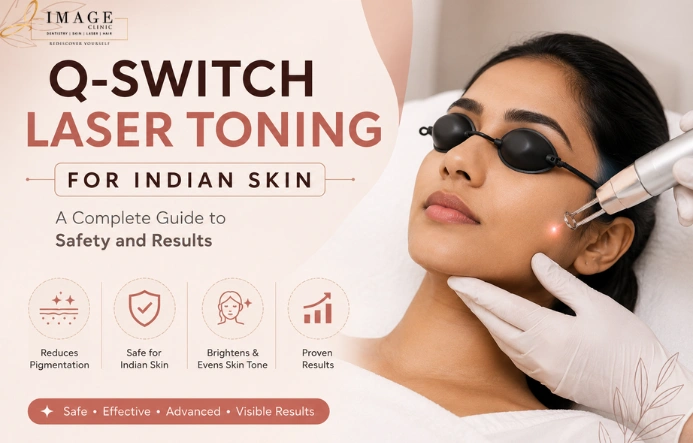
Of all the laser toning treatments available in Kolkata, the Q-switched Nd: YAG laser has the most extensively documented evidence base — and the most specific relevance to Indian skin. While laser technology in aesthetics spans dozens of wavelengths and mechanisms, the Q-switch Nd: YAG at 1,064nm holds a particular position: it is simultaneously the safest laser for Fitzpatrick types III–V and the most versatile for addressing the pigmentation concerns that are most prevalent in the Indian patient population. This guide covers everything patients in Kolkata need to know before beginning a laser toning treatment course.
That means: what the Q-switch laser actually does at the tissue level, why Indian skin requires a different approach from lighter skin tones, what a realistic course of laser toning treatment in Kolkata involves, and how to identify whether you are a good candidate for the treatment.
| Ready to start laser toning? Book your clinical assessment at IMAGE Clinic, Kolkata. Book Your Laser Toning Assessment |
What Is Q-Switch Laser Toning? The Mechanism Explained
‘Q-switching’ refers to the method by which laser energy is stored in the laser cavity and released in extremely brief, high-intensity pulses — measured in nanoseconds (billionths of a second). This ultrashort pulse duration is what makes Q-switched lasers uniquely effective for pigmentation treatment. The mechanism operates on a principle called selective photothermolysis: the laser wavelength is chosen to be selectively absorbed by the target chromophore (melanin, in the case of pigmentation) while passing through the surrounding tissue without significant absorption.
At 1,064nm, the Nd: YAG laser’s energy is absorbed preferentially by melanin clusters. The ultrashort pulse delivers energy faster than the thermal relaxation time of the melanin particle — meaning the energy is concentrated in the particle rather than dissipating into surrounding tissue. This creates a photoacoustic effect that shatters the melanin cluster into smaller fragments, which the body’s lymphatic system progressively clears over the weeks following treatment. The result is a progressive reduction in the density and darkness of the pigmentation, with the skin’s surrounding tissue largely undisturbed.
Why Indian Skin Requires Specific Q-Switch Laser Protocols
The same Q-switch Nd: YAG laser used at the parameters appropriate for Fitzpatrick type II skin in a European clinic can cause significant post-inflammatory hyperpigmentation (PIH) if applied at those parameters to Fitzpatrick type IV skin in Kolkata. The difference is in melanocyte behaviour.
Indian skin has a higher baseline density of melanocytes and a higher melanocyte reactivity — the melanocytes respond more readily to thermal and inflammatory stimuli by producing additional melanin. This means that the thermal component of any laser treatment in Indian skin must be carefully controlled, and the energy parameters must be calibrated conservatively. High-fluence Q-switch laser treatment that would produce satisfactory results in lighter skin can trigger a PIH response in Indian skin that leaves it darker than before treatment.
At IMAGE Clinic, every laser toning treatment in Kolkata is preceded by a skin assessment that establishes the patient’s Fitzpatrick type, baseline melanin density (using dermoscopy), and any history of PIH from previous treatments. These factors directly determine the starting fluence — the energy delivered per unit area — and the protocol for parameter adjustment across subsequent sessions.
The Pre-Treatment Protocol: Why Priming Matters
Patients presenting for laser toning treatment at IMAGE Clinic begin a priming protocol two to four weeks before the first session. This involves topical depigmenting agents — formulations containing azelaic acid, kojic acid, or vitamin C derivatives — applied daily. The purpose is to suppress baseline melanocyte activity before the first laser session, reducing the risk of the laser stimulus triggering a PIH response in hyper-reactive melanocytes.
During the priming phase, daily broad-spectrum SPF 50+ use is mandatory and non-negotiable. UV exposure during the priming period — or at any point during the laser toning course — can counteract the treatment’s depigmenting effect, as UV stimulation of melanocytes produces new pigment faster than the laser can clear existing deposits.
| Get an accurate assessment of your skin’s suitability for laser toning. Our dermatologists will prescribe the right protocol. Book Your Consultation at IMAGE Clinic |
Session by Session: What a Laser Toning Course Looks Like
| Session | Energy Parameters | What Happens During | What Happens After | Cumulative Result |
| Priming (Weeks 1–4) | Topical only — no laser | Depigmenting agents applied daily | Subtle brightening; baseline suppression begins | Melanocyte activity reduced |
| Session 1 | Conservative — 2.0–2.5 J/cm² | Laser applied to full treatment area; skin response assessed | Mild redness, warmth — resolves in 2–4 hours | 10–20% improvement visible after 2 weeks |
| Sessions 2–3 | Maintained or slightly increased based on response | Progressive laser application | Continued mild redness post-session only | 30–50% improvement cumulative |
| Sessions 4–5 | Parameters optimised for individual response | Deeper melanin targeted as surface deposits clear | Minimal post-session response as skin adapts | 50–70% improvement for PIH; 80–90% for sun spots |
| Maintenance | Lower energy — maintenance dose | Single monthly session | No visible recovery required | Results sustained; prevents reaccumulation |
What Conditions Does Laser Toning Treatment in Kolkata Address?
The Q-switch Nd: YAG laser toning is clinically appropriate for several distinct pigmentation conditions common in Kolkata’s patient population. Understanding which conditions respond best helps set accurate expectations:
- Post-inflammatory hyperpigmentation (PIH): The flat dark marks from healed acne or skin trauma. Laser toning fragments the epidermal and superficial dermal melanin deposits progressively. Four to six sessions typically achieve 50–70 per cent improvement.
- Solar lentigines (sun spots): Discrete, well-defined brown spots from cumulative UV exposure. These respond the most dramatically — 80–95 per cent clearance is achievable in two to four sessions.
- Diffuse photo-damage and tan: The generalised darkening and dullness from sustained UV exposure. Laser toning combined with chemical peels in an alternating protocol addresses both surface and deeper pigment effectively.
- Freckles: Responsive to laser toning but with a high recurrence rate from UV re-exposure. Laser toning is effective for clearing, but strict SPF use is essential to prevent rapid recurrence.
- Melasma (adjunct only): Low-fluence laser toning is used as an adjunct to the Cosmelan depigmentation protocol for the dermal melanin component of melasma. High-fluence laser is contraindicated for active melasma in Indian skin.
Safety: What Can Go Wrong and How IMAGE Clinic Prevents It
The most important safety risk of laser toning in Indian skin is post-laser PIH — paradoxical darkening triggered by the laser stimulus. This is not a theoretical risk; it occurs in clinics that use inappropriate energy parameters, treat without priming, or fail to monitor skin response between sessions. The consequences can be significant: PIH that is darker than the original pigmentation and requires months of additional treatment to resolve.
IMAGE Clinic’s prevention protocol has four components: mandatory priming to reduce baseline melanocyte reactivity; conservative energy parameters calibrated for Indian skin; real-time assessment of skin response at each session with immediate parameter adjustment if early PIH signs appear; and strict mandatory SPF use throughout the treatment course. Patients who cannot commit to daily SPF 50+ are advised to delay laser toning until they can.
For patients whose pigmentation concerns include melasma alongside PIH or photo-damage, the hyperpigmentation treatment protocol at IMAGE Clinic is designed as a multi-modal programme — not laser toning alone.
People Also Ask: Laser Toning Treatment in Kolkata
What is Q-switch laser toning?
Short answer: Q-switch laser toning uses an Nd: YAG laser operating in nanosecond pulses to selectively fragment melanin deposits in the skin. The laser’s energy is absorbed by melanin clusters, shattering them into smaller particles that the lymphatic system progressively clears. At IMAGE Clinic in Kolkata, laser toning treatment is calibrated specifically for Indian skin tones to prevent post-inflammatory hyperpigmentation.
Is Q-switch laser safe for Indian skin?
Short answer: Yes — Q-switch Nd: YAG at 1,064nm is the safest laser wavelength for Indian skin (Fitzpatrick types III–V). Its longer wavelength penetrates to the dermis with minimal epidermal absorption, reducing PIH risk. Safety depends critically on energy calibration — IMAGE Clinic’s protocols use conservative parameters, mandatory pre-treatment priming, and real-time skin response monitoring to prevent paradoxical darkening in darker skin tones.
How many sessions of laser toning are needed?
Short answer: Most pigmentation types require four to six sessions spaced two to three weeks apart. Solar lentigines may respond in two to four sessions. Diffuse photo-damage typically requires six or more. Post-acne PIH: four to six sessions for a significant reduction. Results continue improving between sessions for two to three weeks after each treatment as the lymphatic system clears fragmented melanin.
What is the difference between Q-switch and other laser treatments?
Short answer: Q-switch laser operates in nanosecond pulses and targets melanin non-ablatively — without removing the skin surface. Fractional laser resurfacing ablates the skin surface and is used for texture, scars, and deeper photodamage. Q-switch is the correct modality for pure pigmentation concerns with no downtime; fractional resurfacing is for structural skin changes with two to five days of recovery.
What results can I realistically expect from laser toning?
Short answer: Realistic expectations depend on pigmentation type. Sun spots: 80–95 per cent clearance in two to four sessions. Post-acne PIH: 50–70 per cent improvement over four to six sessions. Diffuse photo-damage: 60–75 per cent improvement over four to six sessions. Melasma: 30–50 per cent improvement as an adjunct to Cosmelan; not as a standalone treatment. View documented results at IMAGE Clinic for reference.
| Laser Toning Treatment in Kolkata — IMAGE Clinic Q-switch precision. Indian skin expertise. Real, measurable results. Book Your Appointment Now | Call: 09830 836 666 Or visit your nearest IMAGE Clinic — find your nearest branch here. |