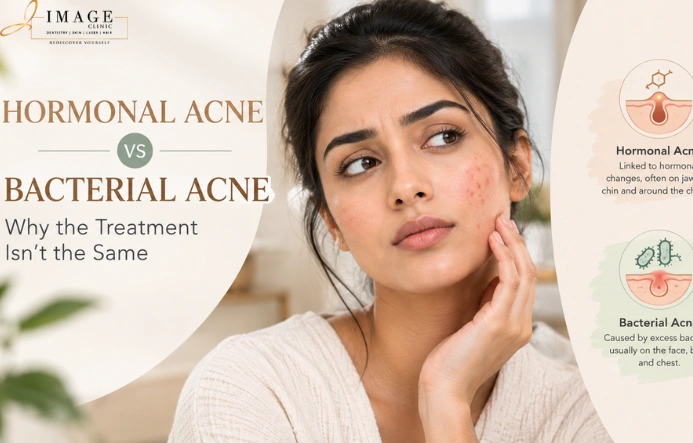
One of the most reliably identifiable patterns in pimple treatment consultations in Kolkata is patients who have been using bacterial acne treatments for what is, in fact, hormonal acne — or vice versa — for months without meaningful improvement. The two conditions look similar on the surface — both produce inflammatory pimples on the face — but they are driven by completely different biological mechanisms and require fundamentally different treatment approaches. Applying a bacterial treatment to hormonal acne is not just ineffective; it can worsen the skin by adding unnecessary antimicrobial agents to a problem that is not primarily bacterial in origin.
This guide from IMAGE Clinic’s dermatologists explains how to tell hormonal and bacterial acne apart, what causes each, and why the treatment must match the mechanism.
| Get an accurate acne diagnosis at IMAGE Clinic, Kolkata — and a treatment plan that actually matches the cause. Book Your Acne Consultation at IMAGE Clinic |
The Biology: What Drives Each Type
Bacterial Acne
Bacterial acne — more accurately called C. acnes-driven inflammatory acne — follows a four-step cascade: excess sebum production fills the follicle; impaired follicular shedding (hyperkeratinisation) blocks the pore; Cutibacterium acnes bacteria proliferate in the oxygen-poor, sebum-rich blocked follicle; and their toxic metabolites trigger an immune response that produces the visible inflammatory lesion. The key driver is C. acnes proliferation within a comedone.
Bacterial acne responds to treatments that target this cascade: topical retinoids (normalise follicular shedding to prevent comedone formation); benzoyl peroxide (destroy C. acnes without producing antibiotic resistance); topical and oral antibiotics (reduce C. acnes load); and salicylic acid peels (dissolve the comedone contents from within the follicle).
Hormonal Acne
Hormonal acne is driven primarily by androgen stimulation of the sebaceous glands — testosterone and dihydrotestosterone (DHT) bind to receptors on sebaceous gland cells, dramatically increasing sebum production. This androgen-driven sebum surge creates the ideal environment for C. acnes proliferation — but the primary driver is not the bacteria; it is the hormonal environment that produces the substrate for bacterial growth. In women, hormonal acne is frequently associated with PCOS, elevated androgens, or hormonal fluctuations around the menstrual cycle.
Bacterial treatments applied to hormonal acne reduce C. acnes load — which helps somewhat — but they cannot suppress the androgen-driven sebum production that continuously recreates the conditions for new comedones. Without addressing the hormonal driver, bacterial treatments for hormonal acne produce partial, temporary improvement that reverses as soon as treatment stops.
Important Read: Acne Scars Treatment in Kolkata: What Causes Acne Scars and How to Treat Them
How to Tell Them Apart: The Clinical Differentiators
| Feature | Bacterial Acne | Hormonal Acne |
| Primary location | Forehead, nose, cheeks (T-zone and entire face) | Lower face, jawline, chin, and neck |
| Lesion type | Predominantly comedones + inflammatory papules/pustules | Deep, painful nodules and cysts; fewer surface comedones |
| Pattern | Diffuse; not clearly tied to hormonal cycle | Cyclical in women — worse before menstruation; consistent in PCOS |
| Associated features | Oily skin throughout; often present from teenage years | May coincide with irregular periods, excess facial hair, weight changes |
| Age pattern | Peak in teenage years; often improves in twenties | Persists or worsens in late twenties and thirties; may begin in adulthood |
| Response to antibiotics | Meaningful improvement | Limited — partial at best |
| Response to hormonal treatment | Minimal | Significant improvement |
The Treatment Approach for Each
Treating Bacterial Acne at IMAGE Clinic
Bacterial acne pimple treatment at IMAGE Clinic combines: topical retinoid (adapalene or tretinoin — the most evidence-based long-term comedone prevention agent); benzoyl peroxide (bactericidal, non-resistance-forming); regular salicylic acid chemical peels (follicular clearance and sebum reduction); and — for moderate to severe cases — a structured short course of oral antibiotics to reduce the established bacterial load before transitioning to topical maintenance.
In-clinic, the carbon laser facial sessions fortnightly during the high-sebum months of Kolkata’s summer and monsoon provide mechanical pore clearance and C. acnes destruction between chemical peel sessions — significantly improving control during the months when bacterial acne is at its worst in Kolkata’s climate.
Treating Hormonal Acne at IMAGE Clinic
Hormonal acne requires a different primary approach. IMAGE Clinic begins with a hormonal balance panel — including testosterone, DHEAS, LH/FSH ratio, and insulin — to establish whether elevated androgens, insulin resistance, or PCOS is the primary driver. The treatment protocol is then designed around the result:
- Oral contraceptive pills (anti-androgenic formulations): For women of reproductive age not planning a pregnancy — anti-androgenic OCP formulations (containing drospirenone or cyproterone acetate) directly suppress androgen-driven sebum production. This is the most targeted hormonal acne treatment available — addressing the primary driver rather than the downstream consequence.
- Spironolactone: An anti-androgenic medication that blocks androgen receptors at the sebaceous gland — reducing sebum production without the contraceptive effect of OCP. Particularly useful for women who cannot or prefer not to use hormonal contraceptives.
- Isotretinoin: For severe hormonal acne (particularly cystic lesions) that has not responded to other measures — oral isotretinoin dramatically reduces sebaceous gland activity through a mechanism independent of hormone levels. Used carefully with contraception due to teratogenicity.
- PCOS management: For women whose hormonal acne is driven by PCOS, the acne management is integrated with the broader PCOS treatment programme — including insulin sensitisers, dietary management, and hormonal regulation.
Important Read: Can Acne Scars Really Be Removed? Treatments That Actually Work
| Hormonal or bacterial acne — the answer determines the treatment. Get a clinical diagnosis at IMAGE Clinic, Kolkata. Book Your Acne Treatment Consultation |
Why Getting the Diagnosis Right Matters
A patient with hormonal acne who receives bacterial acne treatment will typically see some improvement — C. acnes is a contributing factor in both types — but will continue to experience cyclical flares, particularly pre-menstrually, that no amount of topical retinoid or benzoyl peroxide addresses. This partial response is often interpreted as the ‘maximum possible improvement’ rather than correctly diagnosed as an inadequate treatment match. At IMAGE Clinic, pimple treatment consultations specifically assess the distribution, lesion type, and cyclical pattern of acne before prescribing — because the history often distinguishes the two types before any investigation is required.
People Also Ask: Pimple Treatment in Kolkata
How do I know if my acne is hormonal?
Short answer: Hormonal acne typically presents as deep, painful cysts and nodules along the lower face, jawline, and neck — worse in the week before menstruation and improving after. It is associated with irregular periods, excess facial hair, or weight gain in women. Bacterial acne produces diffuse comedones and inflammatory papules across the full face, peaking in teenage years. A dermatologist assessment at IMAGE Clinic confirms the diagnosis with clinical examination and, where indicated, hormonal blood tests.
Why is my acne not responding to antibiotics?
Short answer: Two common reasons: first, the acne may be hormonal rather than primarily bacterial — in which case antibiotics reduce C. acnes load partially but cannot address the androgen-driven sebum production that is the primary driver. Second, C. acnes antibiotic resistance is increasingly prevalent — previously effective antibiotics may have diminishing efficacy over time. IMAGE Clinic‘s approach transitions from antibiotics to non-antibiotic maintenance (benzoyl peroxide, topical retinoid) as soon as adequate bacterial load reduction is achieved.
Is hormonal acne treatable without medication?
Short answer: Hormonal acne can be improved without prescription medication through: a low-glycaemic-index diet (reduces insulin-mediated androgen production); regular exercise (improves insulin sensitivity and hormonal regulation); targeted stress management (cortisol reduction decreases androgen-driven sebum); and regular in-clinic chemical peels and carbon facials. However, for moderate to severe hormonal acne — particularly with PCOS — prescription hormonal treatment consistently produces significantly better outcomes than lifestyle measures alone.
Important Read: Best Dermatologist-Approved Ingredients for Acne-Prone Skin
Can men have hormonal acne?
Short answer: Yes — men can have hormonal acne, driven by testosterone and DHT. In adolescent males, androgen surges during puberty produce the classic teenage acne pattern. Adult male hormonal acne — which may persist or worsen in the twenties and thirties — is less common than in women but occurs. In men, the treatment options are more limited (anti-androgenic OCP is not applicable) — isotretinoin and topical retinoids are the primary approaches for moderate to severe adult male acne.
What happens if hormonal acne is left untreated?
Short answer: Untreated hormonal acne — particularly the deep nodular and cystic variety — reliably produces significant acne scarring (atrophic textural scars requiring MNRF or fractional CO2 to treat) and persistent post-inflammatory hyperpigmentation. The emotional and social impact of moderate to severe acne on patients’ confidence and quality of life is also well-documented. Early pimple treatment matched to the correct type prevents both the physical scarring and the cumulative psychological burden of prolonged untreated disease.
| Pimple Treatment in Kolkata — IMAGE Clinic Right diagnosis. Right treatment. Real acne control. Book Your Appointment Now | Call: 09830 836 666 Or visit your nearest IMAGE Clinic — find your nearest branch here. |