
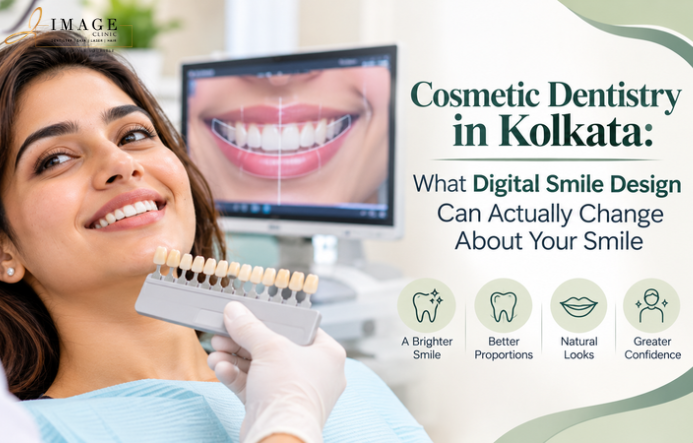
There’s a gap between what most people think cosmetic dentistry in Kolkata can do and what it can actually do. The assumption is usually that cosmetic dentistry means whiter teeth — a brightening treatment that removes staining and not much more. The reality is considerably more interesting. Modern cosmetic dentistry, when planned properly through Digital Smile Design, can change the shape, size, proportion, and overall harmony of the smile in ways that alter how a face reads at normal conversational distance. Not just teeth. The whole smile zone.
Thank you for reading this post, don't forget to subscribe!At IMAGE Clinic, the cosmetic dentistry programme is built around Digital Smile Design — a planning methodology that starts with the face, not the teeth. Before any procedure begins, the patient sees exactly what the proposed outcome looks like. That’s the part that changes how people make decisions about treatment, and it’s the part most clinics in Kolkata don’t offer in a structured, rigorous way.
This guide explains the procedures that fall under cosmetic dentistry, how Digital Smile Design works as a planning process, and who genuinely benefits from it — and who doesn’t.
| Curious what cosmetic dentistry could actually change about your smile? IMAGE Clinic’s Digital Smile Design consultation starts with your face, not a treatment menu. Book Your Smile Design Consultation |
| IMAGE Clinic, Kolkata — IMAGE Clinic is a leading destination for cosmetic dentistry in Kolkata, offering Digital Smile Design consultations, dental veneers, teeth whitening, gum contouring, and comprehensive smile makeovers in South Kolkata. All cosmetic dental procedures are performed by qualified cosmetic dentists using internationally recognised materials and US FDA-cleared equipment. Cosmetic Dentistry at IMAGE Clinic | Orthodontic Treatment | Book a Consultation |
What Is Digital Smile Design, and Why Does the Planning Step Matter So Much?
Digital Smile Design (DSD) is a clinical planning methodology, not a single procedure. It is the step that precedes any cosmetic dentistry treatment — the process through which the dentist and patient design the outcome together before committing to any irreversible clinical work.
The traditional approach to cosmetic dentistry was to diagnose a problem, propose a solution, and proceed. Patients consented to a treatment description without seeing what the result would look like. With DSD, the patient’s facial photographs and digital images are analysed to map the relationship between their teeth, gums, lip line, facial symmetry, and midline. The proposed smile changes are then designed digitally — proportioned to the patient’s actual face — and a physical mock-up (in composite resin or a wax model on a study cast) is made so the patient can see the proposed result in their mouth before anything permanent is done.
This changes the consultation in two important ways. First, it makes the outcome real before any financial or clinical commitment is made — patients who see their proposed result clearly are in a position to give truly informed consent, rather than trusting a description. Second, it exposes the case complexity early: a smile that looks like a simple whitening case sometimes reveals, under proper DSD analysis, that the tooth positions or gum levels need addressing first for the result to be proportionate and stable.
The DSD process at IMAGE Clinic follows four stages: facial analysis and photography, digital design and proportion mapping, mock-up fabrication and patient review, and finalised treatment planning based on what the patient approves in the mock-up.
The Procedures That Cosmetic Dentistry in Kolkata Can Offer
Cosmetic dentistry is not a single treatment — it’s a category that includes several distinct procedures, each with its own indications and outcomes. Understanding which procedure addresses which concern prevents the common disappointment of expecting one treatment to do the work of another.
Dental Veneers
Veneers are ultra-thin ceramic or composite shells that bond to the front surface of the teeth to change their colour, shape, size, or surface texture. They are the most versatile single cosmetic dentistry procedure because they can address multiple concerns simultaneously — a tooth that is discoloured, chipped, slightly rotated, and shorter than its neighbours can be corrected with a single veneer without separate whitening, bonding, alignment, and lengthening procedures.
Porcelain veneers (typically IPS e.max ceramic) are the most durable and natural-looking option, with a lifespan of ten to fifteen years when maintained correctly. Composite veneers are less expensive and can be completed in a single visit but are more prone to staining and surface wear over time and typically need replacing or polishing within five to seven years. IMAGE Clinic uses both materials; the choice is made based on the degree of change needed, the patient’s aesthetic priorities, and the budget.
One thing veneers cannot correct on their own: significant tooth misalignment. When teeth are rotated or crowded beyond a minor degree, orthodontic correction either precedes or replaces veneers, because placing veneers on poorly aligned teeth requires removing more tooth structure than is ideal, and the result reads as unnatural. This is one of the key conversations in the DSD consultation.
Teeth Whitening
Professional teeth whitening at IMAGE Clinic uses higher-concentration bleaching agents than over-the-counter products, in a controlled clinical setting that protects the gums and soft tissue. The treatment is divided into in-clinic whitening (typically one to two sessions of forty-five to sixty minutes each) and a home whitening programme using custom-fitted trays that the patient uses over one to two weeks.
What whitening can and cannot do is important to set out clearly. It reliably lightens the natural tooth structure by several shades, removing extrinsic staining from coffee, tea, red wine, and tobacco, and addressing the generalised yellowing that develops as the translucent enamel layer thins with age. It does not change the colour of existing crowns, veneers, or bonding — those restorations are not porous and do not bleach. And it does not address tetracycline staining (the grey-brown banding caused by tetracycline antibiotic use in childhood), which requires veneers or bonding for masking.
Composite Bonding and Tooth Contouring
Composite bonding uses tooth-coloured resin applied directly to the tooth surface to repair chips, close small gaps between teeth, lengthen slightly short teeth, or improve minor surface irregularities. It is the most conservative cosmetic option — in many cases no tooth structure is removed — and it can be completed in a single visit. It’s the right starting point for patients who want a cosmetic improvement without the commitment of veneers.
Tooth contouring (sometimes called enameloplasty) is the complementary procedure: minor reshaping of the tooth’s natural enamel surface to improve proportions or remove small chips and irregularities. Bonding adds; contouring removes. Used together, they can make a surprisingly significant difference to the overall appearance of the smile zone with minimal clinical intervention.
Gum Contouring
The gum line is as important to a balanced smile as the teeth themselves. A gum line that sits too low on the teeth gives a “gummy smile” — where more gum tissue than ideal is visible above the upper teeth when smiling. A gum line that is uneven creates asymmetry that persists even after veneers or whitening, because the teeth beneath still appear mismatched in length.
Gum contouring at IMAGE Clinic uses laser-assisted soft tissue reshaping to remove excess gum tissue and redefine the gum line at the correct height. The procedure is precise, heals quickly compared with traditional surgical gum work, and produces a result that is visible immediately — the teeth appear longer and more proportionate in relation to the gum tissue above them. Gum contouring is often part of the DSD plan rather than a standalone request, because the digital design process identifies whether gum levels need addressing before or alongside other cosmetic procedures.
For patients with more significant gum concerns — gum disease, bone loss, or recession — the relevant treatment is periodontal therapy rather than aesthetic contouring. Periodontal surgery at IMAGE Clinic addresses the health of the supporting tissue, which is always the prerequisite for cosmetic work on the teeth above.
Clear Aligners for Cosmetic Alignment Correction
Minor-to-moderate tooth misalignment is increasingly treated within the cosmetic dentistry pathway using clear aligners rather than fixed braces. Clear aligners are a series of custom-fabricated transparent plastic trays that progressively move teeth into the planned positions over a period of six to eighteen months, depending on the degree of correction needed.
Clear aligners address a specific but common scenario in cosmetic planning: patients who want veneers for their front teeth but whose tooth positions would require excessive enamel reduction for veneers to sit flush. Correcting alignment first with aligners means veneers can be placed more conservatively — preserving more natural tooth structure and producing a better long-term result. This combined pathway is part of how IMAGE Clinic’s DSD process works; it maps the full treatment sequence, not just the finishing procedure. For more complex alignment cases, orthodontic treatment options are discussed at the consultation.
| A smile makeover is not a single appointment — it’s a plan. IMAGE Clinic’s DSD consultation maps every step before you commit to a single procedure. Start with a Smile Design Consultation |
How IMAGE Clinic’s Digital Smile Design Consultation Actually Works
The DSD consultation at IMAGE Clinic is a clinical appointment, not a sales presentation. It follows a structured sequence that produces a concrete plan — not a treatment recommendation from a menu.
- Step 1 — Photographs and facial analysis — full-face and close-up dental photographs are taken under standardised lighting. The facial midline, lip line, smile arc (the curve of the upper teeth in relation to the lower lip), and gum levels are mapped.
- Step 2 — Digital design — the proposed tooth shapes, sizes, and gum line changes are drawn over the photographs. This allows the dentist to show the patient exactly how the proposed changes will look in proportion to their face before any clinical decision is made.
- Step 3 — Diagnostic mock-up — a physical mock-up of the proposed smile is fabricated and placed temporarily in the patient’s mouth using composite resin. The patient sees and feels the proposed result. This is the stage at which most patients make their decision — not from a digital rendering, but from seeing the actual proposed shape in the mirror.
- Step 4 — Treatment planning — based on what the patient approves in the mock-up, the full treatment plan is documented: procedures, sequence, materials, number of appointments, and costs. Nothing is left vague.
The value of this process is that it surfaces problems early. A smile design that looks correct in the initial digital sketch may reveal, when mocked up in the mouth, that the tooth proportions need adjustment, or that the gum level on one side needs correcting before the final ceramic work is placed. Catching this at the diagnostic stage costs nothing to correct. Catching it after permanent restorations are placed is expensive and upsetting.
For an accessible explanation of how cosmetic dentistry procedures work in practice, IMAGE Clinic’s blog post on smile-enhancing procedures and cosmetic dentistry in Kolkata covers the procedure landscape in accessible detail. A deeper look at specific techniques is available in our guide on cosmetic dentistry techniques to transform your smile.
How Long Do Cosmetic Dentistry Results Last?
| Procedure | Expected Lifespan | Key Maintenance Factors |
| Porcelain veneers (e.max) | 10–15 years | No biting on hard objects; night guard if bruxism; routine scale and polish |
| Composite veneers / bonding | 5–7 years | Avoid staining foods and drinks; touch-up polishing annually |
| Teeth whitening | 12–24 months (in-clinic); varies with diet and habits | Home tray maintenance; reduce coffee, tea, red wine |
| Gum contouring | Permanent — tissue does not grow back after laser contouring | Maintained by healthy gum care; smoking affects healing |
| Clear aligner correction | Permanent tooth movement; retainer required to maintain position | Night-time retainer wear indefinitely |
The lifespan figures above assume regular professional cleaning and check-ups. Composite bonding and veneers placed without addressing an underlying bite problem (grinding, clenching, or an overjet that causes excessive force on the front teeth) will fail earlier than these benchmarks. Part of the DSD process is identifying these risk factors and either addressing them as part of the treatment plan or managing them with a night guard alongside the cosmetic work.
Who Is a Good Candidate for Cosmetic Dentistry?
Cosmetic dentistry in Kolkata at IMAGE Clinic is appropriate for patients who:
- Have teeth that are healthy and structurally sound — gum disease and decay must be treated and stable before any cosmetic work begins. Cosmetic dentistry on unhealthy foundations produces results that deteriorate rapidly.
- Have specific concerns about the appearance of their smile that affect how they present themselves — in professional settings, in photographs, or in social situations — and want to address them with clinical precision rather than accepting the status quo.
- Are willing to go through the DSD planning process properly, including the diagnostic mock-up stage, before committing to permanent restorations.
- Have realistic expectations: cosmetic dentistry improves the smile significantly, but the result must be appropriate to the patient’s face and anatomy. A dentist who promises any smile to any patient regardless of their starting anatomy is not following a clinical standard.
It is not appropriate for patients whose primary concern is tooth pain, infection, or structural damage — these are restorative needs, not cosmetic ones, and must be addressed first. IMAGE Clinic’s dental team assesses both the cosmetic and the restorative health of the mouth at the initial consultation, because placing cosmetic work on a mouth with untreated problems is bad dentistry regardless of how well the cosmetic part is executed.
For patients curious about how smile improvements have helped others, the IMAGE Clinic blog covers the role of cosmetic dentistry in smile transformation, and for those wanting to understand the full breadth of modern techniques, transforming your smile with modern cosmetic dentistry techniques is worth reading before the consultation.
What About Dental Implants — Are They Part of Cosmetic Dentistry?
Dental implants occupy an interesting position: they are restorative in function (replacing a missing tooth root and crown) but cosmetic in one of their primary outcomes (a natural-looking replacement that preserves the smile line and prevents the bone loss and facial change that follows tooth loss). When a missing tooth is in the visible smile zone, its replacement through dental implants is as much a cosmetic decision as a functional one — leaving a gap in the visible smile zone affects how the face reads and how the patient feels about smiling.
At IMAGE Clinic, implant cases in the visible zone are planned with the same DSD methodology used for veneers and bonding, because the shape and colour of the implant crown must integrate with the surrounding natural teeth or cosmetic restorations for the result to look seamless.
People Also Ask: Cosmetic Dentistry in Kolkata
What is included in cosmetic dentistry in Kolkata at IMAGE Clinic?
Short answer: IMAGE Clinic’s cosmetic dentistry programme includes Digital Smile Design consultations, dental veneers (porcelain and composite), professional teeth whitening, composite bonding and tooth contouring, laser gum contouring, and clear aligners for alignment correction. All treatment is planned through the DSD process, which produces a physical mock-up of the proposed result before any permanent procedure begins.
What is Digital Smile Design and how is it different from a normal dental consultation?
Short answer: Digital Smile Design is a structured planning methodology that analyses the patient’s face — not just the teeth — and designs the proposed smile changes digitally before making a physical mock-up in the patient’s mouth. A standard consultation recommends procedures based on the dentist’s assessment. DSD shows the patient the proposed result before committing to any treatment, so the decision is based on a preview, not a description.
How many sittings does cosmetic dentistry take?
Short answer: The number of appointments depends on the procedures involved. Teeth whitening and composite bonding can be completed in one to two visits. Porcelain veneer cases typically require three appointments: the DSD consultation and mock-up, the tooth preparation and temporary veneer placement, and the final bonding. Clear aligner treatment spans six to eighteen months of aligner changes with check-up visits every six to eight weeks.
Are dental veneers permanent?
Short answer: Porcelain veneers involve removing a thin layer of enamel from the tooth surface before placement, which means the tooth will always need some form of restoration on it going forward — the process is not reversible. Composite veneers and direct bonding can be applied with no or minimal enamel removal in some cases. The lifespan of the veneers themselves is ten to fifteen years for porcelain and five to seven years for composite before replacement is needed.
Does teeth whitening damage the enamel?
Short answer: Professional teeth whitening performed under clinical supervision does not damage enamel when protocols are followed correctly. The active agent (hydrogen peroxide or carbamide peroxide) temporarily opens the enamel’s pore structure to release stain molecules, and this closes again within twenty-four to forty-eight hours. Some patients experience temporary sensitivity during treatment, which resolves after the course is completed. Over-the-counter bleaching products used incorrectly are more likely to cause gum irritation and sensitivity.
Can cosmetic dentistry fix crooked teeth without braces?
Short answer: Minor irregularities — slight rotation, small gaps, minor crowding — can often be addressed with composite bonding or veneers, which create the visual appearance of aligned teeth. Moderate misalignment is better corrected with clear aligners before cosmetic restorations are placed, because aligning the teeth first means less tooth structure needs to be removed for veneers to sit flush. Significant crowding or bite problems require proper orthodontic treatment. The DSD consultation determines which approach is appropriate.
What is gum contouring and is it painful?
Short answer: Gum contouring removes excess gum tissue to expose more of the tooth crown, correcting a gummy smile or an uneven gum line. At IMAGE Clinic, it is performed with laser-assisted soft tissue reshaping, which is more precise and heals faster than traditional surgical techniques. The procedure is performed under local anaesthetic and is not painful during the session. Mild soreness and sensitivity for two to three days after the procedure is normal and is managed with over-the-counter pain relief.
How much does cosmetic dentistry cost in Kolkata?
Short answer: Costs vary significantly by procedure. Composite bonding for one tooth is the most accessible entry point. A full porcelain veneer case for the visible smile zone (typically six to eight veneers) represents a larger investment in internationally sourced ceramic materials and laboratory fabrication. IMAGE Clinic provides a detailed cost breakdown after the DSD consultation, once the treatment plan is finalised, because meaningful pricing requires knowing exactly what the case involves.
How long does a smile makeover last?
Short answer: A complete smile makeover using porcelain veneers, gum contouring, and whitening produces results that are stable for ten to fifteen years with proper maintenance. The longevity depends on oral hygiene, diet, whether the patient grinds their teeth (a night guard is prescribed where relevant), and attendance at six-monthly professional cleaning appointments. Composite restorations in the same makeover plan will need replacement or polishing within five to seven years.
Is cosmetic dentistry only for younger patients?
Short answer: Cosmetic dentistry is not age-restricted. Patients in their forties, fifties, and sixties regularly present for smile improvements, and the DSD process produces age-appropriate designs — a smile that looks natural and proportionate for the patient’s face and age, not a design intended for a younger patient superimposed on an older face. The clinical prerequisites are healthy gums and structurally sound teeth, not age. The consultation determines whether the patient’s dental health supports cosmetic work.
| Cosmetic Dentistry in Kolkata — IMAGE Clinic Digital Smile Design. Veneers. Whitening. Gum Contouring. Planned precisely for your face. Book Your Smile Consultation Today Call: 09830 836 666Or visit your nearest IMAGE Clinic — South Kolkata’s premier destination for cosmetic dentistry. |