
Patients researching hair transplant in Kolkata typically arrive at the same decision point: FUE or DHI? Both are the two most widely performed surgical hair restoration techniques in India, both use individual follicular unit extraction from the donor area, and both can produce natural, permanent results when performed correctly. But they are not the same procedure, they are not appropriate for the same patients, and they do not produce identical outcomes. In Kolkata’s subtropical climate, there is also a specific consideration around graft survival and post-operative scalp management that patients and their surgeons need to factor into the technique decision.
Thank you for reading this post, don't forget to subscribe!This guide explains exactly how FUE and DHI differ, what those differences mean for hairline design and natural results, and how IMAGE Clinic’s approach to hair transplant surgery accounts for Kolkata’s unique climate conditions.
| Considering a hair transplant in Kolkata and want to understand your options clearly? Book a hair transplant consultation at IMAGE Clinic. Book Your Hair Transplant Consultation |
| IMAGE Clinic, Kolkata — IMAGE Clinic offers FUE and DHI hair transplant surgery in Kolkata, performed by a qualified hair transplant surgeon in a clinical operating environment. The clinic’s hair restoration programme includes pre-operative donor assessment, personalised hairline design, graft handling to optimise survival in Kolkata’s climate, and a supervised post-operative care protocol. Hair Transplant at IMAGE Clinic | Hair Loss Treatment | Book a Consultation |
The Foundation: What FUE and DHI Have in Common
Both FUE (Follicular Unit Extraction) and DHI (Direct Hair Implantation) are minimally invasive hair transplant techniques that extract individual follicular units from the donor area (typically the back and sides of the scalp, where hair is genetically resistant to DHT-related loss) and transplant them to the recipient area. Both avoid the linear scar of the older FUT (Follicular Unit Transplantation, or strip method), and both produce permanent results because the transplanted follicles retain their genetic resistance to hair loss from their donor origin.
The critical difference between FUE and DHI is not in the extraction phase but in the implantation phase: how and when the extracted grafts are placed into the recipient area.
FUE: The Extraction and Implantation Process
Extraction
In FUE, individual follicular units (each containing one to four hair follicles) are extracted from the donor area using a precision punch tool of 0.8mm to 1.0mm diameter. The punch creates a small circular incision around each follicular unit, which is then extracted using fine forceps. This process is performed across the entire donor area in a pattern that distributes the extraction evenly, preserving donor area density.
Recipient Site Creation
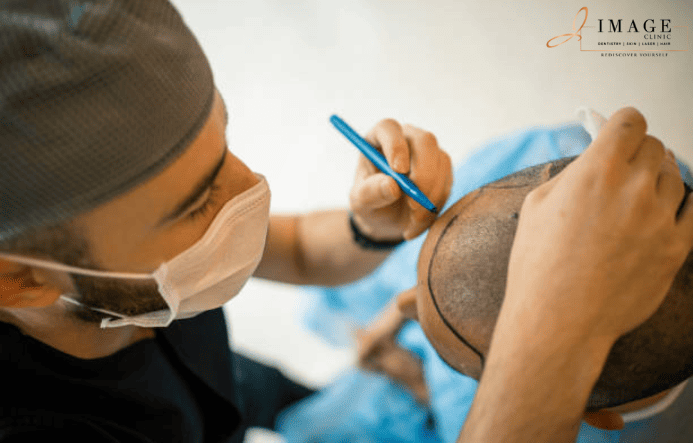
In FUE, the surgeon creates the recipient sites — small incisions into which the grafts will be placed — separately from the extraction phase, and typically before or during extraction. The angle, direction, and distribution of these incisions are the primary tools through which the surgeon designs the hairline and determines the final natural appearance of the result. The density, pattern, and precise placement of the incisions require surgical expertise and artistic judgment that is as important as the technical extraction skill.
Implantation
The extracted grafts are stored in a chilled saline or hypothermosol solution during the implantation phase and are placed into the pre-made recipient sites using fine forceps. The time between extraction and implantation (the out-of-body time) is a critical variable for graft survival: the longer grafts remain outside the scalp, the greater the cellular stress on the follicle. In Kolkata’s climate, managing graft temperature during this phase requires careful protocol, because ambient heat accelerates graft dehydration.
Important Read: Top Hair Transplant Clinics in Kolkata with Proven Results
DHI: The Choi Pen Implantation Difference
The Key Difference
DHI differs from FUE in the implantation phase. Instead of creating recipient sites separately and then placing grafts with forceps, DHI uses a Choi implanter pen — a hollow needle device that loads a single graft and allows the surgeon to create the recipient site and implant the graft in a single action. The graft is loaded into the pen, the needle is pressed into the scalp at the correct angle and depth, and a plunger mechanism deposits the graft directly as the needle is withdrawn.
What the Choi Pen Changes
The DHI Choi pen changes several aspects of the procedure:
- Simultaneous site creation and implantation — because the recipient site and graft placement happen in the same action, the graft spends less total time outside the scalp, and the site is precisely sized to the graft itself, minimising trauma at the implant point.
- More precise angle and direction control in dense areas — the Choi pen allows the surgeon to achieve very precise directional control, which is particularly valuable when implanting into areas where existing hair is present (adding density to a thinning area rather than implanting into a bald area).
- No pre-made incisions — the scalp is not opened ahead of implantation, which some surgeons believe reduces trauma and improves the healing environment for each graft.
DHI’s Requirement for More Pens and Time
DHI requires a larger number of Choi pens (each is loaded and used for one graft before being cleaned), a longer procedure time for large sessions, and a higher degree of technical skill from the implanting team because each graft must be loaded precisely into the pen without follicle damage. This makes DHI more labour-intensive and typically more expensive per graft than FUE for the same session size.
| FUE and DHI produce different outcomes for different patient profiles. IMAGE Clinic’s hair transplant consultation determines which technique is right for you. Get Your Hair Transplant Assessment |
Hairline Design: The Artistic Component That Determines Natural Results
Regardless of whether FUE or DHI is used, the naturalness of the final hairline is primarily determined by the surgical team’s hairline design skills, not by the extraction technique alone. A technically perfect FUE procedure with a poorly designed hairline will not produce a natural result. A well-designed hairline executed with either FUE or DHI will produce a natural result if the surgical execution is competent.
Natural hairline design at IMAGE Clinic accounts for:
- Facial proportions — the hairline position is determined by the patient’s facial dimensions, not by a standard template. The distance between the glabella (bridge of the nose) and the hairline, the temporal recession angles, and the transition between the frontal hairline and the temples are all individualised.
- Follicular unit distribution — the frontal hairline should not be a uniform dense line. Natural hairlines are characterised by a zone of single-follicle units at the leading edge, transitioning to two-follicle and three-follicle units behind. This graduated density creates the soft, natural-looking hairline that distinguishes a well-executed transplant from a pluggy appearance.
- Hair direction and angle — each area of the scalp has a characteristic hair growth angle and direction. Implanted hairs that do not follow these directions are immediately visible as transplanted. The surgeon must create recipient sites, or use the Choi pen, at angles that precisely match the patient’s natural growth pattern.
- Age-appropriate design — a hairline designed for a 30-year-old patient will look incorrect on the same patient at 55. IMAGE Clinic’s hairline design accounts for age-appropriate recession patterns that will remain natural-looking as the patient ages.
Graft Survival in Kolkata’s Climate: Why This Matters
Kolkata’s subtropical climate creates specific considerations for hair transplant graft survival that surgeons in cooler, drier climates do not need to manage with the same attention.
Hair grafts are living tissue outside the body. Their survival is influenced by temperature, humidity, handling technique, and out-of-body time. In Kolkata’s warm ambient temperature, maintaining graft viability during the implantation phase requires:
- Controlled operating environment — IMAGE Clinic’s hair transplant surgery is performed in a fully air-conditioned clinical operating environment that maintains graft temperature during the procedure.
- Hypothermosol or ATP-supplemented storage solutions — storing extracted grafts in chilled Hypothermosol or similar solutions maintains cellular energy and reduces oxidative stress during out-of-body time.
- Minimised out-of-body time — the implantation team is sized to the session, so that the total time from extraction to implantation of each graft is minimised. DHI’s per-graft implantation approach reduces individual graft out-of-body time compared with large-batch FUE implantation.
- Post-operative protocol for humid climate recovery — the first ten to fourteen days after a hair transplant are the most critical for graft survival. In Kolkata, the combination of heat and humidity increases the risk of scalp sweating, folliculitis, and infection during this period. IMAGE Clinic’s post-operative protocol includes specific instructions for scalp hygiene, activity restrictions, and follow-up assessment timed to Kolkata’s climate.
For patients also managing hair loss treatment through PRP or GFC therapy alongside their transplant, these non-surgical treatments are incorporated into the post-transplant care timeline to support graft survival and accelerate native hair retention.
FUE vs DHI: Which Is Right for You?
| Factor | FUE | DHI |
| Best for | Large session sizes (2,500+ grafts), large bald areas, cost-sensitive patients | Density addition to existing hair, smaller precise sessions, frontal hairline zones |
| Implantation precision in existing hair | Good — requires skill | Superior — Choi pen minimises contact with existing hair |
| Out-of-body graft time | Moderate — depends on session management | Shorter per graft — simultaneous site and implant |
| Hairline design control | Surgeon-dependent — site creation is separate | High per graft — directional precision with pen |
| Session duration | Variable — can accommodate larger sessions | Longer per graft — higher technique complexity |
| Cost per graft | Lower for large sessions | Higher — more pen changes and technique time |
| Recovery period | Similar — 10–14 days for crust resolution | Similar — 10–14 days for crust resolution |
| Scar pattern | Minimal circular micropoints in donor area | Minimal circular micropoints in donor area |
IMAGE Clinic’s hair transplant surgeon assesses the patient’s specific hair loss pattern (Norwood scale classification), donor area density, graft requirement, and hair characteristics at the consultation to determine which technique produces the best outcome for that patient. Many patients are good candidates for either technique, and the surgeon’s recommendation will reflect the specific priorities of the case.
For patients who are not yet at the transplant stage, PRP for hair loss and non-surgical hair loss therapies such as hair loss treatment at IMAGE Clinic are effective options that IMAGE Clinic prescribes to slow progressive loss, improve existing hair density, and in many cases delay the point at which transplant becomes the appropriate intervention.
Important Read: Hair Transplant in Kolkata: Common Questions About Hair Transplants Answered
People Also Ask: Hair Transplant in Kolkata
What is the difference between FUE and DHI hair transplant?
Short answer: FUE (Follicular Unit Extraction) extracts grafts and creates recipient sites separately before implanting grafts with forceps. DHI (Direct Hair Implantation) uses a Choi implanter pen to create the recipient site and implant the graft in a single action. DHI reduces individual graft out-of-body time and offers superior precision when adding density to areas with existing hair. FUE accommodates larger sessions more efficiently.
Which hair transplant technique is better for a natural hairline?
Short answer: Both FUE and DHI can produce a natural hairline — the result depends primarily on the surgeon’s hairline design skill, not the extraction technique alone. A natural hairline requires correct positioning for facial proportions, a graduated density zone of single-follicle units at the leading edge, and precise directional implantation matching natural growth patterns. IMAGE Clinic’s surgeon designs the hairline individually for each patient.
How does Kolkata’s climate affect hair transplant results?
Short answer: Kolkata’s warm, humid climate increases the risk of scalp sweating, folliculitis, and graft dehydration in the post-operative period. Grafts stored outside the body are also more vulnerable to temperature-related cellular stress in warm ambient conditions. IMAGE Clinic’s protocol addresses both: a controlled operating environment with chilled graft storage, and post-operative instructions specifically designed for Kolkata’s climate during the critical 10–14 day healing window.
How many grafts are needed for a hair transplant?
Short answer: The graft requirement depends on the area of hair loss and the desired density. Mild hairline recession typically requires 1,000 to 1,500 grafts. A moderate Norwood III–IV pattern requires 1,500 to 2,500 grafts. Extensive hair loss requiring full crown coverage can require 3,000 to 4,500 grafts across multiple sessions. IMAGE Clinic’s consultation includes a donor area assessment to determine how many grafts are available and the realistic coverage achievable.
Is hair transplant permanent?
Short answer: The transplanted follicles are permanent — they retain their donor origin’s genetic resistance to DHT-related hair loss and will continue to grow for life. The native hair around the transplanted area may continue to thin over time if the underlying hair loss condition progresses, which is why IMAGE Clinic assesses the patient’s hair loss pattern and progression rate at consultation and typically recommends medical hair loss treatment alongside transplant to stabilise existing hair.
What is the recovery time after a hair transplant in Kolkata?
Short answer: The transplanted grafts develop small crusts around each implanted unit that shed over ten to fourteen days. The scalp appears presentable within two to three weeks, though the donor area may show minor redness for a similar period. Transplanted hairs shed at three to six weeks — this is normal and expected (the follicle remains active). New hair growth begins at three to four months, with final density visible at twelve to eighteen months post-procedure.
Can women have hair transplants in Kolkata?
Short answer: Yes, women can have hair transplants at IMAGE Clinic. Female hair loss most commonly presents as diffuse thinning across the crown rather than the receding hairline pattern typical in men. The suitability assessment includes evaluation of the donor area density, the cause of hair loss, and hormonal factors, since some causes of female hair loss are better managed medically before surgical restoration is considered. IMAGE Clinic’s consultation includes both the hair loss and the transplant assessment.
Does hair transplant hurt?
Short answer: The hair transplant procedure is performed under local anaesthetic. The administration of local anaesthetic involves minor needle discomfort, but the extraction and implantation phases are performed on anaesthetised tissue and produce minimal sensation. Most patients describe the procedure as comfortable, though a long session (six to eight hours) can be tiring. Mild tenderness and tightness in both the donor and recipient areas are normal in the first two to three days after the procedure.
What causes hair transplant to fail?
Short answer: Poor graft survival from inadequate handling or storage, incorrect angle of implantation preventing natural growth, over-harvesting of the donor area, and transplanting into an area of active inflammation or infection are the most common technical causes of poor results. Poor hairline design produces results that are technically successful but aesthetically unnatural. IMAGE Clinic’s protocols address all of these variables, including Kolkata-specific climate factors affecting graft survival.
How much does a hair transplant cost in Kolkata?
Short answer: Hair transplant cost in Kolkata is typically calculated per graft. The total cost depends on the number of grafts required, the technique selected (DHI costs more per graft than FUE), and the clinic’s surgical team’s experience. IMAGE Clinic provides a transparent cost breakdown at the consultation after the graft requirement has been assessed. The consultation is the appropriate stage at which cost is discussed, because meaningful pricing requires an accurate graft estimate.
| Hair Transplant in Kolkata — IMAGE ClinicFUE and DHI. Expert hairline design. Climate-adapted post-op care. Book Your Appointment Now Call: 09830 836 666 Or visit your nearest IMAGE Clinic — find your nearest branch here. |