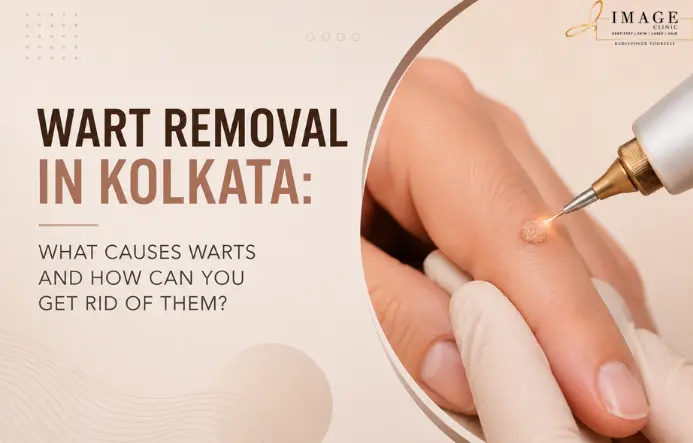
Warts are among the most frequently encountered dermatological conditions — and also among the most misunderstood. Many patients assume warts are simply cosmetic nuisances, treat them with over-the-counter solutions for months without success, and finally present at a dermatology clinic after the wart has spread or multiplied. Others are concerned about the contagious nature of warts and the implications for their families, particularly their children. Both groups benefit from understanding what warts actually are and why professional wart removal in Kolkata produces results that self-treatment consistently cannot.
| Warts that aren’t responding to home treatment? Our dermatologists offer effective, well-tolerated wart removal. Book now. Book Your Wart Removal Consultation at IMAGE Clinic |
What Causes Warts? The HPV Connection
Warts are caused by infection with the human papillomavirus (HPV) — a double-stranded DNA virus of which there are over 200 genotypes, different subtypes causing different types of warts at different body sites. The most clinically relevant types in dermatology are:
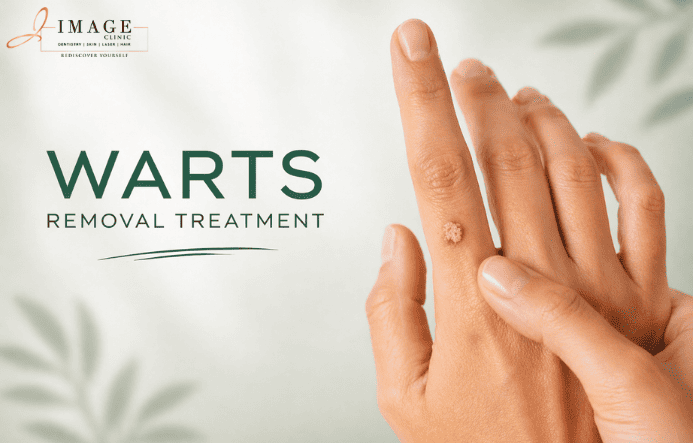
- Common warts (verruca vulgaris): Caused by HPV types 2 and 4. Raised, rough-surfaced, cauliflower-like lesions most commonly occur on the hands, fingers, and knees. These are the warts that most patients recognise immediately.
- Flat warts (verruca plana): Caused by HPV types 3 and 10. Smooth, flat-topped, slightly raised papules — often multiple, occurring in clusters on the face, neck, hands, and legs. They are smaller and less obviously wart-like than common warts.
- Plantar warts (verruca plantaris): Caused by HPV type 1. Warts on the sole of the foot that grow inward due to pressure, producing a characteristic mosaic pattern and often significant pain when walking.
- Filiform warts: Long, narrow, finger-like projections occurring around the eyes, nose, and mouth — caused by HPV types 1, 2, and 4.
- Genital warts (condyloma acuminata): Caused by HPV types 6 and 11 — sexually transmitted, appearing on the genitals and perianal area, requiring a specific management approach distinct from cutaneous warts.
HPV infects the skin through micro-abrasions — small cuts and breaks in the skin surface that allow the virus to access the basal keratinocytes. Once established, the virus remains in the skin indefinitely, and the wart persists until either the immune system clears the infection or treatment destroys the infected tissue. This is the fundamental reason why warts often recur after incomplete treatment — if any viable infected tissue remains, the wart regrows.
Why Do Some People Get Warts and Others Don’t?
Exposure to HPV is extremely common — it is estimated that the majority of adults are exposed to one or more HPV subtypes during their lifetime. Whether infection results in a visible wart depends primarily on the immune response at the time of exposure. Children and immunocompromised individuals have a higher wart burden because their immune surveillance of HPV is less effective. Adults with previously healthy immune systems often suppress new HPV infections without developing visible warts.
In Kolkata’s climate, several factors increase wart transmission risk:
- Public spaces with warm, wet surfaces: Swimming pools, public showers, and sports facilities are high-transmission environments — the warm, moist conditions favour HPV survival on surfaces, and wet, softened skin is more susceptible to micro-abrasion-mediated infection.
- Sharing personal items: Towels, nail files, shoes, and any item that contacts affected skin can transfer HPV to a new host.
- Nail biting and picking: Nail-biters have a significantly higher rate of periungual (around the nail) warts — the repeated micro-trauma creates the entry points HPV needs.
Wart Removal Treatments at IMAGE Clinic: What Works Best
1. CO2 Laser Ablation — The Gold Standard
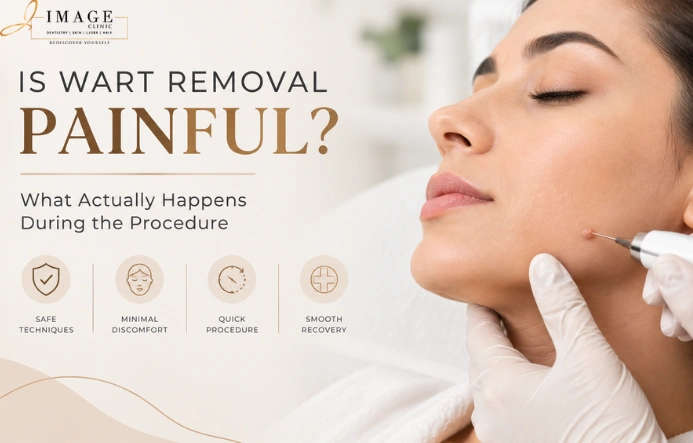
CO2 laser ablation is the most precise and complete method of wart removal — vaporising the infected tissue layer by layer until the entire wart, including its roots, has been eliminated. The laser can be directed exactly to the wart boundaries without damaging surrounding healthy skin, and the thermal energy simultaneously destroys the HPV within the tissue being treated. Laser wart removal in Kolkata at IMAGE Clinic achieves clearance in one to two sessions for the most common, flat, and filiform warts. Plantar warts — which extend deeper due to pressure — may require two to three sessions.
Performed under local anaesthetic, the procedure takes ten to twenty minutes. A small wound heals over seven to fourteen days, leaving no visible scar in most cases for superficial warts. The recurrence rate after complete CO2 laser ablation is significantly lower than for cryotherapy or topical treatment.
2. Cryotherapy — Liquid Nitrogen Freezing
Cryotherapy destroys wart tissue by applying liquid nitrogen (−196°C) directly to the wart. The rapid freezing creates intracellular ice crystals that rupture the infected cells. Repeated freeze-thaw cycles during each session and multiple sessions two to four weeks apart are required for complete clearance. Cryotherapy is effective for common warts and plantar warts but less effective for flat warts, which tend to be numerous and require multiple applications to each lesion.
The procedure produces a blister at the treatment site within 24–48 hours, which heals over one to two weeks. Cryotherapy is slightly less precise than laser ablation — the freeze zone is less controllable than the laser beam — and recurrence rates are somewhat higher. However, it is a well-established and cost-effective option for smaller or fewer warts.
3. Radiofrequency (RF) Ablation
RF ablation uses high-frequency electrical current to cut and coagulate wart tissue, effectively removing it without the thermal spread associated with the CO2 laser. It is particularly useful for filiform warts and raised common warts. The technique is precise, produces minimal scarring, and requires only local anaesthetic. At IMAGE Clinic, RF ablation is used for smaller warts in cosmetically sensitive locations — around the eyes, nose, and mouth — where the greater precision over cryotherapy is clinically valuable.
4. Electrocautery
Electrocautery uses a high-frequency electric current to burn and destroy wart tissue. It is straightforward and effective for common warts, with a one-to two-session clearance rate comparable to the CO2 laser. IMAGE Clinic’s dermatologists select between electrocautery and CO2 laser based on wart type, location, and size — choosing the technique most likely to produce complete clearance with the lowest risk of recurrence.
| Ready to remove warts permanently? Our dermatologists select the right technique for your wart type and location. Book Your Wart Removal Appointment at IMAGE Clinic |
What Happens After Wart Removal: Healing and Recurrence
After any wart removal procedure, the treated area heals over seven to fourteen days, depending on the technique used. Aftercare instructions are provided at IMAGE Clinic and include keeping the area clean and dry, applying the prescribed healing ointment, and avoiding picking or scratching the healing crust.
Recurrence is the most common concern after wart removal — and it is important to understand that recurrence is not treatment failure. It can occur for two reasons: incomplete removal of the infected tissue (in which case the recurrence appears at the same site within a few weeks); or reinfection from residual HPV on nearby skin or re-exposure to the source of infection. At IMAGE Clinic, a follow-up appointment at four to six weeks post-procedure confirms complete clearance and addresses any early recurrence before it becomes established.
People Also Ask: Wart Removal in Kolkata
Can a dermatologist remove warts permanently?
Short answer: Yes — a dermatologist can permanently remove individual warts using CO2 laser, cryotherapy, RF ablation, or electrocautery. The keyword is ‘individual’ — the treatment removes the existing wart, but HPV may persist in the surrounding skin and produce new warts at adjacent sites. Complete long-term clearance depends on both effective treatment of existing warts and a healthy immune response that suppresses any residual HPV in the skin. Patients who are immunocompromised may need more frequent treatment as their wart burden tends to recur more readily.
What is the best treatment for warts on the skin?
Short answer: CO2 laser ablation is the most precise and effective single-session treatment for most cutaneous warts — achieving complete clearance in one to two sessions with the lowest recurrence rate of any wart removal method. Cryotherapy is a well-established alternative with a slightly higher recurrence rate but lower cost per session. The best treatment depends on the wart type, number, location, and the patient’s pain tolerance and healing requirements. Your dermatologist at IMAGE Clinic will recommend the most appropriate technique after assessing the wart.
How many sessions are needed to remove a wart?
Short answer: Most common, flat, and filiform warts are cleared in one to two CO2 laser sessions. Plantar warts — which extend deeply due to foot pressure — typically require two to three sessions. Cryotherapy typically requires three to five sessions for complete clearance. Multiple warts can often be treated simultaneously in a single session, reducing the total number of appointments required.
Are warts contagious?
Yes — warts are caused by HPV, which can spread by direct contact with a wart or with surfaces touched by a wart. Transmission requires a break in the skin. Patients with warts should avoid sharing towels, footwear, or nail care tools; should cover warts in public swimming or bathing facilities; and should not shave over areas with warts, as the blade can spread HPV to adjacent skin.
Do warts go away on their own?
In children, warts often resolve spontaneously as the immune system develops an effective response to HPV — sometimes within months, often within two years. In adults, spontaneous resolution is less predictable and typically slower. Adults with multiple warts, warts in prominent locations, or warts that are spreading should seek dermatological treatment rather than waiting for spontaneous clearance.
| Wart Removal in Kolkata — IMAGE ClinicExpert dermatologists. Right technique, right result. Permanent clearance. Book Your Appointment Now | Call: 09830 836 666 Or visit your nearest IMAGE Clinic — find your nearest branch here. |