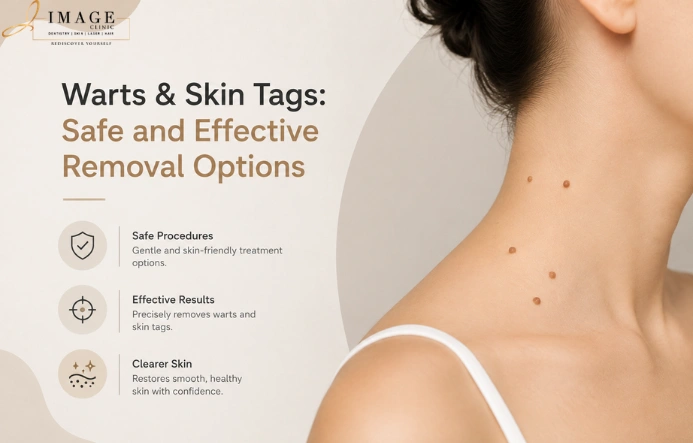
Warts and skin tags are among the most common reasons patients visit a dermatologist for a lesion removal appointment — and also among the most frequently confused with each other. While both appear as growths on the skin surface and are entirely benign, they have completely different causes, biology, and treatment requirements. Treating a wart as if it were a skin tag, or vice versa, produces poor outcomes. This guide from IMAGE Clinic in Kolkata explains the clinical distinction between the two conditions, the most effective wart removal options in Kolkata, and what patients can expect from the treatment and recovery process for each.
| Book a skin lesion assessment at IMAGE Clinic — accurate diagnosis before any treatment begins. Book Your Skin Lesion Assessment |
Warts vs Skin Tags: The Clinical Difference
| Warts (Verrucae) | Skin Tags (Acrochordons) | |
| Cause | HPV (human papillomavirus) infection | Benign overgrowth of skin tissue — not infectious |
| Appearance | Rough, raised, cauliflower-like surface; may have black dots (thrombosed capillaries) | Soft, smooth, flesh-coloured; attached by a narrow stalk |
| Common locations | Hands, fingers, feet, knees, face (filiform) | Neck, armpits, groin, eyelids, under breasts |
| Contagious? | Yes — spreads by direct contact or shared surfaces | No — not infectious |
| Painful? | Plantar warts on feet can be painful; others usually not | Usually painless; can catch on clothing or jewellery |
| Self-resolution? | Sometimes in children; rarely in adults | Never — do not resolve without treatment |
| Treatment urgency | Treat to prevent spread; can multiply rapidly | Elective cosmetic removal; no medical urgency |
What Are Warts? The HPV Connection
Warts are caused by infection with the human papillomavirus (HPV) — a DNA virus with over 200 known subtypes, different strains causing warts at different body sites. Common warts (HPV types 2 and 4) appear on hands and fingers. Plantar warts (HPV type 1) grow on the soles of the feet, driven inward by pressure to create a mosaic pattern that can be significantly painful when walking. Flat warts (HPV types 3 and 10) appear in clusters on the face, neck, and legs. Filiform warts form long, narrow projections around the eyes and mouth.
HPV enters the skin through micro-abrasions — small breaks in the skin surface. Whether infection produces a visible wart depends on the strength of the local immune response at the time of exposure. Children develop warts more readily than adults because their immune response to HPV is less established. Adults with compromised immunity are also more susceptible to wart formation and more prone to recurrence after treatment.
The critical treatment implication is this: because warts are caused by a virus, removing the visible lesion does not guarantee that all HPV-infected tissue has been eliminated. If any viable infected cells remain at the margins of the treatment zone, the wart will regrow. This is the primary reason warts recur after incomplete treatment — and why IMAGE Clinic’s dermatologists assess the full extent of the lesion before selecting the appropriate treatment modality and energy parameters.
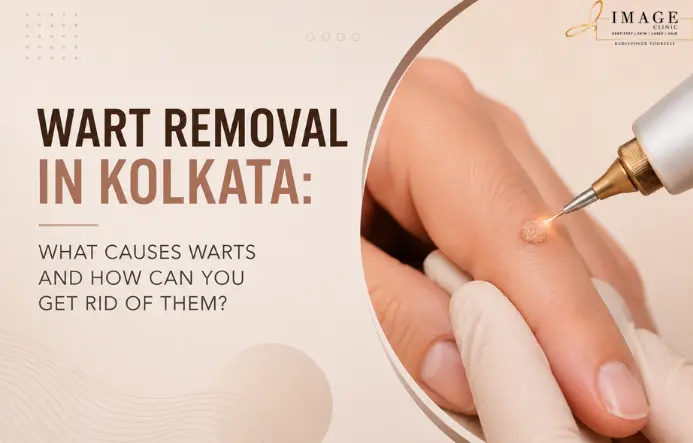
Important Read: Wart Removal in Kolkata: What Causes Warts and How Can You Get Rid of Them?
What Are Skin Tags? Why They Form
Skin tags (acrochordons) are benign fibrovascular growths — small, soft, flesh-coloured pedunculated lesions attached to the skin by a narrow stalk. They are not infectious, not precancerous, and not caused by any virus or pathogen. They form in areas of skin friction — the neck, armpits, groin, and under the breasts — where repeated skin-on-skin or skin-on-clothing contact stimulates localised epidermal overgrowth. Their prevalence increases with age, obesity, insulin resistance (skin tags are associated with Type 2 diabetes and PCOS), and during pregnancy. Skin tag removal is straightforward and is considered a cosmetic procedure — there is no medical urgency, but many patients find them aesthetically bothersome or practically inconvenient when they catch on jewellery or clothing.
Treatment Options for Wart Removal in Kolkata
CO2 Laser Ablation
CO2 laser ablation is the most precise and complete method for wart removal in Kolkata. The laser vaporises the infected tissue layer by layer, targeting the lesion precisely without damaging surrounding skin. The thermal energy simultaneously destroys the HPV within the treated tissue. Most common, flat, and filiform warts achieve clearance in one to two sessions. Plantar warts — which extend deeper due to pressure — may require two to three sessions. Performed under local anaesthetic; healing takes seven to fourteen days.
Cryotherapy (Liquid Nitrogen)
Cryotherapy destroys wart tissue by applying liquid nitrogen (−196°C) directly to the lesion, creating intracellular ice crystals that rupture infected cells. Repeated freeze-thaw cycles during each session improve efficacy. Multiple sessions at two to four week intervals are typically required for complete clearance. Cryotherapy is effective but slightly less precise than laser ablation — the freeze zone is less controllable than a laser beam — and recurrence rates are somewhat higher.
Radiofrequency (RF) Ablation
RF ablation uses high-frequency electrical current to cut and coagulate wart tissue. It is particularly effective for smaller warts in cosmetically sensitive locations. Minimal scarring, local anaesthetic required, and one to two sessions typically achieve clearance. IMAGE Clinic’s dermatologists select between laser, cryotherapy, and RF based on the wart type, size, location, and depth.
Treatment Options for Skin Tag Removal in Kolkata
Skin tag removal is a straightforward elective procedure. Three methods are used at IMAGE Clinic depending on the size and location of the skin tag:
- Snip excision: For larger skin tags with a defined stalk, the stalk is grasped with forceps and the lesion is excised cleanly with fine scissors under local anaesthetic. Instant clearance, minimal healing, and virtually no recurrence.
- Radiofrequency ablation: For multiple small skin tags, RF ablation is highly efficient — the RF current simultaneously cuts and coagulates the tissue, preventing bleeding and producing rapid healing. Multiple tags can be treated in a single session.
- Laser ablation: For skin tags in cosmetically sensitive areas — particularly around the eyes and on the face — laser ablation provides the most precise and cosmetically acceptable result.
Most skin tag removal is completed in a single session. Recovery involves a small healing area for five to seven days.
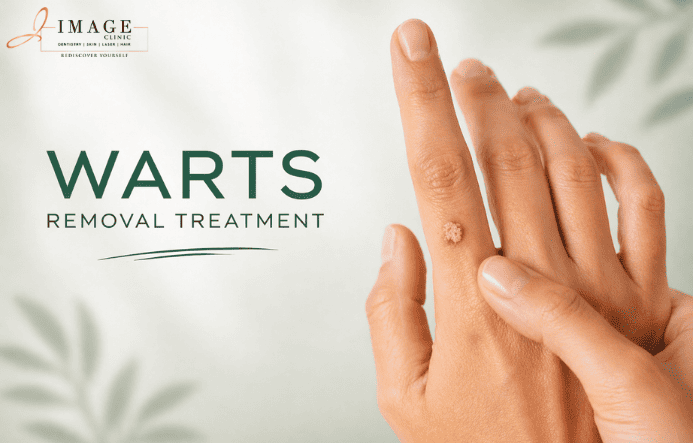
Important Read: Wart Removal Treatment in Kolkata: A Complete Guide to Safe, Lasting Clearance
| Get your warts or skin tags assessed and removed at IMAGE Clinic, Kolkata. One session is often all it takes. Book Your Wart or Skin Tag Removal |
People Also Ask: Wart Removal in Kolkata
What is the difference between a wart and a skin tag?
Short answer: Warts are caused by HPV infection and have a rough, raised surface — they are contagious through direct contact. Skin tags are benign skin overgrowths attached by a stalk — soft, smooth, flesh-coloured, and not infectious. They appear in friction-prone areas and are associated with metabolic factors including insulin resistance and obesity. Both are harmless, but warts in Kolkata require treatment to prevent spread; skin tags require treatment only if bothersome.
Can warts spread to other people?
Short answer: Yes — warts are caused by HPV, which is transmissible through direct skin-to-skin contact with a wart or through surfaces touched by a wart. HPV requires a break in the skin to infect a new host. Patients with warts should avoid sharing towels, footwear, and nail care tools; cover warts in shared facilities such as swimming pools; and avoid shaving over affected areas, as a razor can spread HPV to adjacent skin.
What is the best treatment for warts and skin tags?
Short answer: For wart removal, CO2 laser ablation is the most precise and complete option — achieving clearance in one to two sessions with the lowest recurrence rate. Cryotherapy is a well-established alternative. For skin tags, snip excision or RF ablation achieves instant clearance in a single session. The best treatment depends on the size, location, and type of lesion — confirmed at a clinical assessment at IMAGE Clinic.
Are skin tags dangerous?
Short answer: No — skin tags are entirely benign and carry no risk of malignant transformation. They do not need to be removed for medical reasons. However, their association with insulin resistance and PCOS means that multiple skin tags appearing in a patient who has not previously had them — particularly around the neck and armpits — may warrant a metabolic assessment. Moles, by contrast, may require dermoscopic assessment to confirm benign status before removal.
How many sessions are needed to remove warts completely?
Short answer: Most common, flat, and filiform warts achieve clearance in one to two CO2 laser sessions at IMAGE Clinic. Plantar warts — which grow inward due to pressure — typically require two to three sessions. Cryotherapy typically requires three to five sessions for complete clearance. Multiple warts can usually be treated simultaneously in a single session, reducing the total number of appointments required.
| Wart & Skin Tag Removal in Kolkata — IMAGE ClinicAccurate diagnosis. Right technique. Safe, lasting clearance. Book Your Appointment Now | Call: 09830 836 666 Or visit your nearest IMAGE Clinic — find your nearest branch here. |