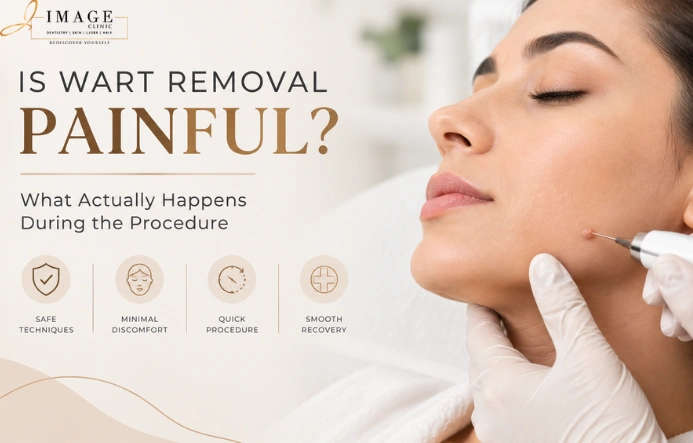
Pain anxiety is the most common reason patients delay wart removal in Kolkata — and it is largely based on misinformation, outdated accounts of less refined techniques, or extrapolation from the experience of less careful providers. What actually happens during a wart removal procedure at IMAGE Clinic — what you feel, at what point, and for how long — is significantly more comfortable than most patients anticipate. This guide addresses the question directly and specifically, method by method, so that an accurate expectation replaces the anxiety.
| Book your wart removal assessment at IMAGE Clinic, Kolkata — we will explain the procedure in full before any treatment begins. Book Your Wart Removal Consultation |
Before the Procedure: Assessment and Anaesthesia
The Assessment
Every wart removal procedure at IMAGE Clinic begins with a dermatological assessment — confirming the diagnosis (distinguishing warts from other lesions), assessing the type (common, plantar, flat, filiform), size, depth, and location of each lesion. The assessment directly determines which removal technique is most appropriate, the anaesthesia approach, and how many sessions are likely to be required.
Topical Anaesthetic
For most wart removal procedures, topical anaesthetic cream (EMLA or equivalent) is applied to the wart and surrounding skin forty-five to sixty minutes before treatment. This cream contains lidocaine and prilocaine — local anaesthetics that penetrate the skin to block nerve signal transmission in the treated area. By the time the procedure begins, the skin surface and the superficial tissue beneath are significantly desensitised. Most patients feel pressure and warmth during the procedure but minimal or no sharp pain.
For larger plantar warts that extend deeper into the foot, an infiltration of local anaesthetic (a small injection adjacent to the lesion) provides deeper anaesthesia. The injection itself is the most uncomfortable part of the procedure for these patients — brief, sharp, and immediately followed by complete numbness of the treated area.
Method 1: CO2 Laser Ablation — The Procedure Experience
CO2 laser ablation is the most precise and most complete wart removal technique at IMAGE Clinic. The laser vaporises the wart tissue layer by layer, destroying the HPV-infected cells with precise control over treatment depth.
What You Feel
After topical anaesthetic is applied for forty-five minutes, most patients feel very little during the laser ablation itself — the anaesthetic has desensitised the surface and superficial tissue adequately. Some patients describe a mild warmth or a faint tingling at the periphery of the treatment zone where the anaesthetic is slightly less dense. Smaller warts on the face, hands, or arms are typically completed with topical anaesthetic alone and are described by most patients as surprisingly comfortable.
The Sound and Smell
One aspect of laser wart removal that patients are rarely prepared for — even though it is entirely normal — is the sound and smell of the tissue vaporisation. The laser produces a brief crackling or popping sound as tissue is ablated; there is a faint smell of vaporised tissue. Both are normal and indicate the laser is working correctly. Neither is related to any pain or damage beyond the target tissue.
Important Read: Warts & Skin Tags: Safe and Effective Removal Options
After the Procedure
Immediately after CO2 laser ablation, the treated site appears as a small crater — the wart tissue has been removed, leaving a depression that will heal over the following one to two weeks. A small dressing is applied. Pain after the anaesthetic wears off (typically two to three hours after the procedure) is mild — most patients manage it comfortably with standard over-the-counter analgesia. Plantar wart sites may be more tender for two to four days as the foot bears weight during healing.
Method 2: Cryotherapy — The Procedure Experience
Cryotherapy applies liquid nitrogen (−196°C) directly to the wart using a spray or probe. The freeze-thaw cycle destroys the wart tissue through intracellular ice crystal formation.
What You Feel
Cryotherapy is performed without anaesthetic in most cases, as the freeze itself produces rapid local desensitisation. The sensation is an intense cold followed by a burning or stinging feeling — described by most patients as more uncomfortable than CO2 laser but tolerable. The sensation lasts during the freeze (typically ten to thirty seconds per application) and for a few minutes after, then settles. Plantar warts and periungual (around the nail) warts are more painful with cryotherapy than other locations.
After Cryotherapy
The treated area typically forms a blister within twenty-four to forty-eight hours — this is expected and part of the treatment process. The blister should not be deliberately popped; it resolves on its own within one to two weeks. The underlying skin heals beneath the blister. Multiple sessions are typically required for complete clearance.
| Concerned about the procedure? Our dermatologists will walk you through every step before anything is done. Book Your Wart Removal at IMAGE Clinic |
Method 3: Radiofrequency (RF) Ablation — The Procedure Experience
RF ablation uses high-frequency electrical current to cut and coagulate wart tissue simultaneously. It is particularly suited to smaller warts in cosmetically sensitive locations.
What You Feel
After topical anaesthetic, the RF ablation produces a mild warmth and pressure at the treatment site — similar to, but typically less intense than, CO2 laser. The current creates a cutting and coagulation effect that most patients with adequate topical anaesthesia find very comfortable. The procedure is quiet and produces no significant smell. Recovery is minimal — the coagulated tissue forms a small crust that separates within five to seven days.
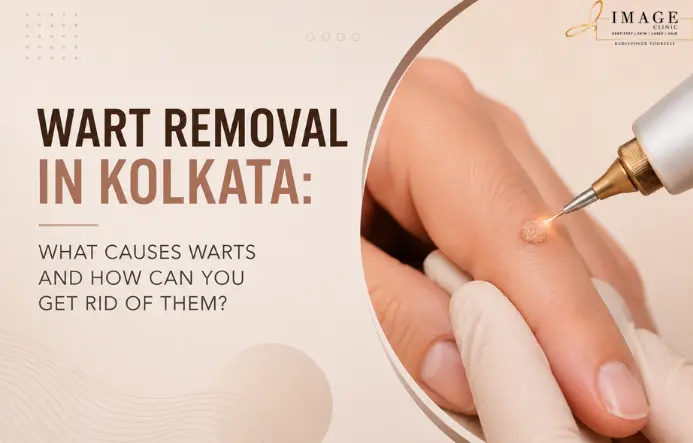
Important Read: Wart Removal in Kolkata: What Causes Warts and How Can You Get Rid of Them?
Recovery: What Happens After Wart Removal
| Method | Pain Level During | Pain Level After | Recovery Time | Sessions Needed |
| CO2 Laser (topical anaesthetic) | Minimal — mild warmth | Mild — manageable with OTC analgesia | 7–14 days to heal | 1–2 for most warts; 2–3 for plantar |
| CO2 Laser (infiltration anaesthetic — plantar) | Injection brief; procedure pain-free | Moderate Days 1–3 (weight-bearing) | 10–14 days; restricted activity Day 1–3 | 2–3 sessions |
| Cryotherapy | Moderate — burning/stinging during freeze | Mild to moderate; blistering Days 1–2 | 7–14 days per session | 3–6 sessions |
| RF Ablation | Minimal with anaesthetic | Minimal | 5–7 days | 1–2 for most warts |
Common Questions About Wart Removal Pain
Patients who have delayed treatment because of pain concern most commonly ask these questions:
- ‘Will it hurt more than a regular injection?’ The topical anaesthetic applied before CO2 laser or RF ablation produces a significantly more comfortable experience than a standard injection — the surface is desensitised by the time any instrument touches the skin. The infiltration anaesthetic for plantar warts does involve a brief injection-level sting, but the procedure that follows is pain-free.
- ‘What if the anaesthetic wears off mid-procedure?’ The topical anaesthetic is applied for a full forty-five to sixty minutes — providing adequate desensitisation for the procedure duration. Procedures are completed within fifteen to twenty minutes of the anaesthetic peak.
- ‘Will it scar?’ Wart removal with CO2 laser and RF ablation, performed at appropriate parameters, typically heals with minimal to no visible scarring. Post-procedure PIH — temporary darkening at the healed site — is more common than scarring in Indian skin and resolves within two to four months.
People Also Ask: Wart Removal in Kolkata
Is wart removal painful?
Short answer: With appropriate anaesthesia, wart removal in Kolkata at IMAGE Clinic is significantly more comfortable than most patients expect. CO2 laser and RF ablation with topical anaesthetic produce minimal sensation during the procedure — most patients describe mild warmth or pressure. Cryotherapy (without anaesthetic) produces a burning-cold sensation during the freeze that most patients find tolerable. Post-procedure soreness is mild and typically managed with over-the-counter analgesia.
How long does wart removal take?
Short answer: The wart removal procedure itself takes fifteen to thirty minutes depending on the number and size of lesions — not including forty-five minutes for topical anaesthetic application before the procedure. Single small warts may take as little as ten minutes. Multiple or plantar warts take longer. The recovery period varies by method: CO2 laser and RF heal in seven to fourteen days; cryotherapy produces a blister that resolves in seven to fourteen days per session.
Will wart removal leave a scar?
Short answer: CO2 laser and RF ablation wart removal at appropriate parameters typically heals without visible scarring. The healed site may show temporary PIH (darkening) in Indian skin — this resolves within two to four months with topical depigmenting agents. Aggressive cryotherapy applied too deeply carries a slightly higher scar risk. IMAGE Clinic‘s parameters are calibrated to achieve complete wart removal with the lowest possible scar and PIH risk for Indian skin.
Can warts come back after removal?
Short answer: Yes — wart recurrence is possible because HPV remains in the surrounding skin tissue even after the visible wart is removed. If viable infected cells are present at the treatment margin, the wart can regrow. IMAGE Clinic’s CO2 laser approach treats to complete depth and adequate margin to minimise recurrence — achieving consistently lower recurrence rates than cryotherapy or over-the-counter topical treatments.
How soon can I return to normal activities after wart removal?
Short answer: For hand, finger, face, and arm warts — normal activities resume immediately; the small dressing does not restrict movement. For plantar (foot) warts — restricted weight-bearing for twenty-four to forty-eight hours; normal walking resumes by day two to three with a protective dressing. Return to sports and exercise is typically at seven to ten days after plantar wart removal at IMAGE Clinic.
| Wart Removal in Kolkata — IMAGE ClinicComfortable procedure. Clinically precise. Safe, lasting clearance. Book Your Appointment Now | Call: 09830 836 666 Or visit your nearest IMAGE Clinic — find your nearest branch here. |