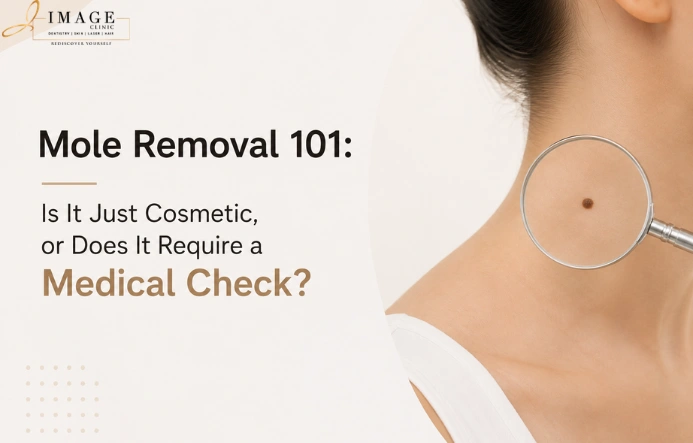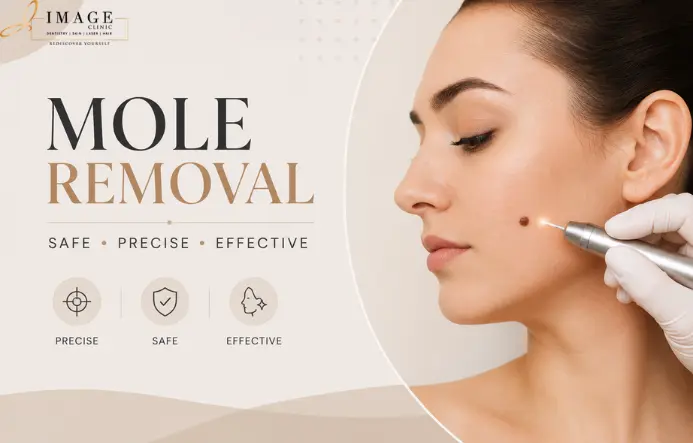
Moles are among the most common skin growths — virtually everyone has at least a few. Most are entirely harmless, but when a mole is cosmetically bothersome, located in an area of repeated irritation, or raises any concern about its appearance, professional mole removal in Kolkata offers a safe, clinically precise solution. At IMAGE Clinic, our dermatologists assess every mole individually before recommending removal — because the method matters as much as the outcome.
Whether you are concerned about the look of a mole on your face, frustrated by one that snags on clothing, or simply want a thorough professional assessment, this guide covers everything you need to know — from how moles form and which ones warrant attention, to the removal methods available and what recovery looks like.
| Have a mole you’d like assessed or removed? Our dermatologists are here to help. Book Your Mole Assessment at IMAGE Clinic |
What Are Moles and Why Do They Form?
Moles — medically termed melanocytic naevi — are clusters of melanocytes (pigment-producing cells) that grow in groups rather than distribute evenly across the skin. They typically appear as round or oval spots, ranging in colour from flesh-toned to pink, tan, brown, or dark brown, and in texture from flat to slightly raised.
Most moles develop during childhood and adolescence, with the average adult having between 10 and 40 on their body. New moles can appear in the late 30s, and existing moles may gradually change in colour or texture over time. The vast majority are benign and require no treatment beyond monitoring.
Common Types of Moles
- Common naevi: The most typical benign moles — round or oval, with a well-defined border, uniform colour, and smooth or slightly raised surface.
- Congenital naevi: Moles present at birth, ranging from very small to large. Larger congenital naevi carry a slightly elevated risk of melanoma over a lifetime and benefit from regular dermatological monitoring.
- Compound naevi: Moles with both surface and deeper components, typically presenting as domed, raised, and evenly pigmented lesions.
- Intradermal naevi: Deeply situated moles that are often flesh-coloured or lightly pigmented and may be mistaken for skin tags. They are almost always benign.
- Dysplastic (atypical) naevi: Moles with irregular borders, uneven pigmentation, or larger-than-average size. While individually benign, having multiple dysplastic naevi is associated with a higher lifetime melanoma risk, making regular dermatological review important.
When Should a Mole Be Evaluated by a Dermatologist?
Not every mole requires removal, but every mole that changes or concerns you deserves a professional assessment before any intervention. Our dermatologists at IMAGE Clinic use the ABCDE criteria — the internationally recognised framework for mole assessment — to evaluate each lesion:
| Criterion | What to Look For | Why It Matters |
| A — Asymmetry | One half does not mirror the other | Benign moles are typically symmetrical |
| B — Border | Irregular, notched, or blurred edges | Well-defined borders are a sign of benignity |
| C — Colour | Multiple shades within one mole (tan, brown, black, red, white) | Uniform colour is reassuring; variation warrants review |
| D — Diameter | Larger than 6mm (roughly the size of a pencil eraser) | Most benign moles are smaller; larger lesions need assessment |
| E — Evolution | Any change in size, shape, colour, or texture; new itching or bleeding | Change over time is the most important warning sign |
If a mole meets any of these criteria, prompt evaluation by a dermatologist is essential. At IMAGE Clinic, mole assessment is thorough and conducted with dermoscopy, where indicated — a technique that provides magnified, illuminated visualisation of the mole’s internal structure, significantly improving diagnostic accuracy beyond what is visible to the naked eye.
| Don’t leave a changing mole unassessed. Book your evaluation with our dermatologists today. Book Your Mole Assessment Now |
Mole Removal in Kolkata: Methods Available at IMAGE Clinic
Once a mole has been assessed as suitable for removal — either cosmetically or for clinical reasons — our dermatologists select the most appropriate technique based on the mole’s type, depth, location, size, and the patient’s skin tone. At IMAGE Clinic, all mole removal in Kolkata is performed with precision instruments and US FDA-approved technology to minimise scarring and ensure complete removal.
Radiofrequency (RF) Ablation
Radiofrequency ablation is the most commonly used technique for mole removal at IMAGE Clinic. A fine electrode delivers high-frequency electrical current to the mole tissue, precisely vaporising it layer by layer without generating significant heat in the surrounding skin. This technique is ideal for raised, protruding moles — intradermal and compound naevi — and produces excellent cosmetic outcomes with minimal scarring.
The procedure is performed under local anaesthesia and takes 10–30 minutes depending on the number and size of moles being removed. The treated area heals over seven to fourteen days, leaving a flat, lightly pink area that gradually blends with the surrounding skin over subsequent weeks.
Laser Mole Removal (Q-Switched Nd: YAG)
For flat or mildly raised moles with surface pigmentation, laser treatment offers a non-incisional option. The Q-switched Nd: YAG laser targets the melanin within the mole, fragmenting the pigment so the body can clear it naturally. This method works best for flat, pigmented moles and post-removal pigment reduction.
Laser removal is often complemented with laser skin resurfacing for improved skin texture at the removal site. It is not suitable for raised or deeply embedded moles, which require RF ablation or surgical excision.
Surgical Excision
For larger moles, moles with deeper dermal components, or those requiring histopathological examination, surgical excision under local anaesthesia is recommended. The mole is excised with a surgical margin, and the wound is closed with fine sutures. The excised tissue is routinely sent for histological analysis when clinically indicated — providing definitive confirmation of the mole’s nature.
While excision leaves a small linear scar, the technique is the gold standard for any mole where malignancy needs to be excluded. Our dermatologists are trained in excision techniques that minimise scarring, particularly for facial moles where cosmetic outcomes are a priority.
Shave Excision
Shave excision uses a fine surgical blade to remove the protruding portion of a raised mole flush with the skin surface. Local anaesthesia is applied prior to the procedure. This technique avoids sutures and heals quickly, leaving a flat, inconspicuous site. It is suitable for raised, benign moles that do not require full-depth removal or histological analysis.
Comparing Mole Removal Techniques: A Quick Reference
| Technique | Best Suited For | Anaesthesia | Healing Time | Scarring Risk | Histology Possible |
| RF Ablation | Raised, protruding moles | Local (topical) | 7–14 days | Minimal | No |
| Laser Removal | Flat, pigmented moles | Topical | 5–10 days | Very low | No |
| Surgical Excision | All types; malignancy suspected | Local injection | 10–21 days | Small linear scar | Yes |
| Shave Excision | Raised benign moles | Local (topical) | 7–14 days | Minimal | Limited |
The Mole Removal Process at IMAGE Clinic: What to Expect
- Initial Consultation and Assessment: Your dermatologist will examine each mole carefully, using dermoscopy where indicated. If there are features warranting further evaluation, a biopsy may be recommended before proceeding to removal. For clearly benign, cosmetic removals, the procedure can typically be scheduled at the same visit.
- Pre-Procedure Preparation: The area is cleaned, and anaesthetic is applied — either a topical numbing cream or a small injection of local anaesthetic, depending on the technique and mole depth. Most patients experience minimal discomfort during the procedure itself.
- The Removal Procedure: RF ablation and shave excision procedures typically take 10–30 minutes for one to several moles. Surgical excision may take slightly longer. The procedure is performed in our clinical treatment room under sterile conditions.
- Immediate Aftercare: A small dressing is applied to the treated site. Your dermatologist will provide specific wound care instructions, which typically include keeping the area clean and dry, applying the prescribed ointment, and avoiding sun exposure on the site.
- Healing and Review: Initial healing occurs over seven to fourteen days. The treated area passes through a scabbing phase before revealing new, healthy skin beneath. A review appointment is scheduled to assess healing and provide guidance on scar prevention if needed.
- Scar Management: For patients concerned about residual marks — particularly after facial mole removal — our dermatologists may recommend laser skin resurfacing, chemical peels, or topical silicone formulations to optimise the final cosmetic outcome.
| Ready to remove a mole that’s been bothering you? Let our experts take care of it safely. Book Your Mole Removal Consultation |
Home Care After Mole Removal: Maximising Your Results
Proper aftercare is as important as the procedure itself in ensuring a clean, inconspicuous outcome. Our dermatologists provide detailed written aftercare instructions, but the key principles are as follows:
- Keep the site clean and dry: Gently clean the area with mild saline or as instructed and apply the prescribed ointment daily to prevent infection and support healing.
- Do not pick or scratch the scab: The scab that forms over the removal site is part of the natural healing process. Disturbing it increases the risk of scarring and infection.
- Strict sun protection: New skin at the removal site is highly susceptible to UV-induced pigmentation. Apply a broad-spectrum SPF 50 sunscreen to the area once it has healed, and avoid direct sun exposure in the initial weeks. For face moles, use a physical (mineral) sunscreen for the best protection.
- Avoid swimming and gyms temporarily: Chlorinated water, sweat, and friction can disrupt healing in the first week to ten days post-procedure.
- Monitor for infection signs: Increasing redness, swelling, discharge, or pain after the first 24–48 hours should prompt a call to IMAGE Clinic. Infection is rare when aftercare instructions are followed, but should be addressed promptly if suspected.
Why Choose IMAGE Clinic for Mole Removal in Kolkata?
- Dermatologist-Led Assessment: Every mole at IMAGE Clinic is assessed by a board-certified dermatologist — not a therapist or technician — before any removal decision is made. This ensures clinical safety alongside cosmetic outcomes.
- Dermoscopy-Aided Diagnosis: Our specialist team uses dermoscopy to evaluate moles with significantly greater accuracy than visual inspection alone, ensuring that no clinically concerning mole is casually removed without appropriate evaluation.
- Precision Technology: US FDA-approved RF systems and laser devices allow precise, layer-by-layer removal that minimises damage to surrounding tissue — directly translating to better cosmetic results.
- Indian Skin Expertise: Post-inflammatory hyperpigmentation (PIH) at the removal site is a particular risk for Fitzpatrick types III–V. Our dermatologists adjust technique and aftercare protocols specifically to minimise this risk.
- Histopathology When Indicated: IMAGE Clinic has established pathology referral pathways for moles requiring histological analysis — providing the complete clinical picture when it matters most.
- Comprehensive Skin Health: Visit our before and after gallery to see outcomes achieved across a range of skin lesion treatments, including moles and warts removal.
Frequently Asked Questions: Mole Removal in Kolkata
1. Is mole removal in Kolkata painful?
Discomfort is minimal. Topical anaesthetic cream is applied before most procedures, and a local anaesthetic injection is used for surgical excision. Patients typically feel mild pressure or warmth during the procedure, but not sharp pain. Post-procedure soreness is mild and usually resolves within 24–48 hours.
2. How long does mole removal take at IMAGE Clinic?
Most mole removal procedures take between 10 and 30 minutes for one to three moles. Surgical excision of larger or deeper moles may take slightly longer. Multiple moles can often be removed in a single session.
3. Will mole removal leave a scar?
All mole removal techniques involve some degree of skin disruption, and a degree of healing response is inevitable. RF ablation and laser removal generally produce minimal, inconspicuous marks that fade over three to six months. Surgical excision leaves a small linear scar that typically becomes barely visible with appropriate aftercare. Our dermatologists use the most scar-conservative technique appropriate for each mole.
4. Can moles grow back after removal?
When a mole is completely removed, recurrence is uncommon. Incomplete removal — particularly with shave excision — can occasionally leave residual pigment cells that repigment the area. If this occurs, a follow-up procedure to address the residual pigmentation is straightforward.
5. How do I know if my mole needs to be removed or just monitored?
Any mole that changes in size, shape, or colour, bleeds spontaneously, or causes itching should be assessed promptly. Moles meeting the ABCDE criteria also warrant evaluation. For clearly stable, cosmetically bothersome moles, removal is elective. Our dermatologists will provide clear guidance during your consultation.
6. Can I remove multiple moles in one session?
Yes. Multiple moles can typically be removed in a single session at IMAGE Clinic, making the process efficient and convenient. The total number removed per session depends on the size and location of each mole.
7. Is laser mole removal better than RF ablation?
The best technique depends on the type of mole. Laser removal is most effective for flat, pigmented moles, while RF ablation excels for raised, protruding moles. Your dermatologist will recommend the most appropriate method during your assessment.
8. What should I do if a mole appears inflamed or bleeds?
A mole that suddenly becomes inflamed, bleeds without trauma, or changes rapidly should be assessed as soon as possible. Contact IMAGE Clinic directly at 09830 836 666 to arrange a priority consultation.
9. Are there moles that cannot be removed at IMAGE Clinic?
Very large congenital naevi or moles in surgically complex locations may require referral to a specialist plastic surgery facility. Our dermatologists will advise you honestly during the consultation if a mole falls outside the scope of in-clinic removal.
10. How do I book a mole removal appointment in Kolkata?
You can book online or call IMAGE Clinic at 09830 836 666. Visit your nearest IMAGE Clinic branch in Kolkata to begin with a thorough dermatological assessment of your moles.
| Safe, Precise Mole Removal in Kolkata — Trust IMAGE ClinicDermatologist-assessed. Clinically precise. Minimal scarring. Book Your Appointment Now | Call: 09830 836 666Or visit your nearest IMAGE Clinic — find your nearest branch here. |