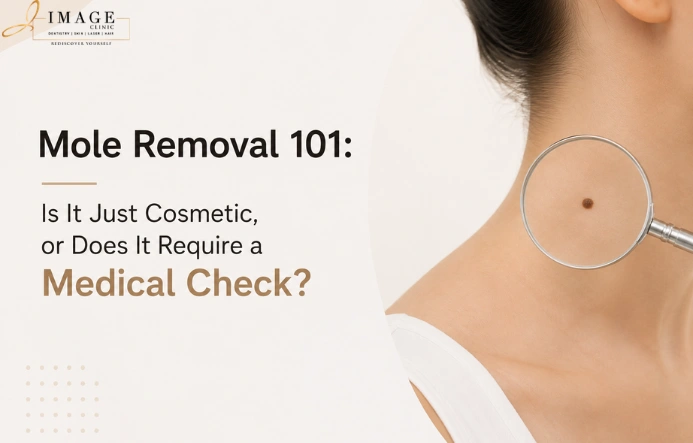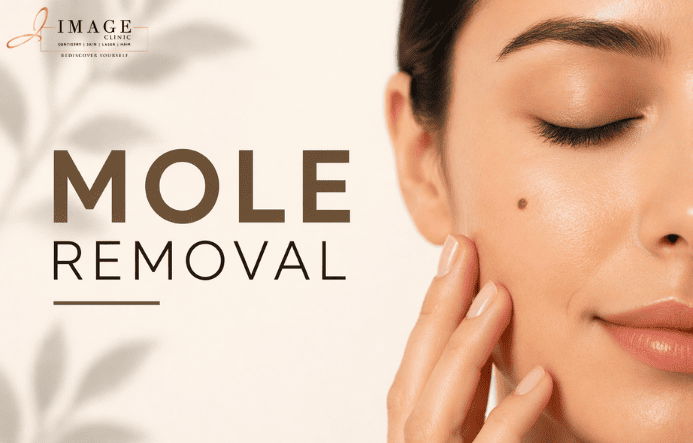
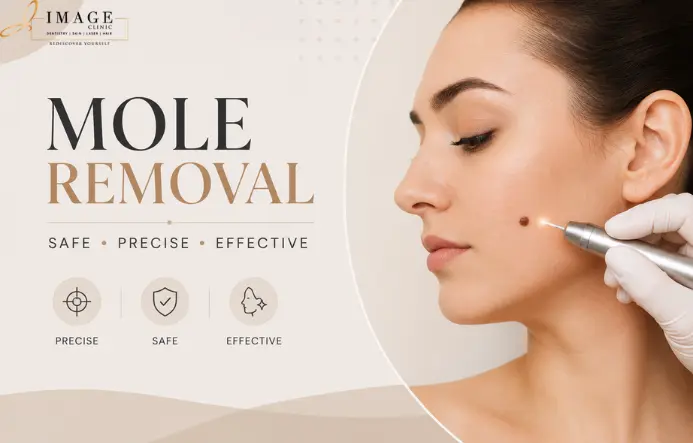
Moles are among the most common reasons patients seek a dermatologist’s assessment — some because of aesthetic concern, others because a mole has changed in appearance and they want it checked. Both are valid reasons, and both lead to the same essential first step: a clinical assessment that distinguishes a benign mole suitable for removal from one that requires further investigation.
This guide walks through the complete journey of mole removal in Kolkata at IMAGE Clinic — from what happens at the initial consultation to what the healed result looks like — with the honest detail that patients need to make an informed decision before committing to the procedure.
| Considering mole removal? Book your assessment at IMAGE Clinic — clinical evaluation before any decision is made. Book Your Mole Assessment at IMAGE Clinic |
Before: The Clinical Assessment — Why It Comes First
No reputable dermatologist will agree to remove a mole without first performing a clinical assessment of that mole. This is not a bureaucratic formality — it is a clinical necessity. Not all pigmented lesions on the skin are benign melanocytic nevi (common moles). Some are seborrhoeic keratoses, dermatofibromas, or lentigines — which are benign but require a different approach. A small number are melanomas — malignant lesions that require urgent surgical excision and histopathological analysis, not laser removal.
At IMAGE Clinic, every mole assessment includes:
- Dermoscopy: A dermoscope is a handheld instrument that magnifies the mole 10–20x under polarised light, revealing structural features not visible to the naked eye. Dermoscopy significantly improves the accuracy of clinical diagnosis — allowing the dermatologist to assess pigment network regularity, border definition, colour homogeneity, and the presence of atypical structures that indicate whether the lesion is benign or warrants further investigation.
- Clinical history: How long the mole has been present, whether it has changed in size, shape, colour, or surface texture, whether it bleeds or itches, and family history of melanoma are all clinically relevant factors assessed during the consultation.
- The ABCDE criteria: Asymmetry, Border irregularity, Colour variation, Diameter greater than 6mm, and Evolution (change over time) are the established clinical flags for moles that require urgent further evaluation rather than cosmetic removal.
If the dermoscopic assessment identifies features of concern, IMAGE Clinic’s dermatologists will recommend excision biopsy with histopathological analysis rather than cosmetic removal — because it is clinically essential that the tissue is examined by a pathologist to rule out malignancy. Cosmetic laser removal of a malignant lesion would destroy the tissue needed for diagnosis.
For moles confirmed as benign, the appropriate removal technique is then selected based on the mole’s depth, size, type, and location. View the IMAGE Clinic team for more on the dermatological expertise behind our assessments.
Mole Removal Techniques: Which Is Used and Why
| Technique | Best For | Anaesthesia | Recovery | Scar Risk |
| Laser ablation (CO2 or Er: YAG) | Superficial flat moles, junctional nevi, seborrhoeic keratoses | Topical cream | 3–7 days crusting | Very low for superficial moles |
| Radiofrequency (RF) ablation | Raised, dome-shaped intradermal nevi | Local injection | 3–5 days crusting | Low — RF is very precise |
| Shave excision | Raised, pedunculated moles | Local injection | 5–10 days healing | Minimal — follows skin surface |
| Surgical excision + suture | Deep compound nevi, any mole with dermoscopic concern | Local injection | 10–14 days (sutures out) | Fine linear scar; enables histopathology |
For most cosmetic mole removals at IMAGE Clinic — flat or mildly raised benign moles confirmed by dermoscopy — laser ablation using the CO2 or Er: YAG laser is the preferred technique. The laser precisely vaporises the mole tissue layer by layer without cutting into the surrounding skin, producing the most cosmetically acceptable result with the lowest scar risk.
During: What Happens at the Removal Session
The removal session itself is straightforward and typically takes fifteen to thirty minutes, depending on the number of moles and the technique used.
- Preparation: The treatment area is cleaned, and the mole is photographed for the patient record. A topical anaesthetic cream is applied and left for thirty minutes for laser ablation; for RF ablation or excision, a small injection of local anaesthetic is administered.
- Removal: The mole is removed using the selected technique. For laser ablation, the laser is applied in controlled pulses that vaporise the mole tissue layer by layer until the dermatologist confirms the lesion has been fully addressed. The procedure is well-controlled, and the laser can be stopped and assessed between passes.
- Wound care: A small wound or raw area remains at the treatment site. A wound dressing or healing ointment is applied, and detailed aftercare instructions are provided before the patient leaves the clinic.
Most patients tolerate the procedure very comfortably. The brief topical or local anaesthetic ensures that pain is minimal during the removal itself.
Read More: Mole Removal in Kolkata: Everything You Need to Know Before Choosing a Clinic
After: Healing, Aftercare, and Final Results
Days 1–3: The Initial Healing Phase
Immediately after the procedure, the treatment site appears as a small raw area — the mole tissue has been removed, and the healing process is beginning. In the first 24–48 hours, a crust forms over the wound site. This is normal and essential to the healing process — the crust should not be picked or removed, as premature removal increases the risk of scarring and prolongs healing.
Mild redness, swelling, and tenderness around the site are normal and resolve within 24–48 hours. The treated area should be kept clean and dry, and the prescribed healing ointment applied as instructed.
Days 3–14: Crust Shedding and Early Healing
The crust gradually softens and sheds over days three to fourteen — earlier for superficial laser removals, later for surgical excisions or deep moles. As it sheds, the new skin forming beneath is initially pink or slightly lighter than the surrounding skin. Sun exposure to the healing site must be strictly avoided during this period — UV exposure on healing skin reliably produces post-inflammatory pigmentation, particularly in Indian skin.
Weeks 2–6: The New Skin Matures
As the new skin fully matures, the pink fades and the site progressively matches the surrounding skin tone. For most superficial mole removals, the healed result is either invisible or leaves only a very faint, flat mark that is indistinguishable at conversational distance.
Ongoing: SPF and Review
Daily broad-spectrum SPF 50+ on the healed site for at least three months is essential for achieving the most cosmetically acceptable result. UV exposure on the healing skin drives melanin deposition that creates the darker marks patients sometimes notice after mole removal — which are not scars but PIH, treatable with laser toning if they persist. A review appointment is scheduled at IMAGE Clinic four to six weeks post-procedure to assess healing and address any concerns.
| Considering mole removal? Start with an expert assessment — our dermatologists evaluate every mole before any decision is made. Book Your Mole Assessment at IMAGE Clinic |
People Also Ask: Mole Removal in Kolkata
Is mole removal safe and permanent?
Short answer: When performed by a qualified dermatologist following clinical assessment, mole removal is safe. The primary safety requirement is dermoscopic assessment before removal — to confirm the lesion is benign and appropriate for cosmetic removal. For confirmed benign moles, laser and RF ablation are extremely safe with very low complication rates. Removal is permanent for the specific lesion treated — the removed mole does not regrow. New moles may develop elsewhere, as is normal for any individual with an active melanocytic system.
How much does laser mole removal cost in Kolkata?
Short answer: IMAGE Clinic does not publish fixed pricing, as cost depends on the number of moles, the technique required (laser, RF, or excision), and the mole size and depth. A consultation with our dermatologists provides a transparent cost breakdown before any procedure is agreed. Book your consultation here to discuss your specific moles and receive a personalised quote.
Does mole removal leave a scar?
Short answer: Scarring risk depends on the mole type, removal technique, and the patient’s skin healing tendencies. Superficial flat moles removed by laser ablation heal with minimal to no visible marks in most patients. Raised or deeper moles may leave a faint flat scar that is typically far less noticeable than the original mole. Surgical excision leaves a fine linear scar that fades progressively. Post-inflammatory pigmentation — not true scarring — is the most common visible change after mole removal in Indian skin and is treatable if persistent.
Can I remove multiple moles in one session?
Yes — IMAGE Clinic routinely removes multiple moles in a single session, which is more convenient and cost-effective than multiple separate appointments. The number that can be addressed in one session depends on their location, size, and the technique required. Your dermatologist will advise at the consultation.
How do I know if a mole needs to be removed or checked?
Any mole that shows change — in size, shape, colour, surface texture, or sensation (itching, bleeding) — should be assessed urgently by a dermatologist. For moles you wish to remove for cosmetic reasons, any time is appropriate to book an assessment. The ABCDE criteria (Asymmetry, Border irregularity, Colour variation, Diameter> 6 mm, Evolution) are the clinical flags for moles requiring urgent evaluation. Book your mole assessment at IMAGE Clinic — dermoscopy is performed at every assessment appointment.
| Mole Removal in Kolkata — IMAGE ClinicClinical assessment first. Expert removal. Safe, accurate results. Book Your Appointment Now | Call: 09830 836 666 Or visit your nearest IMAGE Clinic — find your nearest branch here. |